
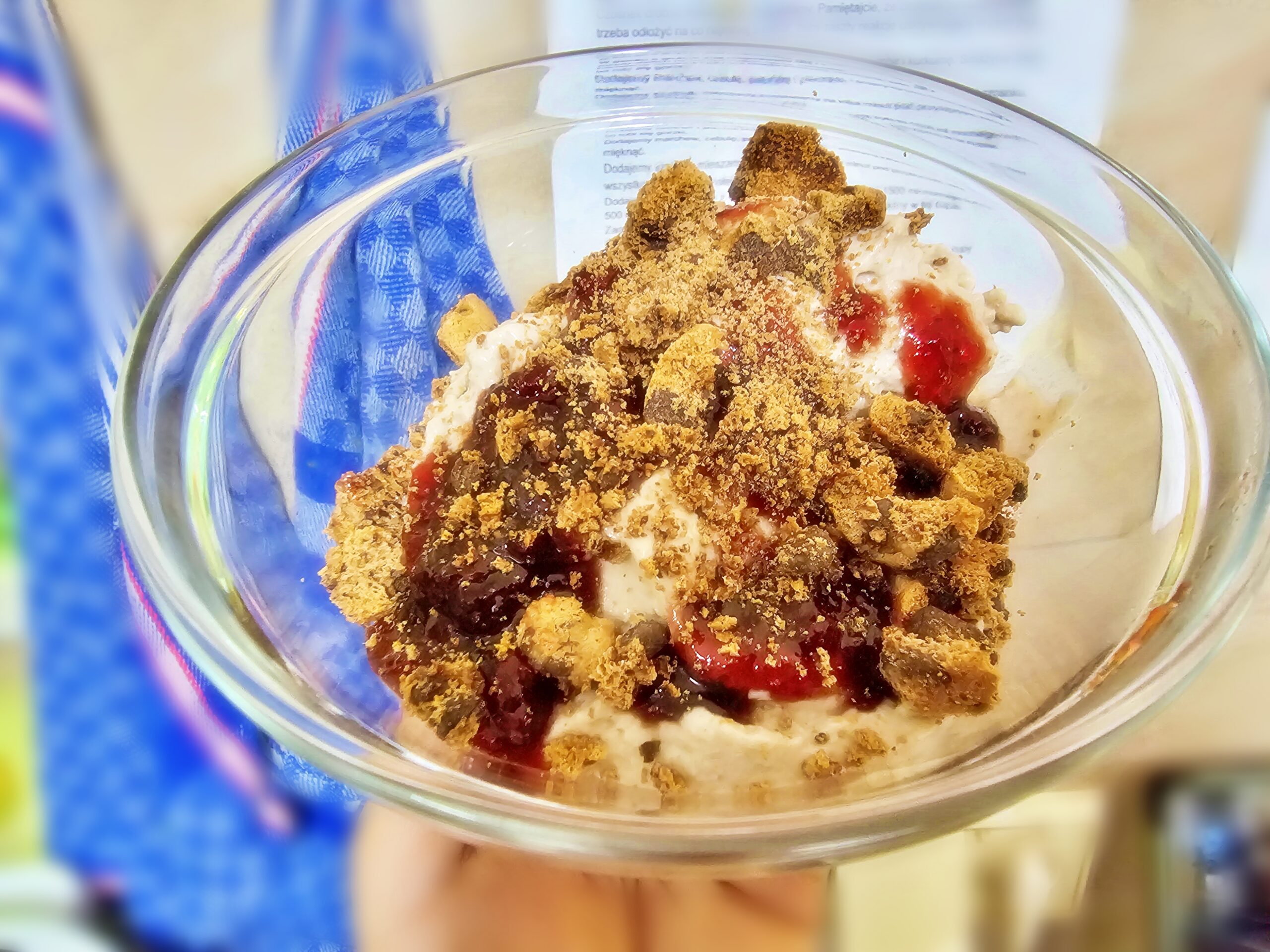
Odd as it sounds, there’s a holiday for it. And it was just the other day, 19 July.
And it’s dead symbolic, especially with the US waging war on Iran, the heir to ancient Persia.
To make ice cream you need an ice cream maker, and it’s not pricey kit. You can pick one up for a bit over 100 złoty, and in Germany from 25 euro.
And definitely, especially if you’ve got kids, that’s money well spent.
Just remember the bowl has to freeze for a good twelve hours or more beforehand. Best thing in practice, especially in season — wash it after use, dry it, back in the freezer.
INGREDIENTS:
100 g walnuts
200 g soy yoghurt
200 g coconut milk
1 ripe banana
approx. 40 g sugar
1 tbsp lime or lemon juice
a pinch of salt
METHOD:
Cover the walnuts with hot water. Leave to cool. Drain.
Blend as thoroughly as you can with all the other ingredients.
Pour into the ice cream maker you froze the day before and that’s it.
Well, you have to switch it on and wait till the ice cream happens. I love progress!
It’d drive me mental if I had to crank a handle for 20 minutes to make ice cream.
VARIATIONS:
First off, you can use different nuts.
Peanut butter can give a really interesting result — peanuts aren’t actually nuts, but they work a treat too.
In Germany you can get almond butter. Nut butters and purées are a cracking ingredient for ice cream, they give you two things ice cream needs — fat and protein.
Coconut milk gives you fat too, and it’s good for everything.
You can swap the soy yoghurt for oat or coconut, each one gives a slightly different flavour.
NOTES:
I’ll probably do a batch this season with my full-fat yoghurt and the elderflower cordial I got as a present.
A banana ripe enough to have gone brown is very sweet, you can use a few bananas instead of adding sugar.
Worth remembering, in fact you have to remember, that the ice cream base should be too sweet, too strong in flavour — once it’s frozen you taste it less intensely.
SERVICE:
Best if you’ve got an ice cream scoop.
You can buy ready-made cones, you can put it in bowls or sundae glasses, add dried fruit and nuts, syrups, chopped chocolate, yoghurt, coconut milk, fresh fruit, blended strawberries… skai ys de limit.
The first desserts that today’s ice cream comes from were being enjoyed by rich Persians 2,500 years ago.
And for two thousand years ice cream was the East’s business. The first written recipe for ice cream came out of 13th-century Syria.
Three centuries later the Mughal Empire, a Muslim state on the territory of today’s India, ran a system of horse relays to bring ice down from the mountains for making ice cream.
Europe was only just discovering the basic technique for making ice cream.
Using a mix of ice and salt. Ice melts at 0 degrees, so you can chill something with it, but not freeze it.
A mix of ice and salt melts at -20 degrees and drops to that temperature fast.
You just put a bucket with the dessert mix into a bigger vessel of ice and salt, and stir.
Stirring is crucial for good ice cream. Recipes along the lines of stick the mix in the freezer for a few hours and you’ve got lovely ice cream… No! You haven’t got good ice cream. You’ve got a block of ice.
I don’t recommend the idea of taking the ice cream out of the freezer every 15-30 minutes and blending it either. For several hours on end.
And the idea of me running back and forth to the freezer for 6 hours? Well, it’s not exactly sexy. But blending the ice cream is a worse idea still. To make ice cream you need something that aerates it, same as with whipped cream. That’s when you get that nice, fluffy texture. Which is exactly what an ice cream maker with a paddle gives you.
And only after discovering, maybe nicking a look at, how the infidels did it, Europe fell in love and started stuffing itself with ice cream.
Let’s be honest. Not all of Europe. More like the richest 1% of the day.
What came after is democratisation thanks to technology. Along with the development of the productive forces came the development of cooling techniques, and the discovery and spread of electricity was the breakthrough. Ice cream got cheaper and cheaper and more available, today for pretty much every social class.
And so it rolled along until 1984, when Ronald Reagan signed the proclamation establishing National Ice Cream Day. It probably made some kind of sense, especially to the ice cream manufacturers. Because that day, falling on the third Sunday in July, is first and foremost a celebration of ice cream marketing.
And like the whole of American pop culture, National Ice Cream Day and the American way of seeing ice cream as something American spread, sometimes with the help of the American army, across the world.
Which is in a way nobler than celebrating Christmas. Or Valentine’s. Because it doesn’t pretend to religious or romantic transports like Christmas or Valentine’s, it’s just what it is. Imperialism. Ice cream imperialism.
Because what’s the point of Ice Cream Day? Sell more ice cream, buy more, consume more.
One of the basic assumptions and ideologies of capitalism is constant growth and expansion. Like a tumour.
And it doesn’t have to be an imperial attack, like on Iran.
There’s no territory or resources left on this planet that come easy. The current war in the Middle East shows it perfectly.
How do you keep growing when there’s nobody left to conquer? You conquer inwards.
The direction of conquest changed a while back. Imperialism became the commodification of one area of our lives after another. It turns into a commodity the time you spend with family, dating, relationships, even the revolt against this state of affairs itself (Che Guevara T-shirts, for instance).
And what’s happened to every holiday is a perfect example. We celebrate consumption.
What happens when everything has become a commodity?
Can you imagine it? Not really, me. As the fella said, it is easier to imagine the end of the world than the end of capitalism.
Dwie rzeczy, które zrobiłem bez pytania: literówki poprawione po cichu (czasami, spędzany, szlachetniejsze niż, „Czy pomysł” → „And the idea”), a „uchwałę” oddałem jako „proclamation” — po angielsku „resolution” byłoby po prostu faktograficznie fałszywe i czytelnik z USA złapie to od razu. Jeśli chcesz wierniej, zmienię na „resolution”, ale wtedy warto poprawić też polską wersję.
The kitchen is my space for lifestyle medicine.
I'm not a dietitian or a doctor – I'm a chef, and a member of the Polish Society of Lifestyle Medicine. Nutrition is essential to a modern kitchen, and that's nothing new: working from Hippocratic dietetic principles was part of a cook's craft centuries ago. At Rude Kitchen I tie that tradition to modern science — and to lifestyle. Read more about how I bring cooking and lifestyle medicine together on the About page.