
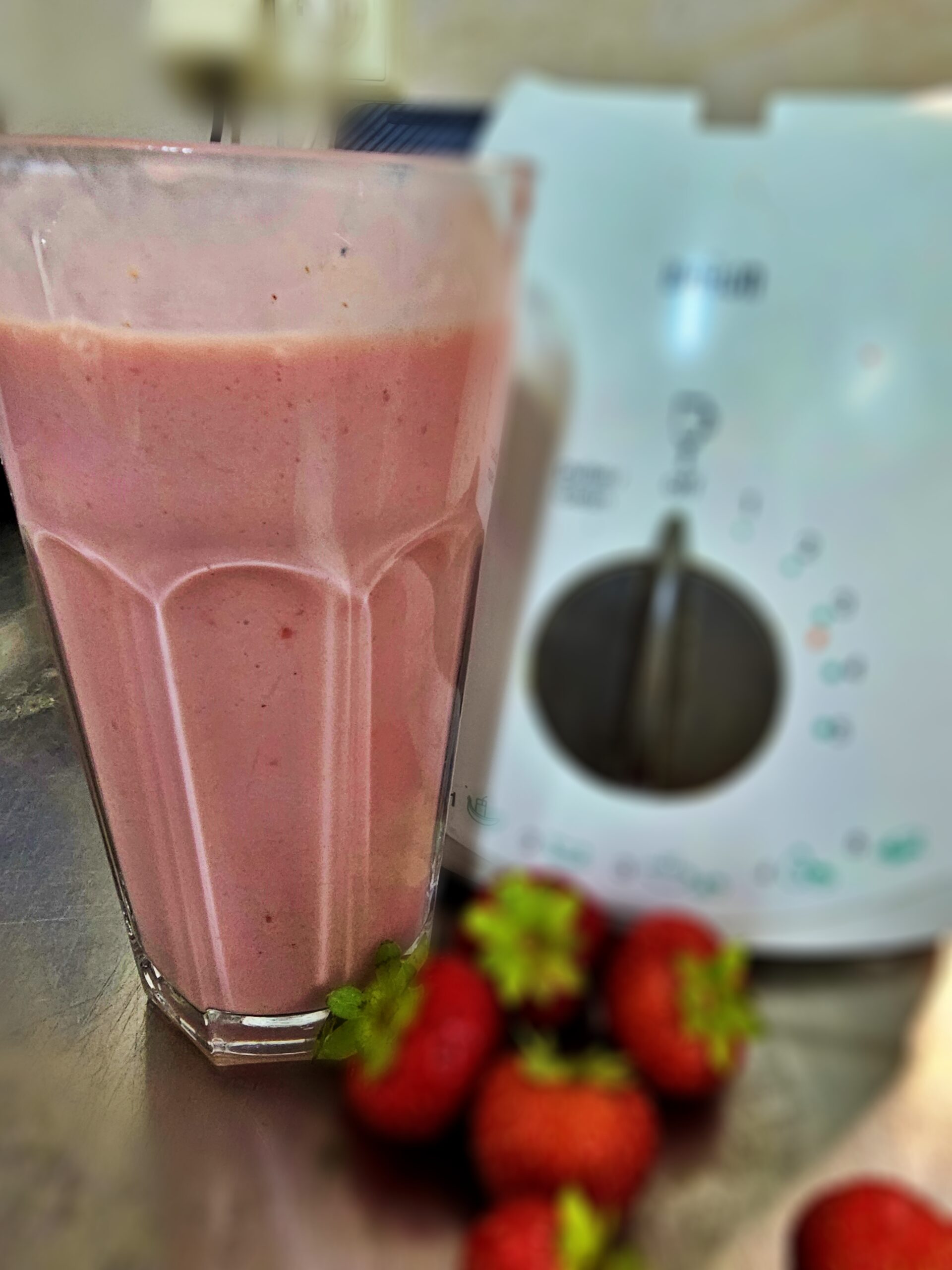
Hard to say whether it’s more of a drink or a dessert.
A liquid dessert, best in the heat.
Best still with ice cubes, and if you haven’t got any, haven’t made ice cubes, then definitely with ingredients chilled in the fridge.
that’s ingredients from the fridge.
And like ice cream, it comes from Asia, from a time when our ancestors in this part of Europe were walking on all fours and barking, and the USA wasn’t even on the cards.
INGREDIENTS:
500g soy yoghurt
150g oat milk
30g sugar
a big pinch of salt
1 small fresh chilli
1/4 tsp cardamom
fruit:
200g strawberries
METHOD:
Pour the yoghurt and milk into a jug blender, add the sugar and spices.
Blend for at least 2-3 minutes. The point is to get the drink to whip up a bit, to froth.
And that’s the base version of lassi, and in my opinion that’s already a fucking wicked drink.
But it’s peak season and who knows how much fruit there’ll be, or what next year will bring, so it wouldn’t be a sin to use, say, strawberries.
Add the fruit to the base version (worth cutting the strawberries in half, bigger ones even into quarters, so they blend easier) and blend again for a few minutes.
VARIATIONS:
In my version, classic lassi isn’t too sweet.
But in my opinion real lassi always has to have that hot note, a bit of chilli. But you can make it more on the sweet side, more on the salty side.
You can use all sorts of different fruit, the classic fruity one is obviously mango lassi. Mango’s a fruit that’s always been grown in the Indus Valley.
The kind of plant milk you use will also affect the taste and texture. Almond, for instance, can give interesting results.
You can also add a spoonful of coconut milk to a lassi like this.
Instead of milk you can use water (though we all know what fish get up to in water), but make it SPARKLING.
SERVING:
Best in a cold glass.
Extra trick for you in this heat, keep the glasses in the fridge or even the freezer. Best an upright one. Along with a good drug dealer series, like Snowfall.
But it also works a treat for drinking while working in the kitchen.
Lassi has three thousand years of tradition behind it, it comes from the Indus Valley, the territory of one of the oldest human civilisations, which arose 3,000 years before our era (our era? well, fuck, doesn’t feel like mine).
Here in northern Europe, the Funnel Beaker culture dominated at the time, along with its German variant, the Salzmünde culture. A culture from even before the stage of military democracy, back when the Pakis were already building civilisation, cities and the state.
The Funnel Beaker culture does have a lot in common with lassi though, because it’s the period when dairy fermentation and its products, like curd cheese, became widespread.
Though not yoghurt. And let’s be honest about that too.
Asians started using dairy fermentation, conservatively speaking, 2,000 years before Europeans, still in the phase before the development of civilisation.
And that’s something that shows how everything’s closely tied to the development of the productive forces, dietary habits included.
The discovery and large-scale use of dairy fermentation followed on from the domestication and rearing of dairy cattle.
Maybe that’s retroactive thinking about history, but it shows the determination of social development by the development of the productive forces, as laid down by Marx.
And if you read a bit about those old Asian civilisations, you understand what Mao Tse-tung, representing Chinese civilisation (3,500 years, conservatively speaking), said when asked to assess the French Revolution: it’s too early to tell.
The kitchen is my space for lifestyle medicine.
I'm not a dietitian or a doctor – I'm a chef, and a member of the Polish Society of Lifestyle Medicine. Nutrition is essential to a modern kitchen, and that's nothing new: working from Hippocratic dietetic principles was part of a cook's craft centuries ago. At Rude Kitchen I tie that tradition to modern science — and to lifestyle. Read more about how I bring cooking and lifestyle medicine together on the About page.