Asparagus is one of those vegetables whose popularity and the excitement people feel about them are completely beyond me. Probably partly because all my life I’ve liked strong, intense experiences — culinary ones too — and the delicate, refined asparagus, together with the typical upper-class cultural aura surrounding this vegetable, is just completely unattractive to me.
A lover of asparagus was Bishop Ignacy Krasicki, who threw truly Lucullan feasts at his court, and much earlier the first Roman emperor Augustus used his power to gorge himself on asparagus spears delivered by special units of the Roman army. He was also supposedly the author of the now somewhat forgotten saying “faster than asparagus cooks,” meaning something had to be done immediately and at lightning speed. Today people just say ASAP. And how are you not supposed to believe conservatives talking about the decline of language and civilization…
This year one of the bigger problems caused by the pandemic became the question: “who’s going to harvest the asparagus?” And just like there’s some country — I can’t remember which one — that has a bundle of arrows on its coat of arms, you could probably add a bundle of asparagus to the German eagle, that’s how insanely popular, almost worshipped, this vegetable is in Germany.
Well, German cuisine is one of the areas untouched by my Germanophilia. You know that story about rubber-Germans and rats? Speaking of Germanophilia…
The thing is, the local Buddhists, as part of dana practice, keep gifting us this delicacy. Which is of course a beautiful and heartwarming gesture… but on the other hand, I still have to eat the stuff! I barely survived the previous batch and another bag of asparagus already arrived. So, just like in Arnold Wesker’s play, it’s become “asparagus with everything” (or rather “asparagus for everything” — I guess that’d actually be the proper Polish equivalent of Chips with Everything).
Ingredients
- 2–3 white asparagus spears
- 1/3–1/2 block tofu
- 5–8 small oyster mushrooms
- 1–2 tbsp rice vinegar (or another aromatic vinegar)
- 1/2–1 tbsp dandelion syrup or another sweetener
- 10 larger cherry tomatoes
- fresh chili or ginger — depending on your taste
- fresh coriander
Preparation
Prep:
- Peel the asparagus and cut into 4–5 cm pieces
- Cut tofu into strips
- Finely chop the ginger and chili
Cooking:
- Throw the asparagus into hot olive oil and fry, stirring/turning so it cooks evenly on all sides. Tongs or a fork help.
- Once it starts browning, add the tofu, still stirring constantly.
- When the tofu starts browning, add the oyster mushrooms whole.
- From this point cook over low heat.
- Add the chili and ginger.
- After a minute or two add the rice vinegar, cover, and simmer for a few minutes so the oyster mushrooms soften slightly.
- Remove the lid, add the dandelion syrup, let the vinegar evaporate, and fry another 2–3 minutes to lightly caramelize the sugar.
- Add another half tablespoon of dandelion syrup and fry a little more to deepen the caramelization.
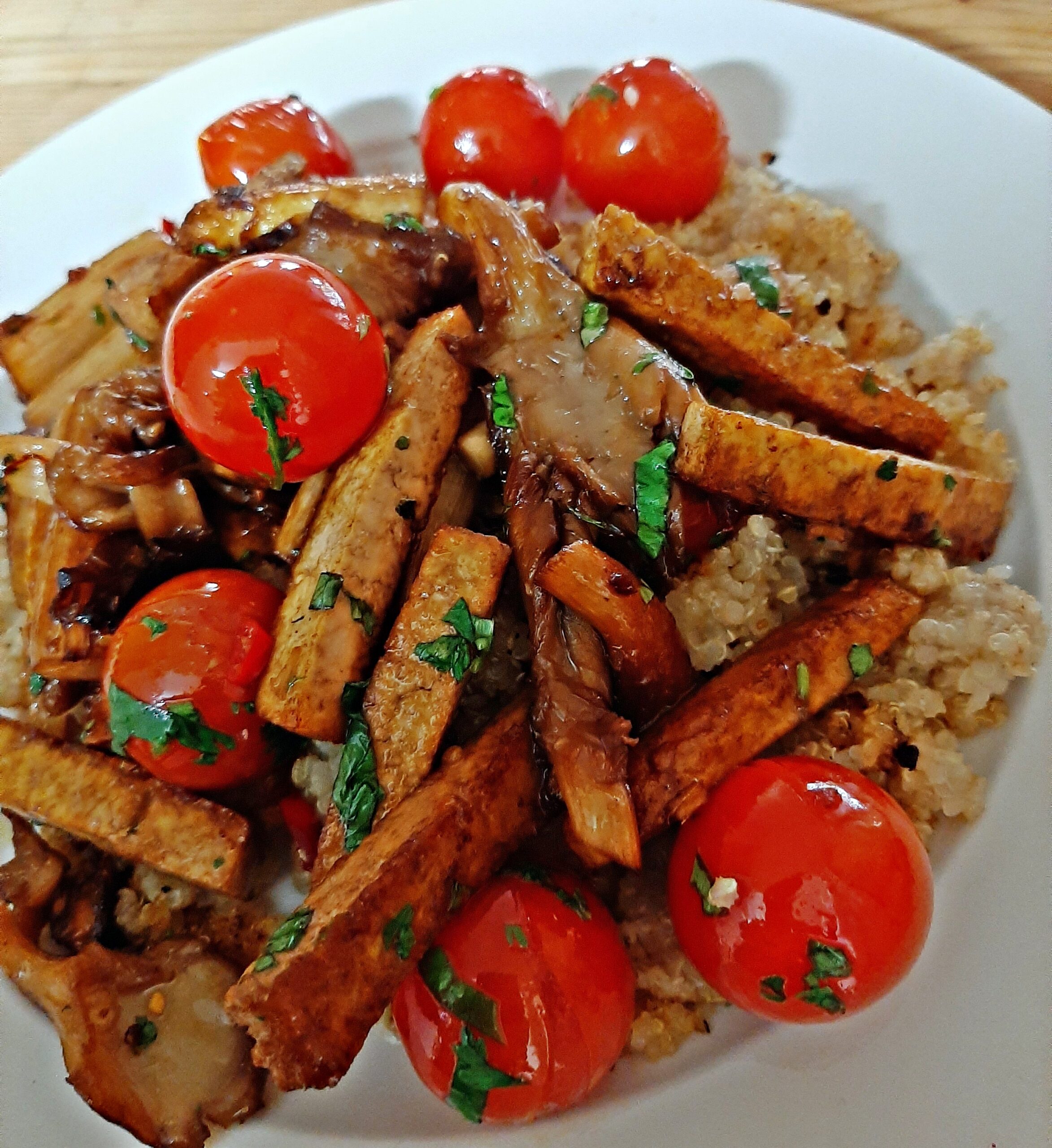
- Add the whole cherry tomatoes, cover for about 3 minutes. The goal is for the tomatoes to soften and the skin to start splitting while still staying al dente.
- Finally add the coriander, cover for one more minute.
- Remove from heat.
- Serve.
Serving
This goes wonderfully with quinoa, but boiled potatoes or mashed potatoes (I especially recommend my colorful mash) would also fit perfectly.
Variations
I used black rice vinegar in this recipe, but basically any aromatic vinegar will work, not just rice vinegar. Definitely worth experimenting here.
I also used dandelion syrup that I’d made a few days earlier and have been playing around with since, but any liquid sweetener would work — even dark sugar, especially muscovado. Date syrup could create a really interesting effect too.
What I don’t recommend are sweeteners like xylitol, because the whole point here is caramelization, and you won’t get that effect from sugar alcohols like xylitol or erythritol, or from stevia.
Notes
The important thing in this dish is balancing sourness, heat, and sweetness. So even if you don’t like spicy food, at least add a little fresh ginger — it lifts and deepens the flavor beautifully.
The kitchen is my space for lifestyle medicine.
I'm not a dietitian or a doctor – I'm a chef, and a member of the Polish Society of Lifestyle Medicine. Nutrition is essential to a modern kitchen, and that's nothing new: working from Hippocratic dietetic principles was part of a cook's craft centuries ago. At Rude Kitchen I tie that tradition to modern science — and to lifestyle. Read more about how I bring cooking and lifestyle medicine together on the About page.