
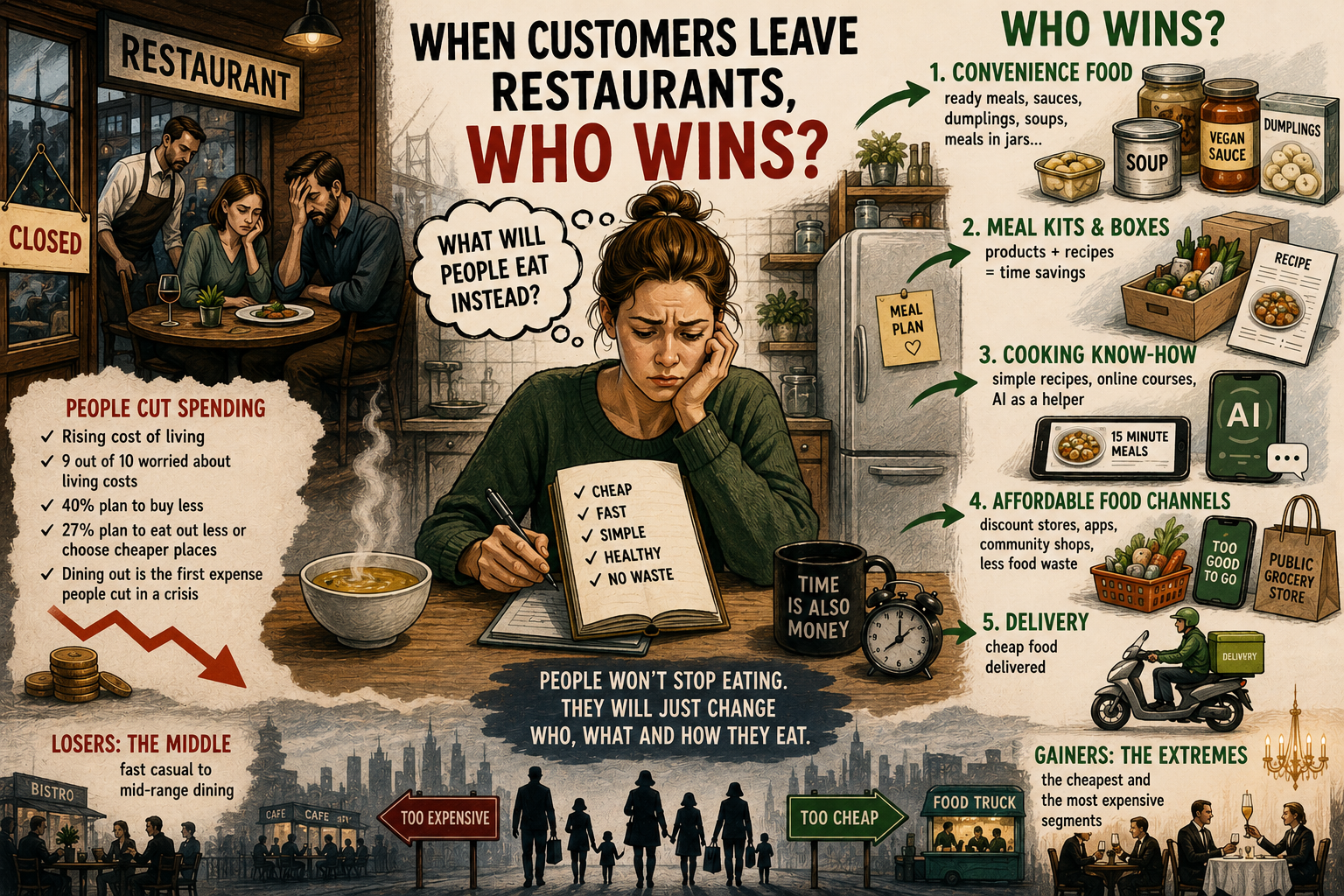
PwC’s recurring consumer sentiment survey in the UK shows a global trend.
The UK consumer confidence index dropped from -1 in January to -13 (sic!), while 9 out of 10 consumers are worried about the cost of living. 8 out of 10 want to reduce spending in the near future. 40% of respondents want to buy less, and 27% plan to eat out less often or choose cheaper places. Eating and drinking out is always one of the very first things people cut back on during a crisis.
For many restaurants, combined with rising food and energy prices, this will be deadly.
The places most at risk are mid-range venues. The most expensive restaurants, where the truly wealthy eat, won’t lose customers.
As history teaches us, crises like this make the rich even richer, meaning they can afford even more expensive restaurants.
Customers from higher segments will move toward the cheapest places, fast food chains, and similar options. In general, everything between fast casual and lower-end fine dining will lose out.
The cheapest and the most expensive segments of gastronomy will benefit. Or rather — they will lose less than others, because some customers will give up eating out altogether.
The question is: what will replace restaurant dining?
Because if someone eats out regularly, they usually don’t have the time and/or the skills to cook for themselves.
And this is where the first major winner appears:
1. Convenience food
Ever since Andy Warhol painted Campbell’s soup cans, they’ve been a symbol of modern cuisine — and modern culture itself.
I’m full of admiration for those unknown heroes from dark industrial kitchens developing recipes for Campbell’s soups and Kotliński sausages. Their work powered the transformations of the 20th century. Convenience food and the automatic washing machine were just as important for women’s liberation and equality as feminism and voting rights.
And this may be not only a threat, but also an opportunity for restaurants. A great example is Ed Red, which during the pandemic lockdown switched to producing artisan canned convenience meals — and became a nationwide success.
As a chef, I’d gladly help create products like that.
And as a customer, I happily buy ready-made flour-based products: dumplings, noodles, little pasta dishes. Ready-made Schupfnudeln or Spätzle are permanently on my shopping list. I don’t feel like making that kind of thing for myself, even though, like everyone else, I enjoy eating them. They also have an advantage over potatoes or rice: they’re ready in minutes.
And time will be crucial for people giving up restaurant lunches where meals arrive ready to eat in 5–30 minutes.
So the future belongs to simple, quick, easy-to-prepare meals and semi-prepared products such as:
- ready-made sauces in jars where you only add tofu/protein/a piece of corpse and maybe boil some pasta;
- prepared dumplings and noodles like the ones mentioned above.
This could also become an interesting opportunity for retailers — for example by offering complete ingredient sets for specific meals or weekly menus — and for producers including simple recipes with just a few ingredients directly on packaging.
This is a bit like the “lipstick effect”:
“I can’t afford dinner at a good restaurant anymore, but I can afford their semi-prepared products.”
So instead of buying some random pasta sauce, you buy an original RudeKitchen pasta sauce with my instructions on how to prepare and serve it.
2. Meal boxes with ingredients and recipe plans
I noticed this in Germany several years ago already. I don’t know how big the market is, but this segment may gain some of the customers giving up restaurants.
Because they don’t have to shop themselves — and if someone used to eat out every day, walking into a grocery store feels like Lemmy Kilmister in a kindergarten: “I don’t know what I’m doing here.” Or like GG Allin on Epstein Island.
And naturally this is also a field for chefs designing those menus. There’s also space for farmers — or rather agricultural cooperatives — because a single farmer probably couldn’t provide all the products needed for a full weekly menu. I myself have an idea for creating a PDF with recipes for a complete 7-day menu.
But I have absolutely no idea for sweet breakfasts. I’ve never eaten sweet breakfasts! And when I search online, it’s all pancakes and sweet fritters.
Seriously — do people actually make pancakes every morning?
That’s a nightmare. Messing around with batter, then washing a mountain of dishes afterward. Who has time for that in the morning? Maybe only the mythical 1950s American housewife.
Notice that supermarket chains already do something similar by publishing recipes using products from their own stores. Which leads us to the next point.
3. Kitchen know-how
It’s worth remembering the pandemic period, when online cooking courses exploded in popularity. Jamie Oliver showed people how to cook simple, tasty meals at home with just a few ingredients. Simple recipes and “15-minute meals” will attract the biggest audiences.
Not overcomplicated dishes for culinary lunatics using 30 ingredients and three hours of preparation.
I have a “15-minute meals” section myself where I’ll publish simple recipes for quick meals requiring no special skills or experience. There are already a few there.
AI has definitely changed the rules of the game, and many people will rely on AI for deciding what and how to cook.
This connects strongly with lifestyle medicine, where diet is one of the foundations. The coming shift in eating habits is an excellent opportunity to promote healthy nutrition through cheap, simple, tasty, balanced meals. I’m absolutely sure that guests who used to come to my place for plant-based falafel, burritos, or healthy vegetable soups won’t recreate those dishes at home.
First, because they don’t know how. And burritos or falafel actually require a lot of preparation and ingredients, so they’re not realistic daily home meals.
But people can throw a sausage into a frying pan with onions and eat it. The challenge is offering them something instead of that sausage.
4. Every possible channel for cheap food distribution
Things like online discount stores such as Motatos (which unfortunately just withdrew from Germany) or apps like Too Good To Go. Consumers will become even more price-driven.
Which is bad news for everyone, like me, who stands on the bright side of the Force and wants people to eat healthy, mostly plant-based, nutritious food. Because from a certain point onward, cheaper food inevitably means worse quality — nutritionally included.
Maybe what Zohran Mamdani recently did marks the beginning of a shift in this vicious cycle of unhealthy eating. The mayor of New York recently opened the first “Public Grocery Stores” — cheap municipal grocery stores in poor neighborhoods. Anyone who regularly reads my work knows I’m a huge supporter of this kind of food distribution.
The right to food is the most fundamental human right. Because if you don’t have food, no other rights matter — you simply die.
This point also includes something that makes evil people like me — who don’t want capitalism flourishing endlessly and GDP growing forever — very happy. Internal redistribution.
Or in normal language: not wasting food. Turning what we recently would have thrown away into another meal, because now we have to save money. Every chef who isn’t a complete idiot constantly thinks about reducing waste. Because, quoting a classic: “Throwing away food is a fucking sin.” And from a business perspective, it’s throwing away money. Incidentally, this also requires a certain kind of know-how.
5. Delivery — cheap food brought to your door
This is generally the lowest sector of gastronomy: cheap chains delivering food for next to nothing.
Customers from higher segments will definitely move into this sector. Although naturally some people who previously ordered delivery will now shift toward cooking at home or buying convenience meals. This industry, dominated entirely by giant digital platform companies, is one of the biggest winners of the pandemic and the 2020s.
And also a place of enormous exploitation, labor law violations, and illegal employment. Fortunately, its future remains uncertain. In the current system, most of the risk is pushed onto workers and couriers, who never know in the morning how much they’ll actually work or earn that day. But this model is necessary to keep delivery cheap.
Couriers earn very little and increasingly have had enough. Across the world — from India through Georgia, across Europe, the UK, the USA, and South America — union movements and strikes among delivery workers are growing stronger. I’ve written about them several times with admiration and respect. And this may become the factor that blows the entire industry apart. Especially in the European Union, where the Platform Work Directive was recently passed.
I do not doubt that the friends of big business will do everything possible in individual countries to delay its implementation and weaken it as much as possible. But any limitation on exploitation will increase delivery costs.
People cannot and will not stop eating. Only their eating and shopping habits will change. The coming trend could be described as a new folk cuisine, where accessibility — especially affordability — of ingredients becomes the key factor.
The kitchen is my space for lifestyle medicine.
I'm not a dietitian or a doctor – I'm a chef, and a member of the Polish Society of Lifestyle Medicine. Nutrition is essential to a modern kitchen, and that's nothing new: working from Hippocratic dietetic principles was part of a cook's craft centuries ago. At Rude Kitchen I tie that tradition to modern science — and to lifestyle. Read more about how I bring cooking and lifestyle medicine together on the About page.