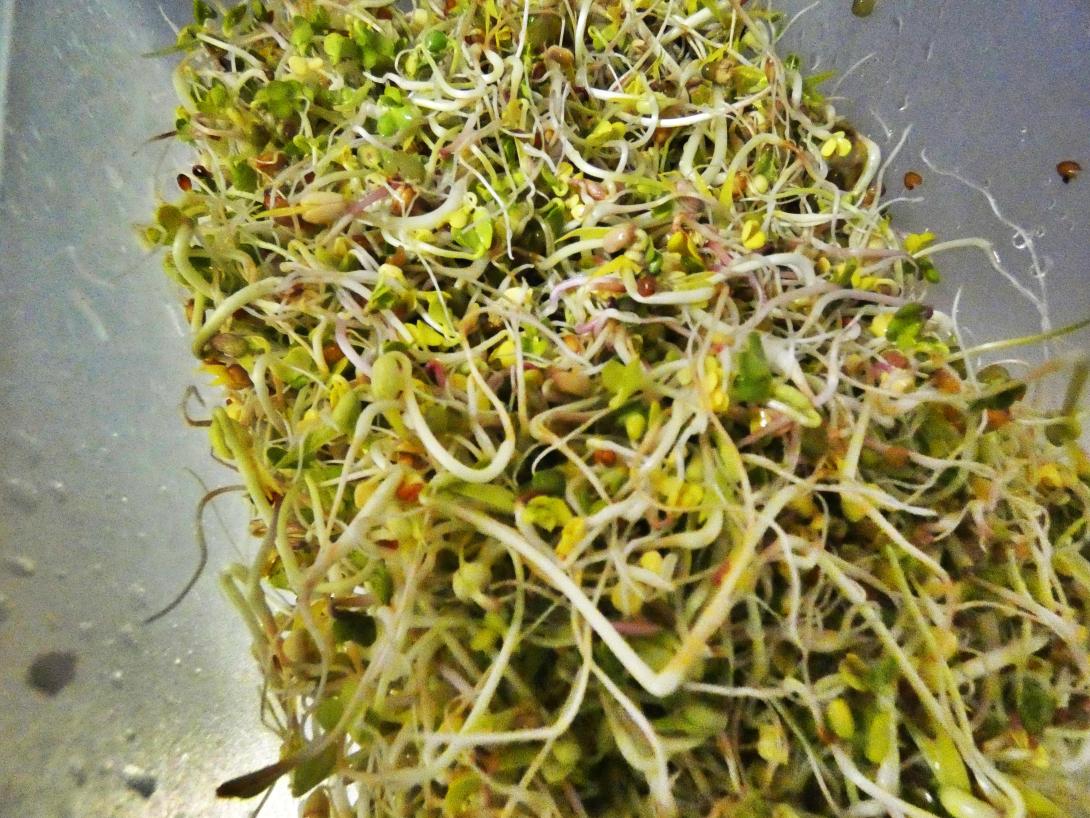
At least 50 people across seven countries — more than half of them in Finland — have been infected with Salmonella. The most likely cause was… sprouts. From Italy.
Products like sprouts and microgreens — so often treated as part of a healthy fitness diet, eaten raw, added as garnish, to salads and slaws — are actually among the biggest microbiological hazards in the kitchen. Especially in the modern kitchen.
Washing is not effective. It does not remove salmonella from contaminated food.
What’s worse, washing may spread the bacteria around with splashing water.
And let’s remember: the kitchen is a dream environment for bacteria. Warm, humid, and full of food.
Why is this especially dangerous in the modern kitchen?
Because nowadays these are usually supermarket sprouts that, like these ones, have travelled a long way from another country.
And a longer supply chain means a greater risk of contamination at one of the stages.
If I take something from my own sprouting tray, and I wash my hands after taking a shit, there’s probably no contamination risk. But every pair of hands that touched those sprouts from field to table means a greater risk of contamination and infection.
What’s interesting is the demographic profile of the infected people.
The dominant group is 45+, people around 50 years old.
Aware that they should take care of their health — but, as it turns out, not really aware of the side effects, risks, and what to do to avoid them.
There is a very simple way to avoid salmonella infection from sprouts:
Don’t eat sprouts!
No, alright, no extremism. Sprouts are cool.
Especially, as I wrote above, when they come from your own sprouter.
The shorter the supply chain, and the fewer intermediaries and kilometres between you and the producer, the lower the risk that the product will be contaminated and dangerous to you.
That’s why homegrown sprouts are best. There’s also another factor: you control hygiene and everything else at every stage. And you can be sure the product is safe.
If part of the field-to-table chain is outside your control, then of course we rely on compliance principles — meaning you trust that a legal supplier follows rules regarding cleanliness and microbiological safety.
Obviously, it would be safer if every batch were tested. But if every stage had to test every batch of those sprouts, they’d go bad before reaching the shop.
And even if they didn’t, in products with a long shelf life, it would still mean more time and enormous costs.
But there’s another side to the story. As always.
At the beginning of February 2024, there was a poisoning case in Poland involving meat jelly. One person died, and two others ended up in the hospital.
The supply chain was very short. The jelly was made by a farmer and his wife using meat from their own farm and was sold locally at a market.
Except during production, he added too much sodium nitrite — a substance used in small amounts for curing meat, but deadly dangerous in excessive quantities.
A local product from a local farmer, a small-scale, homemade — or as people now say, craft — producer carries a much higher risk that food poisoning or contamination will occur. Whether bacterial or, as in this case, chemical contamination through improper use of substances.
Mistakes happen. There may be no internal controls, no food safety procedures, no HACCP system, no staff hygiene training, etc., etc., etc.
In a large company, or corporation, there are always procedures and standards implemented for food production. Production is often randomly tested, and so on.
And of course, rules, procedures, restrictions, and regulations get broken. Counterfeit food is sold under famous brands too — olive oil on an almost industrial scale, for example — and of course, that bypasses sanitary control. Large food factories also experience contamination incidents.
And very often the source of the warning is the producer itself. Large food companies usually have HACCP food safety systems in place, obligating them to monitor their own production.
And of course, that control is not perfect. There’s corruption and all the rest. But the risk of contaminated food slipping through is much lower where procedures exist and breaking them is considered abnormal, than in places with no food safety procedures whatsoever.
Places where the owner’s dog runs onto the production floor, takes a shit, and runs off again.
A real example.
From gastronomy. In one place where they didn’t even ask for a sanitary health certificate, the medical tests for salmonella and such.
A businessman who has no idea what good manufacturing practices are, and thinks HACCP sounds like some secret mind-control weapon, walks into the pickle production area in boots covered in shit. Picks his nose with his fingers and grabs a pickle straight from the barrel.
So the problem is basically one between Scylla and Charybdis — impossible to solve cleanly.
As dietitians love to say, it depends.
Food safety, like the entire field-to-table chain, does not exist in a vacuum. It’s part of a socio-economic system built around the principle of profit.
If profit is the supreme principle, then of course it becomes acceptable — even necessary — to neglect food safety in the name of maximizing profit.
For example, by using glucose-fructose syrup instead of sugar. Because it’s cheaper. And even less healthy than regular sugar.
And that ideological horizon limits what solutions are possible without revolution.
Can we combine small, local, artisanal production with corporate order, procedures, and HACCP systems?
Of course.
And I regularly shop at one example of such a solution.
(They should start paying me for advertising.)
I mean the German cooperative supermarket chain EDEKA.
It operates exactly on that principle: local stores under one brand, connected in a network of equal entities. They have the power of a supermarket chain and supermarket-level procedures, but at the same time, each store — besides the shared product line (a huge range under Edeka and Edeka Bio brands) — also offers local products.
For example, potatoes from a field 6 km from the shop. Seriously, I checked.
So I get a short supply chain and food safety procedures for locally sourced food.
That kind of food distribution model is the best and most beneficial for customers. It combines the supermarket with the local market.
But Edeka was founded over a hundred years ago in a completely different era, when today’s supermarket chains and food corporations were only beginning to emerge.
In today’s food market, there’s basically no room for a newly created network like that.
Unless that path is carved out. At the expense of the corporations that currently control food markets.
And they watch developments very carefully and spare no expense on lobbying — legal and illegal.
The state would have to play an active role in carving out space for such a theoretical food cooperative. Through appropriate legislation — for example, by favouring this kind of ownership structure in contracts for producing food for schools.
And it’s obvious that dominant food corporations work very hard to make sure friendly politicians block such changes.
So, can we ensure food safety?
Though without a socialist revolution, it will be very difficult.
The kitchen is my space for lifestyle medicine.
I'm not a dietitian or a doctor – I'm a chef, and a member of the Polish Society of Lifestyle Medicine. Nutrition is essential to a modern kitchen, and that's nothing new: working from Hippocratic dietetic principles was part of a cook's craft centuries ago. At Rude Kitchen I tie that tradition to modern science — and to lifestyle. Read more about how I bring cooking and lifestyle medicine together on the About page.