
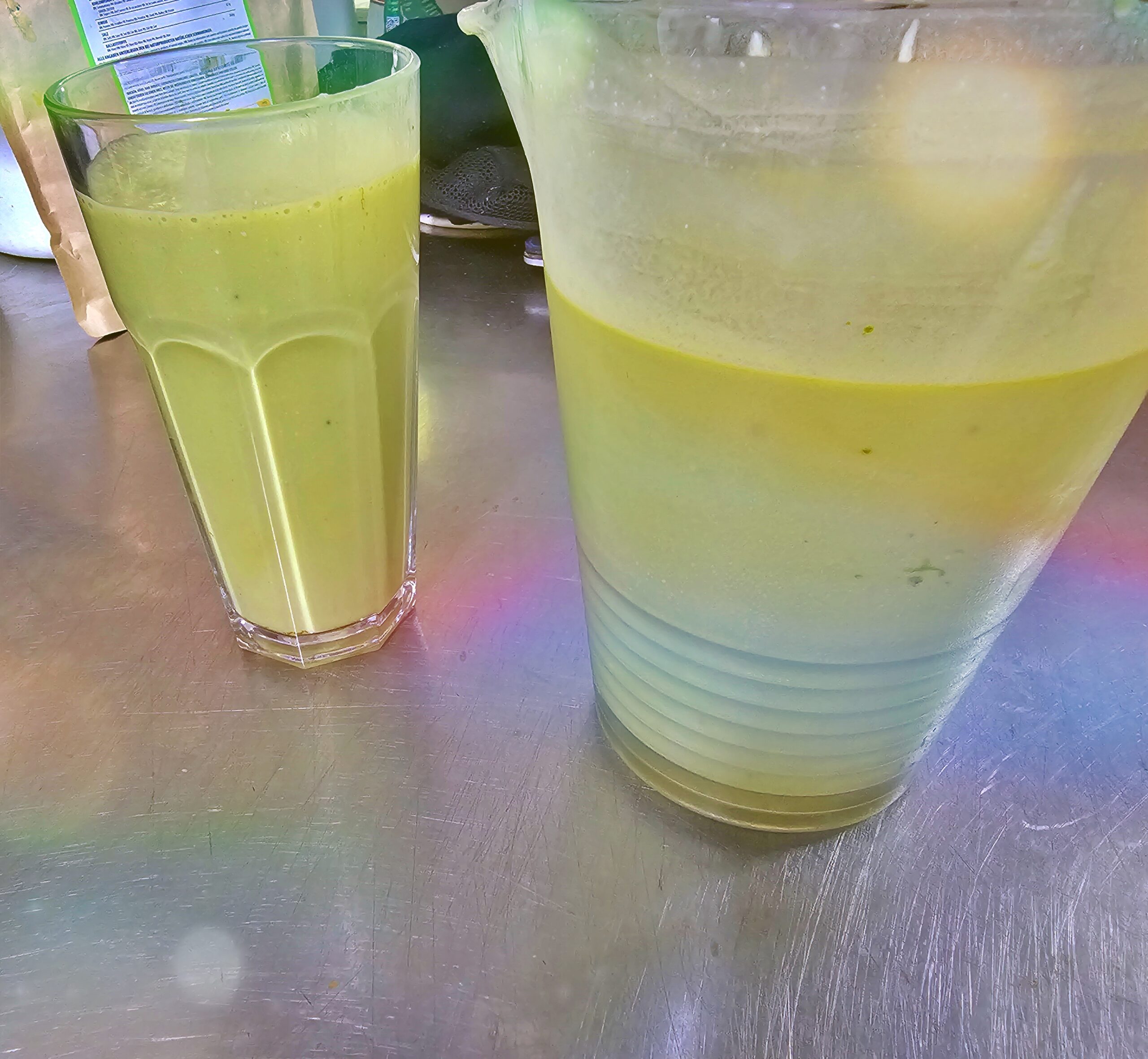
Something Cold with Caffeine!
“Something cold with caffeine!”
That’s what I asked for on Saturday at a restaurant in Hamburg.
And what I got tasted so good that I created my own version of a matcha latte. Or maybe more of a smoothie.
INGREDIENTS:
- 1 litre of soy milk (or any other plant milk)
- 1 can of coconut milk
- 2 small ripe bananas (see Notes)
- 1 heaped tablespoon (15 g) of matcha
- 3 tablespoons (30 g) of sugar
- 2 tablespoons of lemon juice
METHOD:
Keep all the ingredients in the fridge for at least two hours beforehand—especially the soy milk and coconut milk—so everything is nicely chilled.
Blend all the ingredients together in a high-speed blender for a few minutes, until the drink becomes slightly whipped and frothy.
VARIATIONS:
You can add cinnamon or ginger. Instead of bananas, you can use mango or other fruits. Just remember that different fruits will affect the colour.
NOTES:
The best bananas for this are the ones nobody wants to buy at the supermarket. The more brown spots they have, the riper and sweeter they are.
SERVING:
Serve in a tall glass with plenty of ice cubes.
I bought a packet of matcha some time ago, more for experiments than for drinking. I wanted to use it for colouring things, like the icing for Queen Elizabeth’s cake. (I really need to write that recipe down properly and publish it.)
During the French Revolution, I would have been the kind of person making sure the guillotine didn’t jam. But when it comes to cake, I have to admit that the World’s Most Aristocratic Alcoholic had excellent taste.
Although whether she could actually taste anything is another matter. Two hundred grams of alcohol every day doesn’t just damage your brain—it dulls your sense of taste as well. Even when you’re technically sober, your brain remains permanently fogged by alcohol.
I lived like that for a while. Aristocrats live like that all the time. A bunch of degenerate bastards. Elite degenerates!
Matcha used to be elite as well. It was available only to the upper few percent of society: feudal lords, the shogun, aristocrats, and courtiers.
Producing matcha is far more labour-intensive and expensive than making ordinary green tea. Two key elements make the process particularly demanding and costly.
And, just as today, the people doing that work could rarely afford to drink such tea themselves.
The first factor is the special shading structures built over the tea plants so they mature in the shade. This increases chlorophyll levels and gives matcha its beautiful green colour.
Another defining characteristic of matcha—and the reason this recipe produces a smooth suspension rather than loose tea leaves—is the fineness of the grind.
Matcha is traditionally ground in slow-turning stone mills into a powder measuring just 5 to 10 micrometres—that is, thousandths of a millimetre.
Today, both shading and grinding are much easier and faster than they were a century ago. That has democratised matcha, making it available to many more people.
But it has also created a paradox that appears in many areas, including overtourism.
Democratisation means accessibility for everyone.
And that accessibility can threaten the very quality and traditions that made something popular in the first place.
You cannot expand production indefinitely, especially in a country like Japan, where land is scarce.
I imagine there are quite a few Japanese people complaining about the “white dogs”—or whatever equally colourful term they use for Westerners—because all these foreigners are drinking the matcha that used to be reserved for tea ceremonies.
At this rate, we’ll soon see tea-ceremony militias in traditional robes carrying banners saying:
“Matcha for the Japanese!”
A few years ago, I would have called that an absurd idea.
These days, not so much.
And I still have plenty of matcha left, so I’m sure I’ll come up with a few more interesting things to do with it.
The kitchen is my space for lifestyle medicine.
I'm not a dietitian or a doctor – I'm a chef, and a member of the Polish Society of Lifestyle Medicine. Nutrition is essential to a modern kitchen, and that's nothing new: working from Hippocratic dietetic principles was part of a cook's craft centuries ago. At Rude Kitchen I tie that tradition to modern science — and to lifestyle. Read more about how I bring cooking and lifestyle medicine together on the About page.