
Blends of honey from the EU and non-EU countries have started disappearing from store shelves since June 14. Although nobody knows how long this disappearance will last.
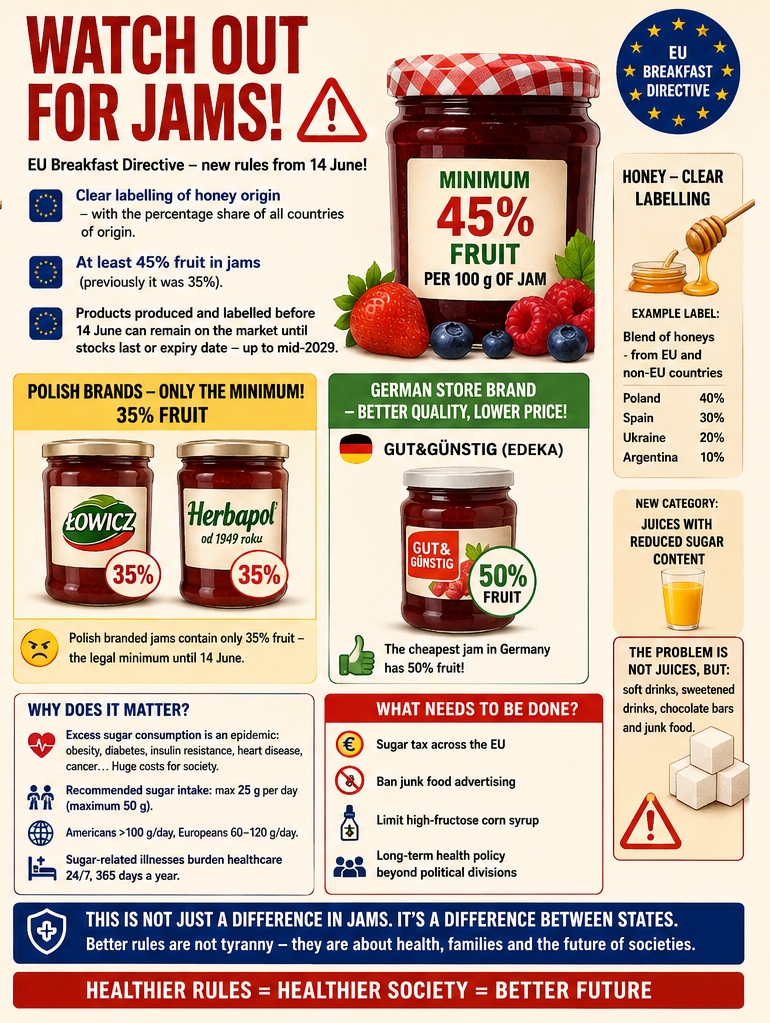
The EU Breakfast Directive, which came into force on June 14, now requires precise labeling of honey blends, including the percentage share and country of origin of every honey used in the product.
The authoritarian European Union is also forcing us to eat… better jam.
From June 14 onward, jams must contain at least 45 grams of fruit per 100 grams of product. Previously, the minimum requirement was 35%.
Products manufactured and labeled before June 14 can still be sold until stocks run out or the products expire. In practice, that could mean until the middle of 2029.
This may actually be good news for jam lovers—many producers and wholesalers may want to clear out their higher-sugar jams as quickly as possible and offer substantial discounts.
But this absolutely broke my patriotic heart.
Because, as I wrote, I checked the jam I buy for my guests.
Then I looked online and, hell, I’ll even name the brands: Łowicz and bloody Herbapol—one of the most iconic brands in Polish history!
Those branded Polish jams contain 35% fruit—the absolute legal minimum that was allowed until June 14. The very least they could get away with.
And although I assume my readers are intelligent people, if anyone missed the irony: I’m genuinely happy that the European Union is imposing stricter standards on food producers.
What annoyed me was the comparison.
Because not only the organic mid-range jam I buy for breakfast guests, but even GUT&GÜNSTIG, Edeka’s cheapest store brand, contains 50% fruit!
Cheap German supermarket jam is of higher quality than premium Polish branded jam.
Not everyone is expected to know this, so let me explain: Poland is one of Europe’s fruit-producing powerhouses, alongside Italy and Spain. Spain’s position is boosted by its dominance in citrus production.
Germany, judging by the fields around me, mainly grows potatoes and rapeseed while importing huge quantities of fruit—much of it from Poland.
And yet they produce better, cheaper jams than we do.
Something here is clearly wrong, and I think the problem is on the Polish side.
What do you think?
This isn’t merely a difference between jams or even between economies. It’s a difference between states.
Producing the lowest-quality food products imaginable is, in many ways, the essence of post-1989 Poland.
It also says a lot about how markets in different countries will react.
If even the cheapest German jams already contain 50% fruit, nothing will really change there. But if branded Polish jams only contain 35%, prices will inevitably rise.
Manufacturers may also try to offset higher fruit costs through downsizing.
I wrote about this recently, particularly about the great success of an organization from Hamburg (of course—the best city in the world).
They may also reduce ingredient quality: more water, more gelling agents, more high-fructose corn syrup—which, personally, I dream of seeing banned across the EU.
Interestingly, the directive also introduces a new category: reduced-sugar fruit juices.
This is a classic example of public health and nutrition policy.
Personally, I have mixed feelings about it, because fruit juices aren’t the main problem. Sugary soft drinks, candy bars, and other junk food are.
A total EU-wide ban on junk-food advertising or a continent-wide sugar tax would probably achieve much better results.
Although when discussing sugar taxes, we should remember the EU paradox.
The European Union still subsidizes sugar beet production—meaning more sugar, and cheaper sugar. That makes sugar more abundant in processed foods, while governments simultaneously impose sugar taxes to cover the enormous and growing healthcare costs associated with excessive consumption.
But the fundamental issue here goes far beyond the quality of our jam or the price of sugary drinks.
It concerns our collective survival and quality of life as societies.
The increasing strain on healthcare systems is becoming one of the greatest challenges facing Western countries, largely because of aging populations.
Unless we improve overall public health, no amount of funding or private payments will save healthcare systems.
We need more hospitals, clinics, scanners, and beds—but also more doctors, nurses, and caregivers.
Future generations simply will not be able to provide enough healthcare workers, regardless of salaries.
Not everyone can—or should—become a doctor or an elderly-care worker. I say that from my own experience of working in care homes for two years.
The recommended daily intake of sugar should not exceed 25 grams, and generally, less is better. Fifty grams is considered the absolute upper limit.
Americans consume over 100 grams per day. Europeans consume between 60 and 120 grams.
Do you know what that means?
It means that as we grow older, more and more people around us develop insulin resistance, diabetes, obesity, and all the diseases associated with obesity.
When I weighed almost 15 kilograms more than I do now, my work was far more exhausting, and I was much less productive. That represents another category of social costs caused by excessive sugar consumption.
Just as alcohol-related cases fill emergency rooms on weekends, the victims of sugar and highly processed food place pressure on healthcare systems 24 hours a day, 365 days a year.
The only way to save healthcare systems in developed countries is through social engineering—creating, encouraging, and sometimes even forcing large-scale lifestyle changes, particularly changes in eating habits.
That requires both interventionist measures and long-term health strategies that transcend political divisions.
I greatly admire British policy in this area—what Starmer’s government has done, building on initiatives originally introduced by the Conservatives.
It makes perfect sense.
If conservatism means caring about families and children, then policies such as sugar taxes should be among its core principles.
The kitchen is my space for lifestyle medicine.
I'm not a dietitian or a doctor – I'm a chef, and a member of the Polish Society of Lifestyle Medicine. Nutrition is essential to a modern kitchen, and that's nothing new: working from Hippocratic dietetic principles was part of a cook's craft centuries ago. At Rude Kitchen I tie that tradition to modern science — and to lifestyle. Read more about how I bring cooking and lifestyle medicine together on the About page.