
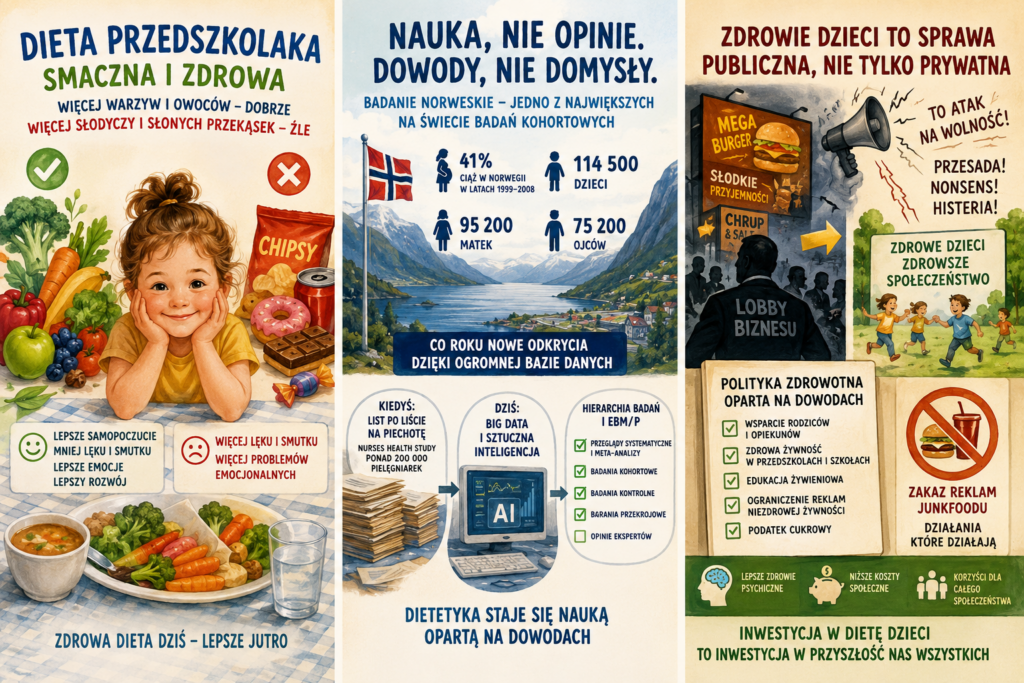
What Diet Is Best for a Preschooler?
A preschooler’s diet should be tasty and healthy.
And everyone should be beautiful, rich, and healthy.
The difference is that the issue of diet has strong scientific backing.
A new study published in *Nutrients*, an international peer-reviewed open-access journal focused on human nutrition, has found a connection between children’s mental development and their diet.
The study, conducted by Norwegian researchers, aimed to identify links between personality traits and symptoms of depression and anxiety measured at age eight, and diet during the prenatal period and throughout childhood up to the age of eight.
The researchers used data from one of the world’s largest cohort studies, covering 41% of all pregnancies in Norway between 1999 and 2008. The project collected an enormous amount of data from 114,500 children, 95,200 mothers, and 75,200 fathers.
Every year, this database produces new discoveries and research findings.
And this is the answer to those who complain that dietary recommendations are always changing and that scientists keep changing their minds about what’s healthy and what isn’t.
Because the last few years have indeed brought an explosion of new discoveries in nutrition science.
This is largely thanks to new technologies and big data. Without them, analyzing datasets of this magnitude would simply be impossible.
By the way, it makes the researchers behind the American Nurses’ Health Study even more impressive. They had to process data from more than 200,000 nurses manually—letter by letter—when participants still mailed in paper questionnaires.
Today, data from that study and many others are being analyzed using artificial intelligence.
This is the moment when nutrition science is finally becoming fully evidence-based practice.
It’s worth remembering that evidence-based medicine is actually quite new.
EBM became standard practice in medicine only about thirty years ago, and in nutrition science roughly ten years later.
Evidence-based medicine means using the best available scientific evidence in clinical practice—not simply accepting something because a famous professor says so.
Two years ago, almost in the center of Hamburg, in a tunnel leading to Münzviertel, I nearly walked into two guys preparing a heroin injection.
A spoon. A lighter. A syringe.
Two of my close friends died from heroin addiction in the 1990s.
Now imagine you’re walking into a pharmacy.
You need a syringe for a medical injection. Or maybe for drawing blood for some magical potion.
And on the way you come across the syringe those guys left behind.
You wouldn’t stop, pick it up, and inject yourself with it.
Right?
Unless you’re already addicted enough that it no longer matters.
If you understand why that syringe is dangerous, you may feel the same unpleasant shiver I do whenever I see something like that.
Then you continue to the pharmacy.
In the mid-19th century, as many as one in four women giving birth in hospitals died.
Then one of humanity’s greatest forgotten heroes appeared: Dr. Ignaz Semmelweis.
The pioneer of evidence-based medicine discovered through observation and research that the key was… washing hands.
We cannot see bacteria or viruses.
The fact that you’re alive and reading this today owes a great deal to Semmelweis and the evidence-based approach he helped establish.
Thanks to it, women stopped dying in childbirth in such numbers.
And thanks to it, you know that using a dirty syringe left by drug users is a terrible idea.
Evidence-based medicine relies on a hierarchy of scientific evidence.
Even without studying research methodology in detail, common sense tells us that a Norwegian study involving more than one hundred thousand children carries different weight than a study of twenty people conducted over two months.
A fictional example—but you’ve certainly seen something similar.
Popular media outlets love finding a tiny study that nobody has replicated and presenting it as a revolutionary breakthrough.
Even more so do various self-proclaimed “critical thinkers” who claim to have “woken up.”
What they really need is a lesson in research methodology.
Because methodology is what allows scientists to analyze datasets as large as the Norwegian study.
So what does this research tell us about preschoolers’ diets?
Surprisingly simple things.
More fruits and vegetables: good.
More salty and sugary snacks: bad.
Children who ate fruits and vegetables more frequently showed fewer symptoms of depression, anxiety, and emotional problems.
Children who consumed more salty and sugary snacks showed more.
The authors acknowledge limitations, including an overrepresentation of highly educated families. They also note the possibility of reverse causation: children already experiencing mental health problems may eat more emotionally, consuming more sugar and fat and fewer fruits and vegetables.
Although the study found a clear association between healthy, varied diets rich in fruits and vegetables and better mental health outcomes, the researchers stress that further research is needed.
They also emphasize the importance of this issue from a public-health perspective.
The study concludes:
“Current adherence to dietary guidelines is low. Therefore, identifying ways to support young populations through structures and systems that influence children, such as early childhood education and primary healthcare services, as well as supporting parents in providing healthy diets, should be a public-health priority.”
The researchers further note:
“Mental health problems are costly both for individuals and society. Ensuring a healthy and varied diet early in life may support children’s mental health and provide substantial societal benefits. Methods to improve dietary habits in early childhood should therefore be identified through targeted intervention studies.”
And this is where politics enters the picture.
The implications for public-health policy are obvious.
They align closely with recent initiatives in the United Kingdom.
Importantly, there is broad political consensus on the issue. Efforts to restrict advertising of unhealthy foods began under the previous Conservative government.
One of the leading candidates to succeed Prime Minister Starmer is former Health Secretary Wes Streeting, who has strongly emphasized this direction of reform.
Whenever we discuss public health, it quickly becomes clear that private choices—such as what small children eat—become political issues when multiplied across an entire population.
This leads to policies such as restrictions on junk-food advertising.
And such decisions almost always run against the interests of some business lobby.
The tobacco lobby.
The alcohol lobby.
The junk-food lobby.
You can usually tell that a policy is moving in the right direction by the amount of noise and outrage it provokes from lobbyists and their sponsors.
Can you hear the howling?
Excellent.
The kitchen is my space for lifestyle medicine.
I'm not a dietitian or a doctor – I'm a chef, and a member of the Polish Society of Lifestyle Medicine. Nutrition is essential to a modern kitchen, and that's nothing new: working from Hippocratic dietetic principles was part of a cook's craft centuries ago. At Rude Kitchen I tie that tradition to modern science — and to lifestyle. Read more about how I bring cooking and lifestyle medicine together on the About page.