Have you ever cooked a classic dish you had no idea how it was supposed to taste? Recently, I was tasked with exactly that.
We were expecting a visit, postponed since the pandemic, from a high-ranking teacher.
You’re not required to know what kind of teacher, so let me explain. I cook at a Tibetan Buddhist Center, Vajrayana or the Diamond Way — not to be confused with Diamond Way “lama” Ole Nydahl’s, famous racist and sexist… Well, he wouldn’t make it into a bar on St. Pauli.
I cook and work whenever we have guests who need meals. Usually, it’s for a Buddhist teacher who comes to give teachings, which are called transmissions. If you’re curious and want to know more about this, let me know in the comments or send me a message by carrier pigeons and I’ll write more. After five years here, it’s so obvious to me that it’s almost invisible.
What’s everyday life for me is mystical exotica for 90% of the general public. I live at the intersection of three (at least) cultures: Polish, German, and Tibetan. I’m actually in one of Europe’s most fascinating spots from a socio-historical and religious perspective, at the heart of the emergence of Western Buddhism. It’s the next iteration after Indian, Tibetan, Japanese, or Thai Buddhism. In each of those countries, Buddhism interacted with local beliefs and cultures, creating new schools, like different Christian denominations. However, Buddhist schools are generally amicable towards each other. Historically, there have been conflicts, but the norm is peaceful coexistence, mutual recognition of titles, ordinations, blessings, and so on. Practicing within two traditions simultaneously is not unusual, nor is it strange for someone to become a monk for a few years, then stop, and perhaps later become one again. I even had a friend like that back in Warsaw.
Part of this shaping of Western Buddhism involves visits from Teachers. And it’s always stressful, worrying if the Teacher will like the food I prepare.
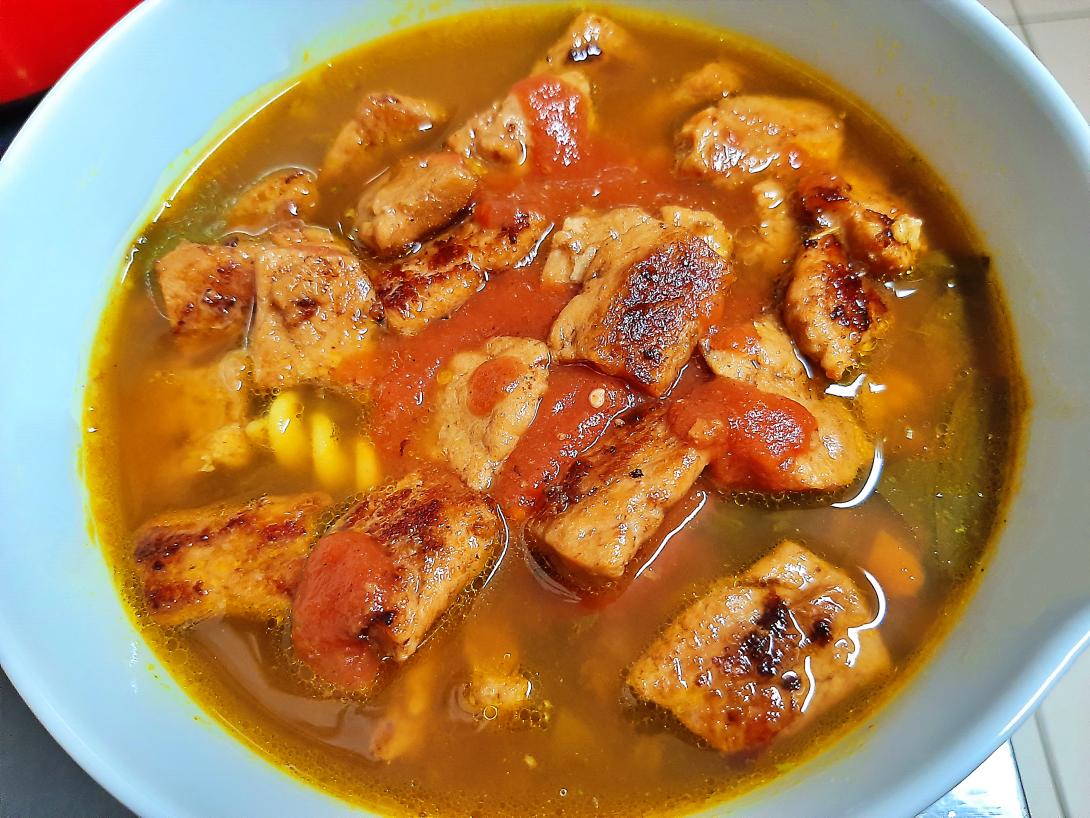
Before one of these visits, my Boss asked if I could make thukpa for the first day’s dinner, as Rinpoche really enjoys traditional, classic Tibetan soup.
INGREDIENTS:
– 1 bell pepper
– 1 large onion
– 250 g mushrooms
– 500 g frozen spinach
– 2 carrots (about 200 g)
– 1 large clove of garlic
– 1/2 tsp ground ginger
– 2 tsp turmeric
– 4–5 tbsp soy sauce
– Optional: fresh chili
– Broth
– 200 g penne pasta
INSTRUCTIONS:
1. Cut the bell pepper into strips.
2. Slice the onion and mushrooms.
3. Grate the carrot coarsely or cut it into thin matchsticks.
4. Finely chop or crush the garlic. Remember to let chopped garlic sit for at least 5 minutes to activate its full health benefits.
5. Heat oil in a heavy-bottomed pot and add ginger and turmeric. Sauté for about a minute or two over very low heat, stirring.
6. Add the garlic and continue to sauté briefly. Be careful not to burn the garlic, as it becomes bitter.
7. Add the carrot, onion, bell pepper, and mushrooms, and sauté for a few minutes until they start to soften.
8. Add the spinach, mix well, and cover, letting everything simmer in a small amount of liquid for a few minutes.
9. Add the broth/water mix, about 2 liters. I used 1500 ml of strong broth and 500 ml of water. A rich, intense broth is crucial for this soup.
10. Simmer over low heat until the vegetables are tender.
11. Cook the penne pasta separately until al dente. Drain and add it, still slightly wet, directly into the soup. The starch from the water affects the soup’s texture and flavor.
VARIATIONS:
In the original recipe, cabbage was used, but since I didn’t have any, I substituted spinach. I knew spinach was sometimes used in thukpa, and it worked well — Rinpoche even requested thukpa every day, so I guess my version got an Imprimatur.
NOTES:
– This soup must be made with a good broth. If it’s really strong, you can dilute it with water.
– Adding the pasta unwashed and still slightly wet is important. The starch influences the soup’s consistency and taste.
SERVING:
Serve immediately after preparation. You can also prepare the soup and pasta separately and combine them just before serving. If left together for hours, the pasta will swell and become mushy.
In the original recipe, the Master suggested serving the soup with a spoonful of spicy fresh tomato salsa, like this
Well-seared pieces of vegan protein, like pea protein chunks, also work well. Pickled chili peppers, sliced garlic, or ginger are great additions too. The cuisine of this region is all about vegetables: garlic, ginger, and chili.
Of course, as with any classic dish, there are countless recipes, each wildly different. Who knows which one is “correct”? Most likely, there are many, since it’s a traditional, popular Tibetan soup — like tomato soup in Poland or potato salad in Germany. There are as many versions as there are families who make it.
And there’s always the question of which version is closest to the one made by our distinguished guest’s grandmother. My experience? Use a recipe from a good chef as a starting point. I used a recipe from Ajay Chopra, a chef from Mumbai who, after a quick search, I discovered is one of the better chefs in India. And India, with a population larger than the EU and the USA combined, has an incredible culinary heritage.
My challenge, as usual, was geography. I live and work 6 km from the nearest town and shop. I can’t just pop around the corner to buy ingredients. I had to modify the Indian chef’s recipe using what I had. Since I knew spinach was sometimes used in thukpa, I replaced the cabbage from the original recipe. It worked out well, as Rinpoche kept asking for more thukpa.
Thukpa is an interesting topic. In Tibet, very little grows due to the harsh mountain climate, aside from barley, so the diet relies heavily on yaks — meat, milk, and its products. Yak butter is a key element in Tibetan tea, which resembles European broths more than typical teas: a tea broth with plenty of butter and spices, serving as a crucial source of calories in the traditional Tibetan diet.
Occupation, modernization, and globalization have also influenced the Tibetan diet, even for those who remain in their occupied homeland. Contrary to common Western belief, Buddhism doesn’t automatically mean vegetarianism. In ancient Tibet, where there wasn’t much else to eat besides yak meat, vegetarianism wasn’t realistic for begging monks, who ate whatever they were given (monks aren’t allowed to accept money), or for ordinary, hardworking farmers exposed to the cold and damp. Buddhism (something I personally appreciate) is pragmatic and goal-oriented, rather than doctrinally rigid or puritanical. The dharmic approach fits well with Jesus’ words: “It is not the healthy who need a doctor, but the sick.”
Whether it’s about diet, alcohol and other drugs, or sex, you don’t have to be perfect to meditate. Of course, if you’re a drunkard and a libertine, it will be more difficult, as your behavior scatters and weakens your mind (not because God dislikes it or it’s immoral — who the hell decides what’s moral? It often seems like those privileged fat cats who have no clue about how we, living at the bottom, survive). But it’s better to drink, carouse, and meditate than not to meditate at all. So there’s hope for everyone, even for a rogue and scoundrel like me. Especially if I’m a good cook.
Did you like this text? Do you want more similar ones? Support my blog
The kitchen is my space for lifestyle medicine.
I'm not a dietitian or a doctor – I'm a chef, and a member of the Polish Society of Lifestyle Medicine. Nutrition is essential to a modern kitchen, and that's nothing new: working from Hippocratic dietetic principles was part of a cook's craft centuries ago. At Rude Kitchen I tie that tradition to modern science — and to lifestyle. Read more about how I bring cooking and lifestyle medicine together on the About page.