
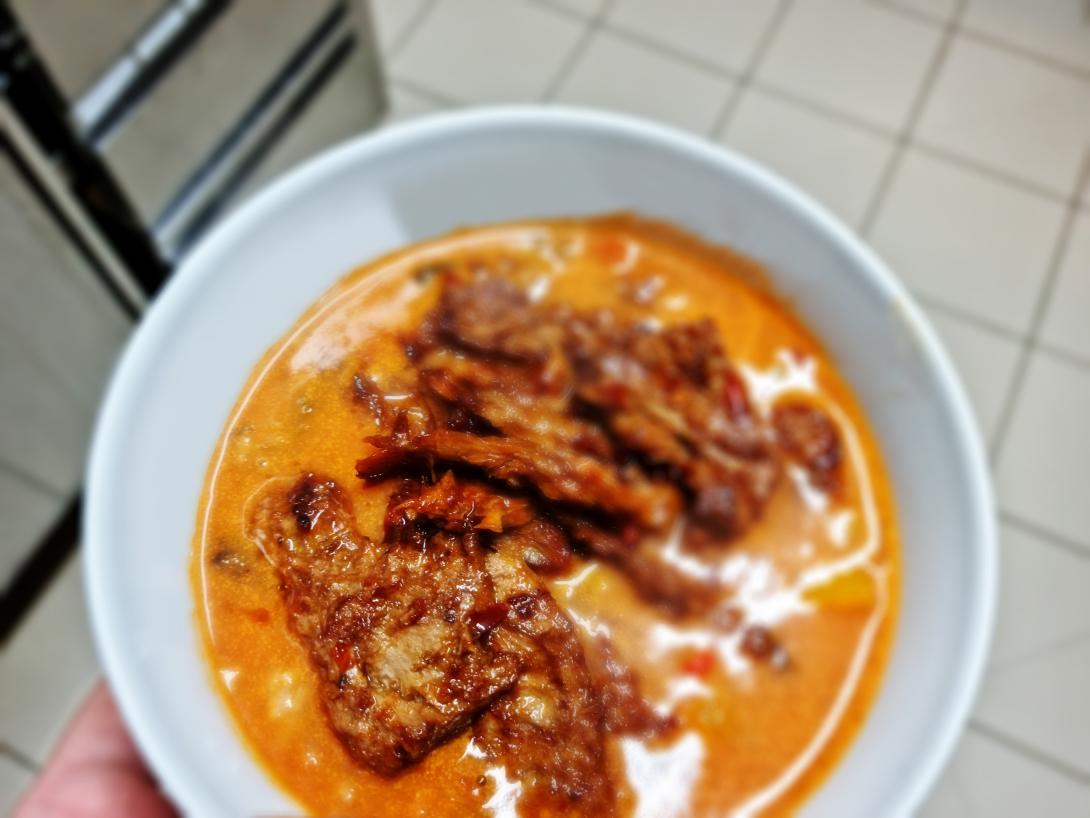
Are you familiar with soups with a regenerative insert?
The regenerative insert, also referred to as the meat insert, was somewhat of a symbol of significant changes that took place in the way Poles ate after World War II, as well as the shortcomings of those changes.
When I have a lot of work, my eating habits are also not quite on point. Well, it’s not a balanced diet, definitely lacking in protein for such heavy work. So, I’ve put together a soup here, mostly from leftovers, to which I’ve added ingredients with a high protein content, like hemp and sunflower seeds. I’ve also enriched it with pieces of texturized soy, which serve a similar role to the meat insert in the soups from the past that were served to workers in canteens.
**INGREDIENTS:**
– 2 bell peppers (300 g) (preferably in two colors)
– 2 onions (150 g)
– 3 stalks of celery
– 50 g whole hemp seeds
– 50 g sunflower seeds
– 1 tablespoon balsamic cream
– 30 g black cumin oil (or other oil)
– Can of chickpeas (or equivalent amount of cooked)
– Can of red beans (or equivalent amount of cooked)
– 1 liter vegetable juice
– 1 can of diced tomatoes
– 1 liter oat and almond milk
– Optional fresh chili
– 150-200 g cooked rice
– Fresh herbs
**Texturized Soy:**
– Texturized soy in the form of cutlets, medallions, or rectangular steaks (best option)
– Soy sauce
– Spices
– Marinade ingredients of choice:
– Sweetener
– Balsamic cream
– Miso
– Marmite
– Mustard
– Spices
**PREPARATION:**
– Remove seeds from bell peppers and dice them.
– Wash celery stalks but don’t peel them. Cut into half-moons.
– Chop the onions into small pieces.
– Roast hemp and sunflower seeds together in a pan until the sunflower seeds start to turn a light brown color and a distinct aroma appears.
– Add a tablespoon of balsamic cream to the seeds, mix, and transfer to a bowl. A Maillard reaction aroma will develop in a few minutes (similar to the crust on roasted meat or bread).
– Drain the chickpeas and red beans (you can use the drained liquid to make mayonnaise).
– Heat black cumin oil in a pan and sauté the onions until they turn yellow. Gradually add celery and bell peppers so as not to lower the pan’s temperature and allow the vegetables to fry crisply.
– Transfer the sautéed vegetables to a heated pot, add chickpeas, red beans, vegetable juice, tomatoes, milk, and bring to a simmer over low heat. Add seeds and chopped chili. Add herbs, remove from heat, and add rice. Mix.
**VARIATIONS:**
– I used Edeka’s vegetable juice, which is excellent as a base for sauces or soups, but it’s not available in Poland. Many other vegetable juices will work equally well. The soup will differ depending on the juice used.
– You could try a version with tomato juice or passata.
– Black cumin oil adds a distinct aroma; if it’s not to your liking, you can use a different oil or olive oil.
– I used a mix of oat and almond milk because that’s what I had open. Of course, you can use different milk alternatives like almond or cashew milk, which often have a creamier consistency than soy or oat milk.
– You can use freshly diced tomatoes, but in that case, add them after sautéing the celery and peppers and simmer until softened.
**Insert:**
– Prepare texturized soy, marinate it in soy sauce and spices, and let it cool after boiling.
– Squeeze slightly, cut into strips, and tear rectangular steaks.
– Prepare a marinade for frying. It’s important to include sugar in it for the Maillard reaction and caramelization. So, from white sugar through Demerara, agave or maple syrups, to apple syrup and various homemade syrups.
– An umami ingredient is needed, like soy sauce, marmite, miso.
– Add spices, similar to those in the first marinade. Basic ones, giving a “meaty” flavor, include nutmeg, smoked paprika, and juniper. This will give the texturized soy a Polish taste. You could also season it in an Arabic style with sumac, cinnamon, and cumin (like for kebabs).
– Marinate the pieces of texturized soy. The marinade should be thick and coat the soy.
– Heat oil in a pan. Place individually marinated pieces of texturized soy. Fry on both sides until the marinade forms a crispy skin.
– **NOTE:** It may splatter during frying.
**NOTES:**
– Everyone (or almost everyone) insists on peeling celery. If it makes sense where raw celery is used, the peel becomes quite soft when cooked.
**SERVING:**
– Serve the soup with bread, croutons/toasts. Garnish with fresh herbs or a spoon of yogurt on top. And of course, the insert.
– Pour the soup into bowls, place the fried hot strips of texturized soy on top.
According to the official ministerial instruction, “soup with an insert” was a “one-dish, high-calorie hot meal provided during breaks directly at the workplace.” In practice, these were usually departmental canteens. This meal was meant to provide 700 to 1000 calories and be consumed in a way that minimally disrupted the production process.
The insert in the soup was closely connected to the dietary model promoted in the People’s Republic of Poland (PRL) and collective dining. Large workplaces had their own large gastronomic departments, and even families of employees could benefit from subscription-based meals.
In the 1960s, employees of the Gdańsk Lenin Shipyard had access to 3 canteens, 6 bars, 8 buffets, a barobus, two meal distribution points within departments, and 7 grocery kiosks. Employees of Nowa Huta had access to 9 canteens, 14 bars, 20 grocery kiosks, a casino (yes!), and a cafe.
In the 1980s (and perhaps earlier), there was also outsourcing in the food industry. Companies purchased meal subscriptions for employees and their families in nearby eateries, lower-grade restaurants, what we would now call fast-casual establishments.
Many large companies also had their own supplementary agricultural and food production farms. This is the origin of the “insert.” In the PRL era, a major civilizational change occurred in the way Poles ate. This change wouldn’t have happened without collective dining, heavily inspired by the Soviet Union.
Collective dining, especially employee canteens, was where most Poles started eating meat regularly. What’s more important, they started eating to their fill. A breaded pork chop, often with an egg, a simplified relative of Wiener schnitzel, was the
most sophisticated dish they had ever tasted.
Even the not-so-glorious PRL revolution was devoured by its own offspring. The success of changing Polish diets led to an increased appetite for animal products, especially meat. This surge in demand caused shortages of meat, but it also highlighted the inadequacies of the collectivization and urbanization of society. Meat shortages became a major
Did you like this text? Do you want more similar ones? Support my blog
The kitchen is my space for lifestyle medicine.
I'm not a dietitian or a doctor – I'm a chef, and a member of the Polish Society of Lifestyle Medicine. Nutrition is essential to a modern kitchen, and that's nothing new: working from Hippocratic dietetic principles was part of a cook's craft centuries ago. At Rude Kitchen I tie that tradition to modern science — and to lifestyle. Read more about how I bring cooking and lifestyle medicine together on the About page.