
Hazelnuts aren’t exactly a staple in daily diets, likely due to their cost. In Germany, hazelnuts are nearly twice as expensive as cashews. Yet, they were once a typical product in traditional folk kitchens.
Labor used to be cheap and available, especially for light tasks like gathering berries, mushrooms, herbs, and nuts — tasks even children could do.
I found myself with several kilograms of hazelnuts: flour, chopped, and whole. Mostly flour — 2.5 kg. All with a short shelf life. So, I’m getting creative.
INGREDIENTS:
– 1 ripe (browned) banana (approx. 80 g)
– 2 tablespoons ground flaxseed
– 100 g passata
– 250 g hazelnut flour
– Whatever you have on hand for the topping
– A baking dish measuring 25 × 15 cm
– Smoked salt
– Black pepper
– Nutmeg
– Ground juniper berries
PREPARATION:
1. Pour four tablespoons of water over the flaxseed and set aside to cool. It’s important not to add too much water; otherwise, you won’t get the right “gooey” effect that replaces the egg.
2. Mash the banana with a fork.
3. Mix the banana with the flaxseed.
4. Combine the passata, hazelnut flour, flaxseed-banana mixture, and spices. Mix thoroughly and knead the dough.
5. Add your chosen toppings and gently press them into the dough.
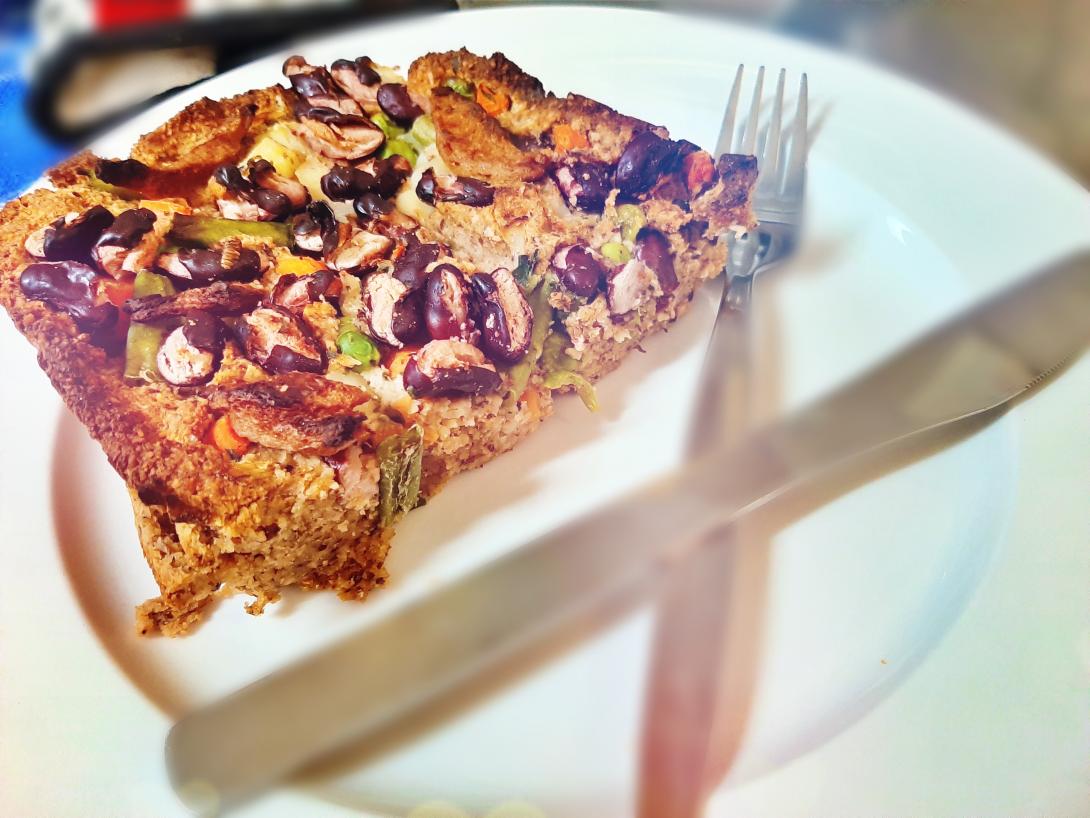
For my casserole, I used leftover mixed frozen vegetables, pieces of tofu, and some canned red beans that I had opened the day before.
6. Bake at 220°C for 20–30 minutes.
VARIATIONS:
Feel free to experiment with different toppings for this casserole. Any leftovers or slightly wilted vegetables work perfectly.
You can substitute smoked salt with smoked paprika. Generally, you can use any spice blend you like. This particular combination leans towards “gamey” or roasted flavors, which I’ve been enjoying lately.
NOTES:
This casserole is highly caloric and contains a lot of fat so that I wouldn’t recommend it for everyday meals. Instead, it’s better suited as a recovery meal after intense exercise or a long hike. In addition to fats and calories, it also contains a good amount of protein, especially if you include toppings like tofu or red beans.
SERVING:
Best served cold, with a spicy sauce and fresh or pickled vegetables. It yields two large or four small portions. Ideally, you’d serve it in four portions along with some starch, like potatoes or groats, which aligns with Polish folk tradition. Steamed or boiled vegetables would make a good low-calorie side dish.
Given its high caloric content, it’s better to pair the casserole with low-calorie sides. For example, boiled potatoes rather than fries, and steamed vegetables rather than fried. The same applies to sauces — opt for low-calorie, spicy, or yogurt-based sauces. Stay away from mayonnaise or vinaigrettes.
NUTRITIONAL INFORMATION:
One casserole (without sides) contains 1,900 kcal, along with 40 g of protein and 13 g of fiber — one of the most important nutrients for our health — plus other beneficial components like potassium and arginine.
It’s interesting to note how such valuable foods as nuts have largely disappeared from our diet. I doubt that price is the only reason.
Rather, the cost is a symptom of the same social processes that led to the disappearance of gathering — a relic of primitive societies — as a significant branch of the household economy that strengthened the position of women.
But it wasn’t a male conspiracy against women; it was the same mechanism that led to the disappearance of wild manna from our diet when the cost of labor increased, and food became more accessible and abundant, leading to further labor division and specialization.
Even in the few decades of my life, I’ve noticed how more and more household work has become externalized and commodified (which is both a cause and consequence).
I still remember my mother making homemade pasta when I was a child. But by the time I was a teenager (and started cooking myself), store-bought pasta had become the norm.
The popularity of ready-made food isn’t just about convenience and the lower cost of prepared food (even partially prepared, like pasta) compared to the labor required to make it yourself. It’s also the reverse effect — the more and harder someone works, the more they need ready-made products. We pay for outsourcing household labor with our own labor, which allows us to buy external labor.
This isn’t just about cooking, but also various household tasks, repairs, sewing, and more.
In fact, this process is a natural and obvious consequence of the development of production relations and the increasing wealth of society. After all, whether it’s cooking, cleaning, sewing, or raising children, the wealthiest families have always purchased these services. Today, a large part of society can afford them, to varying degrees.
Conversely, sewing your clothes, baking your bread, or cleaning according to the KonMari method instead of hiring a cleaner, have become signs that you can afford it, that you have the time (much like in the sci-fi movie “In Time,” in a culture of excess time is the most critical resource, ), a class privilege.
If edible manna were to return today, it would be a luxury product, surpassing all trendy foods like quinoa. Manna can’t be cultivated; its harvest is long and laborious, yielding very small crops per hectare. When a poor person could send five kids to gather it for free, it was the food of the poor. Today, such a product would be very expensive and luxurious.
Cuisine changes with the development of production methods and the resulting changes in social relations. The entire history of food is the class history of the society that eats it. And the society that cooks it.
Did you like this text? Do you want more similar ones? Support my blog
The kitchen is my space for lifestyle medicine.
I'm not a dietitian or a doctor – I'm a chef, and a member of the Polish Society of Lifestyle Medicine. Nutrition is essential to a modern kitchen, and that's nothing new: working from Hippocratic dietetic principles was part of a cook's craft centuries ago. At Rude Kitchen I tie that tradition to modern science — and to lifestyle. Read more about how I bring cooking and lifestyle medicine together on the About page.