The Easter Menu is part of my project “The Ritual Year,” dedicated to food and culinary customs connected to the traditional ceremonial yearly cycle.
Designing a Christmas Eve menu has been great fun for me for years. Christmas Eve is a fasting meal, and a properly strict one, at least in the most orthodox version—meaning not only without meat and sausages but also without eggs, butter, or cream.
Yes, my dears. If someone adds egg-based mayo to a Christmas Eve salad, it’s a sin!
But Easter is different.
Here the table’s center is all about eggs and every kind of meat. A time of feasting after the hunger of early spring.
And there were few vegetables, because almost nothing had grown yet. From my childhood I remember radishes—when they appeared in spring it was a great joy. And they were one of the first spring vegetables on the Easter table.
Radish is particularly interesting because it’s a short-day plant that forms a root only for a short period—when the night is long, the day is short, and it’s warm enough—so for 1–2 months in spring and fall. That’s how it was… Now it’s totally different, and this shows how our culinary customs and habits change like everything else in society, along with the development of production tools.
“New season” vegetables have basically disappeared, and even the word itself is no longer used. In Morocco or Chile, after all, vegetable season lasts all year.
The egg at Easter carries not only culinary significance, but symbolic and magical meaning too. Which makes designing an appropriate plant-based Easter menu more complex.
So the approach has to be different from the Christmas Eve menu. With more humor, playfulness, postmodern winks and playing with convention and symbolism.
Though of course, references to heavy, meaty, fatty Easter flavors must still be there.
—
Eggs
I’ve written about this many times and will probably return to it again, because it’s one of those aspects of culinary tradition that fascinate me.
That is—culinary illusions. Developed especially during the Baroque period in Polish cuisine, when forbidden foods during fasting—like meat and sausages—were replaced by ham or sausage made from fish, and cheese was replaced with almond “cheese.”
And in this tradition, something like an egg made from tofu or a sweet coconut milk egg fits perfectly. With a “yolk” or kogel-mogel made from sweet potato and pumpkin.
1. The key issue is the right mold.
You can buy special molds for cooking eggs without shells, which are perfect for this.
Though of course, you can make rectangular eggs—why not? If you want to use vegan eggs for vegetable salad and dice them, rectangles might even be better.
2. The egg flavor is achieved by adding Kala Namak black salt.
3. To set the runny egg-like mixture, we use agar, a gelling agent made from seaweed. Notably—it’s labeled E 460. I wrote recently about this fear of ingredients marked with the letter E. This is another completely natural substance with such a label.
Things to keep in mind when using agar:
– Proportions. Agar is a stronger gelling agent than gelatin. Different types of agar vary, and it’s good to remember that. In my recipes, the proportions follow the package instructions—always check the instructions when using agar.
– If working not with clear water, juice or broth, but with blended tofu, for example, you’ll need to add a bit more agar.
– A big advantage of agar is its reversibility. After cooling and setting, you can reheat and melt it again over low heat, and it will set once more when cooled. So if your jelly turns out too soft or too hard—no disaster. You can reheat, adjust, and redo it.
But agar isn’t everything when making a good egg illusion. To achieve both flavor and nutritional value, we should add fat and protein. Tofu provides protein. For fat, the best is plant-based cream.
And the same idea works for dessert eggs. Based on coconut milk (fat) and soft tofu (e.g., silken tofu).
The yolk is needed, and I have several versions of it—from a classic firm chickpea-based “hard-boiled” yolk, to a soft yolk sauce and this year’s kogel-mogel-style sauce from pumpkin and sweet potato.
Here’s an older recipe for tofu eggs:
—
Sausages, Meats, Cold Cuts
After eggs, these are the most important element of the Easter table.
And honestly, these days there’s no problem replacing sausages, cold cuts, or even roasts with plant-based products. The market has more and more of them—and of higher and higher quality, both in taste and ingredients. I stopped following and testing them a while ago—the selection is so big it’s hard to keep up.
But of course, you can prepare your own homemade plant-based specialties.
Here are a few I’ve prepared:
Seitan (not to be confused with Satan) is a wheat-based product used in Asian cooking for about 1,500 years. It comes from China and is technically pure wheat gluten. Gluten is made by washing starch out of flour. You get a sticky, stretchy product that’s later cooked.
Seitan is also sold in powdered form—ideal for the kitchen.
You can add spices or flours—personally I prefer high-protein flours like hemp or lupin.
Also important is adding umami-rich ingredients—like tomato products (this year I used sun-dried tomatoes in my seitan, which worked great) or soy sauce. And of course, a flavor carrier—oil. This year I used tomato oil, also a source of umami.
3. Vegan “meat” in puff pastry
TVP (Textured Vegetable Protein) is my favorite plant-based meat alternative. The oldest such product from the West, now very underrated.
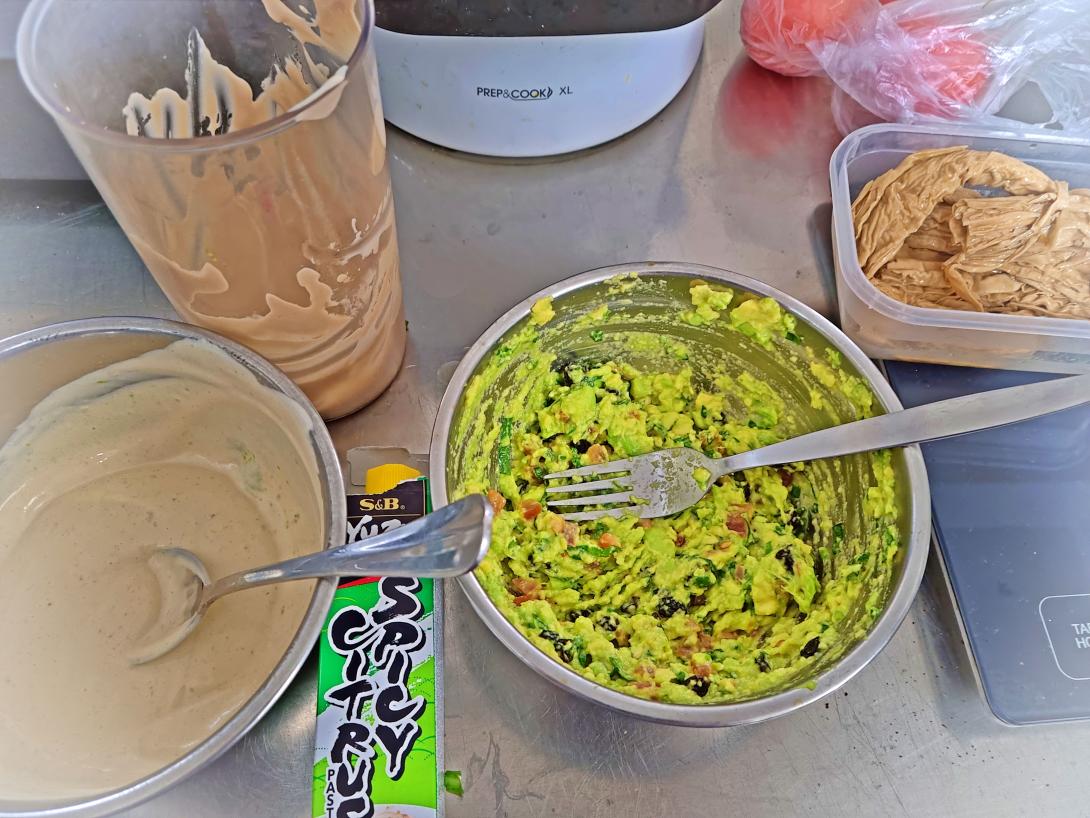
Yuba is another Asian product, made as a by-product of tofu production. Simply put—it’s dried “skin” from boiling soy milk.
Soups
Typical Easter soups are white borscht or sour rye soup. Which is funny, because in earlier times, if someone served sour rye soup for Easter, they’d be beaten up and buried with it—according to the tradition of the “funeral of sour rye soup and herring.”
Sour rye and herring were essential parts of the fasting diet.
Traditionally (though this is rarely followed today), sour rye soup and borscht were fasting soups based on flour ferment (rye for sour rye soup, wheat for white borscht) or vegetables (e.g., beet borscht). The fermentation process adds umami, which meat normally provides.
I went with another traditional soup from Małopolska—krzonówka (now usually called chrzanówka). Sułkowicka krzonówka is on the official list of traditional Polish products.
—
Salads
Salads are a Polish specialty for parties and holidays.
Whether the classic vegetable salad (also known as Olivier salad, from its creator, a Russo-French chef in Moscow’s Hermitage restaurant around 1860), or any wild ideas your mind cooks up.
Salads are similar in nature to soups—you chop everything, mix, and add something like mayo. Soups are the same, except you add water and cook.
—
**Horseradish and Greens**
Horseradish is a staple of the Polish Easter table. One of the best condiments ever. Solo, with cream, apples, mayo, cranberry, hot or cold, with beets, with apples. Plus—it kills bacteria, fungi, and viruses!
It can compete with Japanese wasabi, which I use almost interchangeably. The color matters—green fits Easter beautifully.
Same with wild garlic, which is in season just before Easter. Its sharpness is milder but flavorful.
The green color is important on the Easter table symbolically too. So here’s a suggestion for wild garlic pesto:
—
Sauces
Wild garlic is a key ingredient in green sauces. For me, green was always a symbol of Easter—when the world turns green again.
Colorful mayo sauces (careful! obesity kills), mayo-yogurt sauces (highly recommended—just as tasty when well-seasoned and your body will thank you), spicy yogurt sauces, tartar sauce, Thousand Island, horseradish or wasabi.
This year I also made sauces with wild garlic and less mayo.
Mayo is key in sauces (and salads) for its fat content. Fat is a flavor carrier—it’s a basic rule of delicious cooking. Fat also adds smoothness, that creamy texture.
So while limiting fat in your diet is good and necessary, it must be done wisely, with an awareness of its culinary and taste consequences.
Instead of cutting out all fats—as in various dumb “miracle diets” everyone quickly abandons—cut down and compensate with more spices to get the same eating pleasure. In sauces and salads, half-mayo, half-yogurt works great.
Desserts
Polish Easter means a mountain of cakes and sweets—as if carnival has finally defeated Lent, and those who live rejoice for surviving another winter.
Given the harsh winters and difficult conditions of just a few centuries ago—even just a hundred years back—that was cause for joy, celebration, and fun.
Here I’ve prepared one original cake of mine and a suggestion to use it for Easter dessert, plus a few ideas using sweet agar-based eggs.
You can support my work on *The Ritual Year* project by leaving a tip.
Preparing these recipes is not just time and effort—much more goes into it than what you see. Most recipes take many trials and tests, and also cost money, sometimes for pricey ingredients.
You can support my work on *The Ritual Year* project by leaving a tip.
Your support will encourage me to keep working.

The kitchen is my space for lifestyle medicine.
I'm not a dietitian or a doctor – I'm a chef, and a member of the Polish Society of Lifestyle Medicine. Nutrition is essential to a modern kitchen, and that's nothing new: working from Hippocratic dietetic principles was part of a cook's craft centuries ago. At Rude Kitchen I tie that tradition to modern science — and to lifestyle. Read more about how I bring cooking and lifestyle medicine together on the About page.