I was inspired by a Christian friend who shared my recipe for a vegetarian dinner he made on a Friday. And I thought it made sense. To share a recipe for a ‘vegetarian dish’ on Fridays. Generally, any 100% plant-based meal is 100% vegetarian.
My first suggestion is for vegetarian French toast with leftover toppings.
In the ancient, very strict fasting of Eastern Europe, besides meat, eggs, and dairy were also excluded. So, permitted were fish and… beavers. And why mention the recipe for vegetarian French toast with suggested toppings? It’s also an excellent leftover dish. Most often wasted, especially in households, is bread. French toast is a perfect way to use stale bread with other leftovers.
INGREDIENTS:
Broth (optional)/water 150 ml + 30 ml
Chickpea flour 100 g
Black salt 1/2–1 teaspoon
Ground flaxseed 1 tablespoon (10 g) (optional)
Hulled hemp seed 30 g (optional)
Rapeseed oil 3 tablespoons (30 g)
PREPARATION:
Soak flaxseed in 3 tablespoons of water, mix well, and let it sit for about 5 minutes to thicken.
Gradually add chickpea flour to the broth (see variations), stirring, preferably with a whisk.
Mix until you achieve a smooth batter, similar in consistency, possibly slightly thinner than an egg. Add flaxseed, mix thoroughly until smooth. Add hemp seeds and mix.
Dip bread slices in the batter on both sides and fry on both sides in a well-heated pan with oil.
VARIATIONS:
Instead of broth, you can use water or plant-based milk, preferably soy. You can also add nutritional yeast or any desired seasoning.
NOTES:
I used mainly what was left after the last event for this entire dish. That’s why, for example, I used about 1.5 liters of broth that was left.
The addition of hemp is not necessary, but it adds proteins and unsaturated fatty acids.
It’s essential for the oil in the pan to be really hot. This way, the toast will absorb less oil.
I made this for six slices of sandwich bread.
SERVING SUGGESTIONS:
As I mentioned earlier, it’s an excellent leftover dish. I mainly used leftovers from the last event.
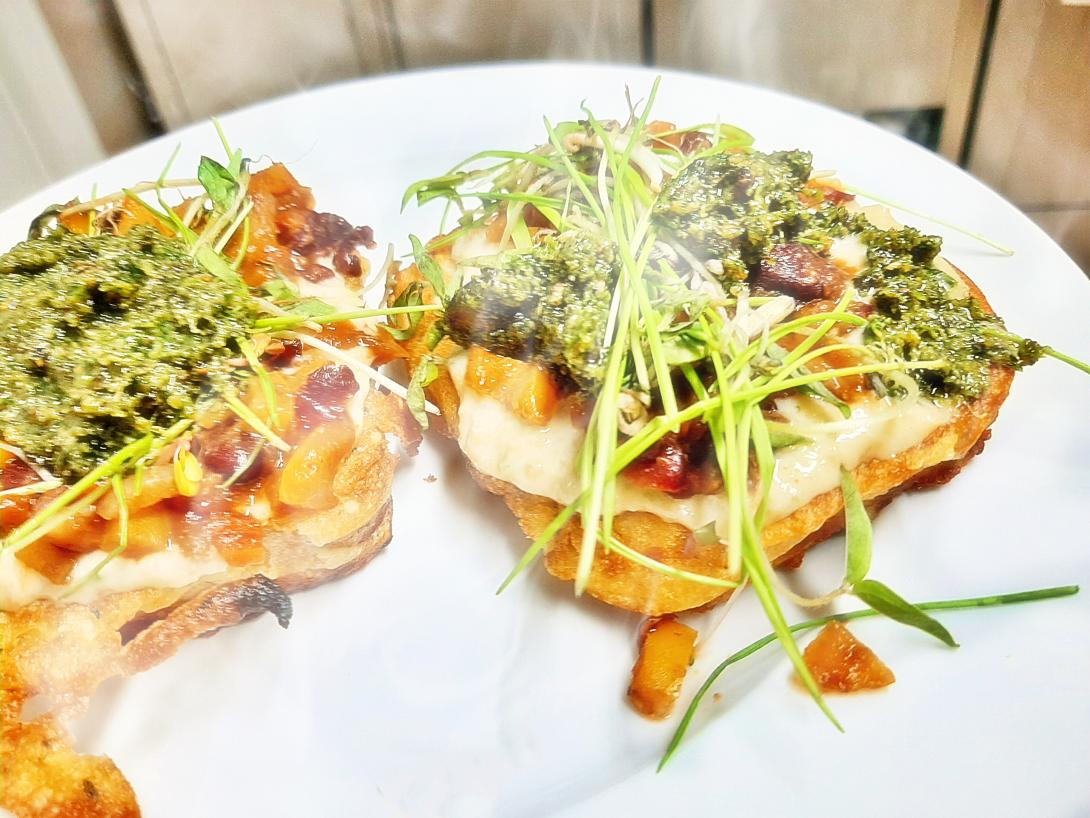
Onions, red beans, tomatoes, and peppers in the pan. Seasoned with balsamic cream, soy sauce, and/or Worcestershire sauce. Reduced and caramelized.
Homemade mayonnaise with aquafaba (the best, but store-bought works), yogurt (I used homemade sunflower-buckwheat yogurt), and a wilted cucumber.
A bit of sprouts.
Various fresh or pickled items will go well.
Leftover parsley and radish pesto with pumpkin seeds and hemp seeds.
The rules of the old Christian fast were based on Hippocrates’ humoral dietetics. The aim of the fasting diet was to restrain and cool down aroused carnal desires, and according to Hippocrates, meat and animal products had a stimulating effect.
Except for fish and other aquatic creatures, as they all had a cooling nature. Cooling down carnal desires allowed focusing on God.
It’s tempting to discuss whether such a fasting formula makes sense in modern times and whether, like many other Church teachings, it’s time to revise it. But it’s not for me to get smart here.
Personally, I love the fasting tradition because it gives me a lot of culinary inspiration. And it’s from the kitchen that interests me the most — folk-class cuisine.
The fasting cuisine is a bit not just a religious tradition but also cucina povera; it was the kitchen of the poor, the peasantry, the overwhelming part of society. Kitchen and diet have a class character. Like everything else.
And also, there’s no obligation to know, so I’ll write it.
Never was this Christian tradition close to me. Nor any other, except for Christmas, or rather, the Christmas Eve supper itself. But also, not experienced religiously. My religious attitude has changed from atheism through various, sometimes strange sects, to Buddhism.
Due to upbringing, faith, and place of residence, I look at Christian traditions and the traditional Polish ritual year a bit from the outside. Incidentally, my therapist made me realize that by living here in a Buddhist center, I’ve chosen another form of being outside society, being an outcast.
And Christianity in general, nor Catholicism in particular, was never part of my spiritual path.
Well, maybe besides ‘Cloud of Unknowing’ by Anonymous from Asia. In many other works or figures of Christianity, I found many valuable inspirations. Spiritual and culinary.
Not that there’s any special difference between these two fields.
Entre los pucheros anda el Señor, literally translating to ‘Among the pots walks the Lord,’ a saying by St. Teresa of Avila, a great mystic and saint of the Catholic Church.
I came across this saying browsing Twitter, and it seems to fit Advent when many people spend time in the kitchen preparing holiday dishes.
It’s easy to forget, amidst the kitchen hustle, why we do it. I know from experience. It’s hardest to remain in a state of grace when you have to wash dishes. Who likes doing the dishes?
Ken Wilber. Ken Wilber, while doing the dishes, organized his concepts and books in his head. He’s a bit on the other spiritual pole compared to St. Teresa of Avila. But his ‘Grace and Grit” is also an extraordinary testament to the human spirit.
And it’s precisely Wilbur who showed spiritual experience a bit like a culinary recipe. Buddhist teachers have been writing such meditation instructions for millennia.
Sometimes these instructions are very precisely described and detailed by minutes, the number of breaths, mantra repetitions. But also outlined only broadly like: ‘maintain unwavering presence while chopping onions (okay, that bit about onions is from me), whatever you do.’ Even if you accidentally touch the hot door of a convection-steam oven heated to 250°C. What you scream then isn’t ALLELUIA!!! or OMMMMMM…
So spontaneously, this idea came out during Advent, a period where fasting also takes on special meaning (as far as I’m able to understand something from Christian spirituality). My experience, more culinary and professional than spiritual, is that our intention matters significantly.
Why do I cook? Why do I eat? Does what I cook serve others or harm them?
Today, that serving and harming take on a radically different and broader meaning. I live 300 meters from a reserve, about 1 kilometer from another; I often walk in these forests and see from year to year how there’s increasingly less water, how there are more irrigation systems in fields.
And so, I think that if the Lord walks among pots, He blesses everything in the kitchen and pantry, and every piece of bread is a relic… and at the same time, it’s a Living Buddha. And I believe it’s worth celebrating fasting in the kitchen
Did you like this text? Do you want more similar ones? Support my blog
The kitchen is my space for lifestyle medicine.
I'm not a dietitian or a doctor – I'm a chef, and a member of the Polish Society of Lifestyle Medicine. Nutrition is essential to a modern kitchen, and that's nothing new: working from Hippocratic dietetic principles was part of a cook's craft centuries ago. At Rude Kitchen I tie that tradition to modern science — and to lifestyle. Read more about how I bring cooking and lifestyle medicine together on the About page.