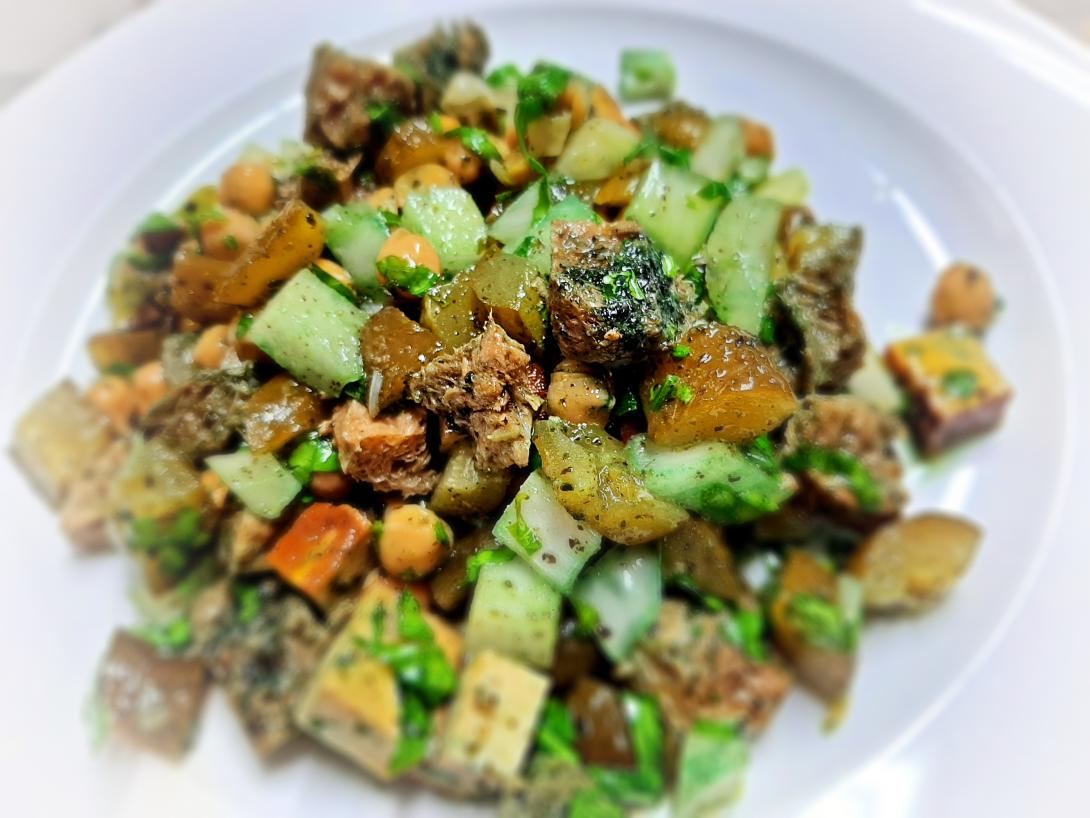
Gryfny Shalad for Advent. That’s about the extent of my Silesian, which is barely better than my German. These languages are very much relevant here because *Hekele* is a Silesian Advent salad, sometimes also served on Christmas Eve. And Silesia is one of the most fascinating corners of Europe. Situated between Poland, the Czech Republic, and Germany, it has created a unique blend of these three cultures, languages, and cuisines, while maintaining its own distinct Silesian character, specific culture, and language.
Hekele is a Silesian salad, or sometimes *Brotaufstrich*, as the Germans call it—a spread for bread, more suited for Advent than Christmas Eve.
It’s made simply, quickly, using cheap, readily available ingredients. It can either be diced into a large-chunk salad for speed or finely chopped—or even ground—into a sandwich paste.
INGREDIENTS:
Seaweed mix
- 5 g of bladderwrack
- 5 g of nori
- 5 g of wakame
- 10 g of spirulina
Soy cutlets
- **Marinade for the cutlets:
- 1 liter of water or broth
- 1 tbsp *cremo balsamico
- 2 sheets of nori
- 2–3 tbsp of strong soy sauce
-4 soy cutlets
- 100 g smoked tofu
- 100 g chickpeas (canned or cooked al dente)
- 50 ml mustard oil (or oil made from mustard seeds)
- ½–1 tsp black salt
- 1 large onion (~150 g)
- 4–5 pickled cucumbers (~300 g)
- 1 bunch of fresh parsley
- 1–2 tbsp lemon juice
PREPARATION:
1. Boil the soy cutlets in water with soy sauce and nori, and remove as soon as the water begins to boil.
Caution: The addition of soy sauce causes the water to boil violently.
Set aside to cool completely, ideally overnight.
2. Prepare the “seaweed mix”:
Grind the nori, wakame, and bladderwrack together, then mix with spirulina.
3. Dice the tofu, pickles, and onion into fairly large cubes.
4. Chop the parsley.
5. Sauté the chickpeas and tofu in mustard oil with black salt until the salt begins to emit an intense egg-like aroma, then set aside to cool.
6. Lightly squeeze the soy cutlets from the marinade and slice them into strips 0.5–1 cm wide.
7. Mix the soy cutlets with chickpeas and tofu (along with the oil), pickles, and onion in a bowl. Add 2 tsp of the seaweed mix, lemon juice, parsley, and season with salt and mustard as needed.
VARIATIONS:
- The tofu in this recipe can be smoked (as I used), plain, or marinated. If you want a very authentic herring-like taste, marinate the tofu in brine with seaweed—I plan to try this myself, though I’ll need to go to Harburg for good tofu.
- It’s best to replace mustard oil with flaxseed oil and add a tablespoon of mustard.
- For the seaweed mix, use any seaweed you have on hand; nori is the easiest and most widely available, so you can simply grind nori sheets.
NOTES:
- It’s worth preparing extra soy cutlets and keeping them in the marinade in the fridge. They’ll stay good for up to a week.
- Similarly, prepare more seaweed mix to use in other “fish-free” or “marine” dishes.
- You can buy mustard oil online or in some Asian shops—I found mine in Harburg. You can also substitute mustard oil with flaxseed oil or even a standard oil, or skip the oil and add 2–3 tbsp of mayonnaise and some mustard to the salad—it’ll still taste great.
- The 2–3 tbsp measure applies to strong, concentrated soy sauce. If yours is lighter or more diluted, use more. You can also add a spoonful of miso if you have it. Worcestershire sauce complements marine flavors well too. If you don’t have *cremo balsamico*, add a teaspoon of sugar or, even better, a sweet syrup to the marinade.
SERVING:
Serve with bread, on toast, or even with boiled potatoes. A particularly rustic and traditional way to serve *Hekele* would be on a flatbread.
Traditionally, Advent was a fasting period, as was Christmas Eve dinner. Hence, traditional Advent dishes are vegetarian, free from meat, and in keeping with older Polish fasting traditions, also devoid of dairy and other products derived from land animals.
It’s worth reiterating and dispelling a common misunderstanding (often perpetuated by conservative politicians claiming “fish isn’t meat”)—a statement that reveals their ignorance about the history of their own religion. Fasting was never just about abstaining from meat; it was, and remains, about turning to the Absolute, however the fasting individual’s beliefs define it.
The proper diet is an important but secondary element of fasting. Just as important is refraining from partying or indulging in sexual activity.
In early Christian traditions, fasting was practiced as early as the beginning of the 2nd century. Hippolytus of Rome, in the *Apostolic Constitutions* from the first half of the 3rd century, defined the fasting diet as follows:
*"Eat only bread and salt with vegetables, drink only water, and abstain from wine and meat."*
These principles were later developed in line with the dietary theories of Hippocrates, the father of ancient Greek medicine, which categorized foods by elements and their warming or cooling nature. Foods that "warm" stimulate vital juices and bodily desires, diverting focus from God. Meanwhile, the meat of aquatic creatures (not just fish) is considered cooling, extinguishing the fire of carnal desires. Thus, fish, and even creatures like beavers that live in water, could be eaten during fasting periods.
Animal products from land animals were not permitted during fasting because they are considered warming and stimulating, similar to the animals they come from.
Interestingly, among Hare Krishna practitioners and during some forms of fasting in Buddhism, garlic, onions, chili, and ginger are also avoided for the same reason—they are warming and stimulating.
Advent is a time of preparation for Christmas, not only in a spiritual sense but also in a (no pun intended) material sense: cleaning, shopping (nowadays), and in the past, much more labor-intensive household and kitchen tasks.
Traditional gingerbread was prepared as early as a month before Christmas. Incidentally, I have a recipe for *Hamburg’s Kemm’sche Kuchen*—sometimes called Hamburg gingerbread—where the dough is meant to mature for at least a week.
*Hekele* is traditionally made with herring and apples, replaced here by tofu and chickpeas with black salt. Like many Silesian dishes, it is known in both “Polish cuisine” and “German cuisine” (assuming, of course, we can talk about “Polish” or “German” cuisines as singular entities). The German version, *Häckerle*, is usually a finely chopped or ground spread, served with bread or boiled potatoes.
This difference struck me after moving from Poland to Germany—the sheer popularity of various bread spreads here.
This salad became popular in Silesia in the late 20th century.
---
A THEORY:
Why did herring become popular in Silesia in the second half of the 19th century?
My theory is this: it was due to advances in transportation, particularly the railway.
The first railway in Silesia, the Upper Silesian Railway, was built in 1843, connecting Wrocław and Mysłowice. As railways expanded and made the transportation of goods from the sea inland more accessible, cheaper herring also reached Silesia.
Herring has always been one of the cheapest fish. Unfortunately, it has been overfished today, like all Baltic fish.
In the first episode of *The Career of Nicodemus Dyzma*, there’s a scene where he orders in a cheap tavern: "a *stopka* and herring." A *stopka* was a 50 g shot of vodka served in a small stemmed glass, now mostly obsolete but still common in my childhood. Similarly, herring was then considered a folk, cheapest fish.
---
This brings us back again to the topic of folk cuisine and how the development of productive forces ties into dietary changes, showing how deeply diet is class-conditioned.
Did you like this text? Do you want more similar ones? Support my blog
- Zaloguj lub zarejestruj się aby dodawać komentarze