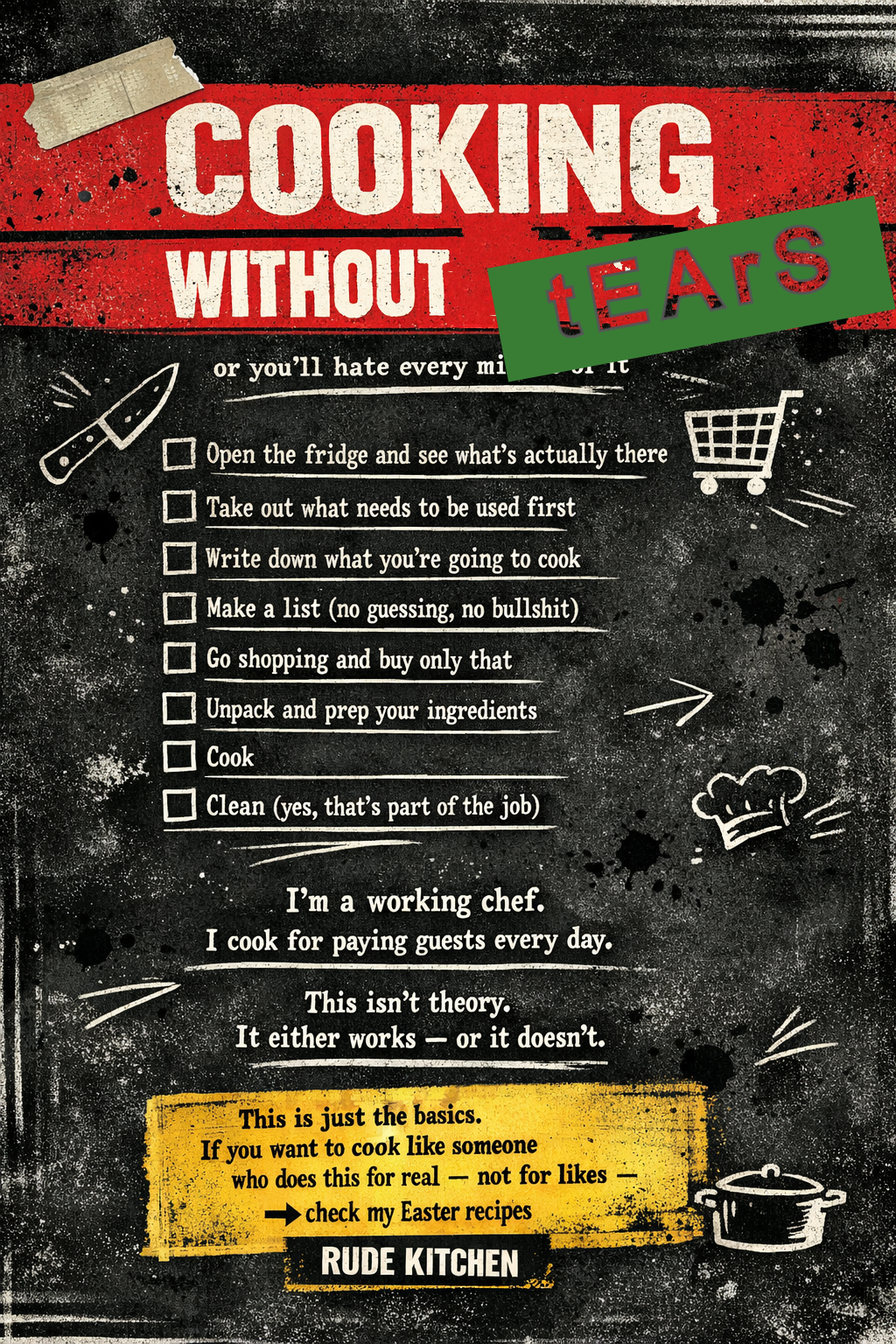
Cooking starts long before you chop the vegetables.
It’s worth making that process easier, optimizing it — to make your life and cooking simpler.
Simpler, not more complicated, so if any step feels unnecessary to you, just skip it. This is just a framework to help you out.
1. Start with the menu
For Easter cooking — or any bigger event — the best place to start is the menu.
At the same time, review what you already have at home and build your menu around that.
That’s why this year I’m planning to use wasabi in a new recipe.
For the same reason, I’m also thinking about using couscous in some Easter dish.
There’s a rule in gastronomy: money tied up in inventory is frozen money — sometimes literally wasted.
Instead, that money should be used to buy ingredients, cook, sell, make a profit, and repeat the cycle — not sit unused (or literally frozen).
It’s worth applying that idea to your home menu and shopping planning.
Using what you already have at home leads directly to something very important:
2. A short shopping list
The shorter, the better.
Once your menu is ready, go through the recipes and list all the ingredients you need —
plus about 10% extra.
Remember:
Some vegetables have more waste than others. Not every carrot or onion is the same.
Sometimes it’s worth adding a note about what a product is for.
For example: if you’re buying cashews for vegan cheese or pesto, you can buy broken ones, which are cheaper — because you’ll grind them anyway.
While making your list, double-check your pantry so you don’t buy duplicates.
A shorter list = less time spent shopping.
You might also want to split your list into two parts:
Products with a long shelf life (nuts, oils, etc.)
Products that spoil quickly (lettuce, sprouts) — buy these as late as possible
Also, think about which dish you’ll cook first and plan accordingly.
Tip: remember the 80/20 rule — leave some flexibility depending on availability and promotions.
For example: today I planned to buy wild garlic, which I love and associate strongly with spring — but I couldn’t find any.
So I went with a big bunch of parsley instead, for spring pierogi with pesto.
3. Plan your route
With your shopping list ready, check flyers, websites, or apps and plan your route.
When I lived in Warsaw, I had a fixed route covering three stores on the way home from work.
Even though I’m generally a total neophile who loves new things, when it comes to shops I’m a hardcore conservative — I stick to the same places.
Why? Because you remember the layout:
aisles, product placement, the order in which you pass sections from entrance to checkout.
And you can organize your shopping list accordingly.
Even if you don’t remember the layout, group items by category:
fruits & vegetables
canned goods
nuts & dried fruit
etc.
Tools
I do this whole process digitally.
I build my menu and shopping list on my laptop using Scrivener, but for home use a simple note app or text editor is more than enough.
Or go analog — a notebook works great.
Actually, a big notebook is ideal so you can keep menus and recipes from previous years.
Then I copy everything into Google Keep, but any simple app that works across Windows and Android will do.
In my opinion, shopping with a list on your phone is much more convenient than using a piece of paper.
- Zaloguj lub zarejestruj się aby dodawać komentarze