One of the most important Christmas Eve dishes of my childhood, a dish never made at any other time, was “kutia”. For some, it’s noodles with poppy seeds. In Silesia, there’s moczka, there’s siemieniotka. A sweet dish with nuts, raisins, honey, and sometimes alcohol (a good kutia needs a touch of brandy) is a legacy of pre-Christian rituals. Such sweet dishes — sometimes simply honey in Poland — were kindly received by household and local spirits, lokapala, as they are called in Tibetan Buddhism.
In Danish tradition, there are local, household spirits known as Nisse. Surprisingly, they resemble small Santa Clauses and help with Christmas preparations. To give them strength and willingness to do so, risalamande is prepared for them.
INGREDIENTS:
- Rice: 1/2 cup
- Cashew milk: 500 ml (or another milk, see Notes)
- Coconut milk: 100 g
- Tahini: 50 g
- Sugar: 30 g
- Nuts and dried fruit: 100 g
- Plums: 500 g
- Sesame oil: 10 g
- Sugar: 30 g
- Lime juice: 10 g
- Cardamom and cinnamon: generously
PREPARATION:
Cook the rice in plant-based milk over low heat for about half an hour. Especially towards the end of cooking, you must stir constantly and possibly add a bit of water.
Set the hot rice aside.
Cut the plums into quarters.
In a saucepan, heat the sesame oil, add the plums, and sauté for a few minutes, stirring. Cover the pan. If the plums release little liquid, add a few tablespoons of water. Add sugar, lime juice, and season generously with cardamom and cinnamon. Simmer over low heat until the plums break down.
Chop the nuts and dried fruit.
Mix coconut milk with tahini and sugar, then combine with the nuts and dried fruit. Mix thoroughly with the rice. Top with the plum mixture.
VARIATIONS:
This dessert exists in virtually all of Scandinavia and has recently become popular in Germany, so there are many variations, with each country creating its own twist.
The base is always overcooked rice served with fruit — fresh, as a jam, or as a hot sweet sauce on top.
Thus, you can vary the type of fruit and how it’s prepared. I’d especially recommend seasonal products, so fresh fruits like pears or apples, jams, or fruit purées. Instead of lime juice to balance the sweetness, you can use lemon.
Of course, the nuts and dried fruit can be adjusted in type and proportion. I used equal amounts of raisins, walnuts, and almonds, chopping the nuts and almonds.
You can also change the oil, but remember that good sesame oil adds an incredible aroma.
In the original recipe, the base added to the rice is whipped cream or butter. I naturally replaced these with plant-based products, which evoke a similar festive, sweet impression.
NOTES:
Cooking time will vary depending on the type of rice used. You can use brown rice, but it will need about an hour to cook.
The milk used to cook the rice should be thick and intense, possibly mixed with oat cream.
SERVING:
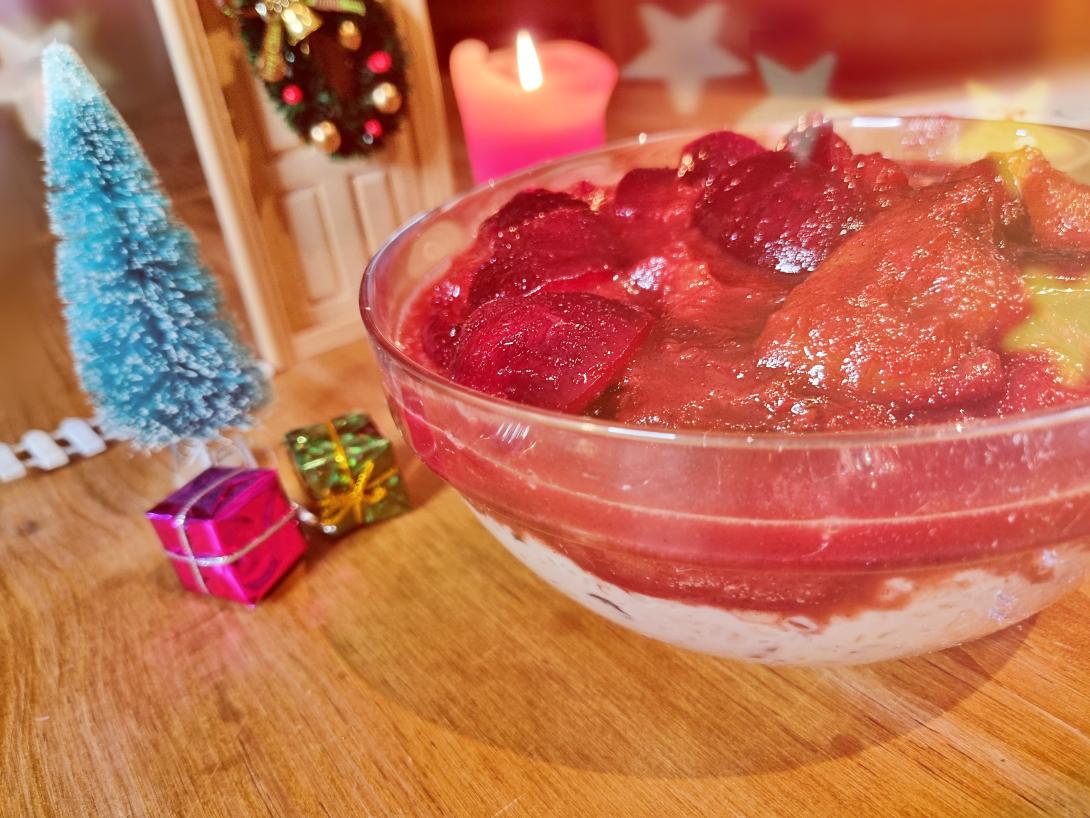
Serve warm or cold in two ways. You can portion the rice and top it with fruit for each person, or as shown in the photo, serve everything in one dish, with rice on the bottom and fruit on top.
Nisse are a type of household spirit from Scandinavian traditions, associated particularly with the Christmas (or Winter Solstice) season. They became popular during the wave of 19th-century Romantic folklore revival that swept through Europe. Nisse belongs to the same category as Ossian or Wernyhora, neo-myths. But — because there’s always a “but” — and the “but” has its own “but”…
The eminent German expert, theorist, and practitioner of magic Frater U.D., also known as Ralph Tegtmeier, the creator of “pragmatic magic,” an incredibly fascinating figure, showed in his brief yet fundamental text “Models of Magic” that such mythologies can be created according to different paradigms. Those arising from contemporary pop culture (like Nisse) or from politics and art (like Wernyhora and Ossian) are no less valid than those of our ancestors’ faith. IN FACT! In some situations, they turn out to be more effective, better, and more practical. They are tools.
Chaos magic inherently rejects dogmas, but it has its own dogmas, one being that beliefs are tools.
Thus, doors for elves bought on Amazon, placed in front of which we leave risalamande (itself a 19th-century dish), made following a recipe found online, do indeed ensure the help of elves. These elves, having spread from Scandinavia through pop culture into Germany, can surely reach Poland.
From the psychological model, we can explain this as autosuggestion: believing in Nisse might inspire us with such vigor and enthusiasm that preparations genuinely go faster and more smoothly.
And it doesn’t matter at all whether it’s autosuggestion or some micro-Santa-like spirits. You know what matters? What matters is why we do it. Is it to throw such an over-the-top Christmas Eve that spiteful Mary’s jaw will drop with envy, or to make others happy this Christmas? That’s the only thing that matters. That’s the one truly magical element without which no holiday exists. It’s what Christianity calls Agape and Buddhism Bodhicitta.
And that’s also the magic that happens in the kitchen when you cook with love and the desire to share goodness with others.
And that’s what I wish for you — not just this Christmas, but always. That kind of magic in your daily and extraordinary life.
If you enjoyed this article, you can treat me to a virtual coffee. or buy something in my shop on Redbbule
- Zaloguj lub zarejestruj się aby dodawać komentarze