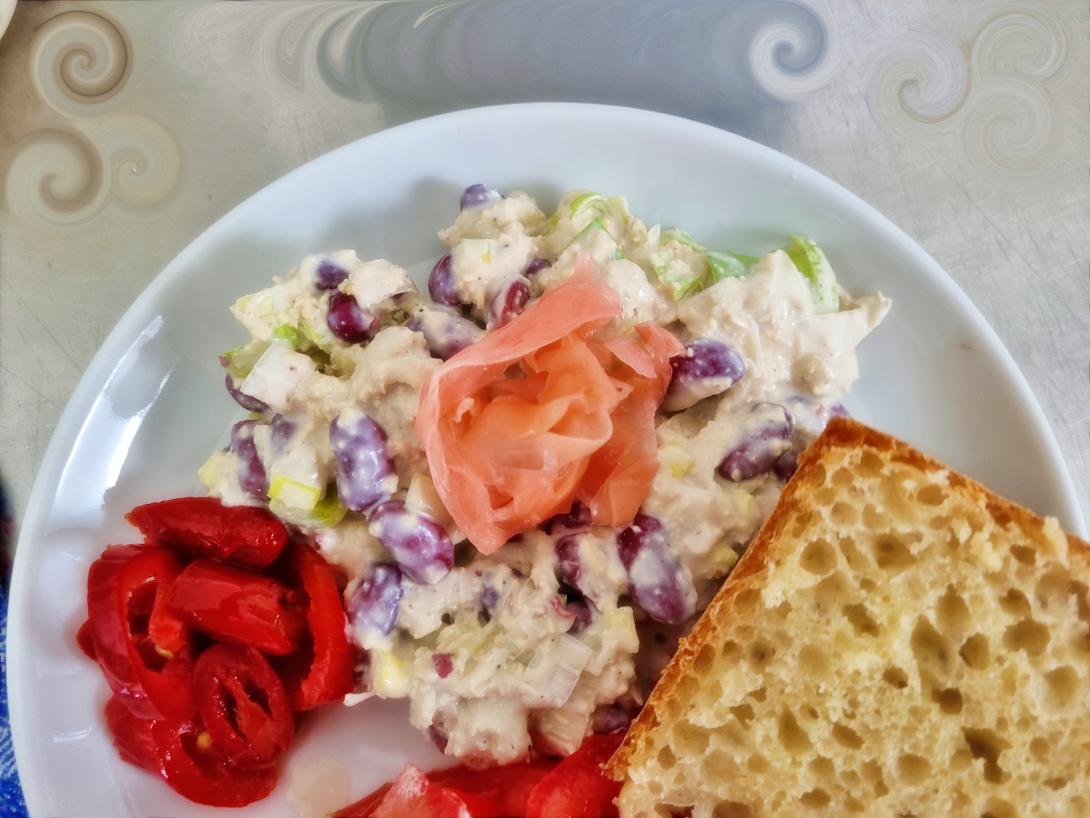
How to Make a Punk Salad from Leftovers and What's Left, or 8 Rules of Salad Composition Like the 8 Arms of the Chaos star
Salads, salads, salads. Hastur, hastur, hastur.
Next to soups and casseroles, they are unrivaled in the world of leftover cuisine.
They're always made differently, as we use whatever we have in the fridge or pantry that needs to be eaten.
However, it's worth applying a few simple rules when composing a salad.
INGREDIENTS:
1 can of red beans (or the same amount of cooked beans)
1 leek, white part, about 60g
1 apple, about 100g net weight
100g tofu
50g vegan mayonnaise
50g lupine or other vegan yogurt
Lemon juice
PREPARATION:
Drain the beans from the can, but keep the liquid; you can use it to make mayonnaise with this recipe.
Slice the leek lengthwise and then into half rings.
Peel and grate the apple with a coarse grater.
Grate the tofu as well.
Mix all the ingredients together, add mayonnaise and yogurt. Mix thoroughly, season with black salt and lemon juice.
Refrigerate for at least half an hour.
VARIATIONS:
Like almost any salad, this one is made by checking what you have and what needs to be used up. It offers a multitude of variations.
Raisins, dried cranberries, or dried currants work well in it.
NOTES:
I used plain tofu, but smoked tofu will also work very well here.
SERVING:
Serve with bread or croutons.
You can also add rice to the salad, in which case serve it without bread. The salad also works well as part of a mezze or appetizer plate.
How to compose a punk salad from leftovers and what's left, or 8 rules of salad composition like the 8 arms of the chaos star.
1. Variety of Ingredients:
A significant part of the charm of salads lies in their diverse flavors, textures, and colors. It's often said that more variety in ingredients is better, but not to an extreme degree.
2. Texture:
It's good if the salad includes some crunchy elements. Evolutionarily, we are conditioned to enjoy crunchy textures, and the act of crunching triggers pleasure centers in the brain. In this salad, leek provides that element.
3. Balancing Flavors:
Sweet, sour, spicy, salty – it's a good idea to incorporate each of these flavor elements into your salad. In this case, the apple adds sweetness, lemon juice brings sourness (but mustard is an excellent and common substitute), and leek adds spiciness. Of course, you can change the ingredients for different flavors. Raisins, dried cranberries, or pineapple can provide sweetness, while onions, chili (if you like it really spicy), or mustard can add spiciness. Lemon, lime, or even flavored vinegar can also contribute a tangy flavor.
4. Fat:
You can't do without it. I usually use a 50/50 mix of mayonnaise and yogurt to reduce the calorie content, but some fat is necessary. As the old kitchen masters say, "fat is the carrier of flavor." It doesn't have to be mayonnaise; you can make a simple dressing with oil, lemon juice, mustard, and sugar or another sweetener. I particularly enjoy using maple syrup, which adds a unique flavor note in addition to sweetness.
5. Protein Component:
In this salad, it's beans and tofu. You can use tempeh, chickpeas, or other legumes as well. Green peas work very well (a staple in the Polish vegetable salad, similar to Russian Olivier salad, but better not suggest any connection to Russia to the Poles; they might react strongly).
6. Seasoning:
The term "seasoning" might sound extravagant, but it's essential. Classic mayonnaise-based salads often need some time in the fridge to let the flavors meld, even for several hours. However, some salads are served immediately after preparation and are dressed with oil, lemon juice, or a salad dressing made from oil, lemon juice, and spices.
7. Thorough Mixing:
Seems obvious but is fundamental. All the salad ingredients need to be thoroughly mixed.
8. Carbohydrates:
In the classic Polish vegetable salad (sałatka jarzynowa), root vegetables like carrots, celery, parsley, and potatoes are the base. You can use root vegetables, rice, pasta, or even bread. In one of the world's most wonderful salads, Lebanese tabbouleh, bulgur wheat is used.
Of course, these 8 rules are not set in stone; you can and should break them. In tabbouleh, there's no protein component, and in my salad, there are no carbohydrates. Cooking isn't pharmacy; it's a stage where a chef composes their flavorful music, often improvising, blending different styles and flavors, treating a recipe as a starting point, a score for their own interpretation. This is PUNK! Culinary collages. Tear, discard, use again, use what you have on hand. Question everything, especially yourself and what you do in the kitchen. Always seek something new and have fun with it.
Stay Rude! Rude Kitchen!
Did you like this text? Do you want more similar ones? Support my blog
- Zaloguj lub zarejestruj się aby dodawać komentarze