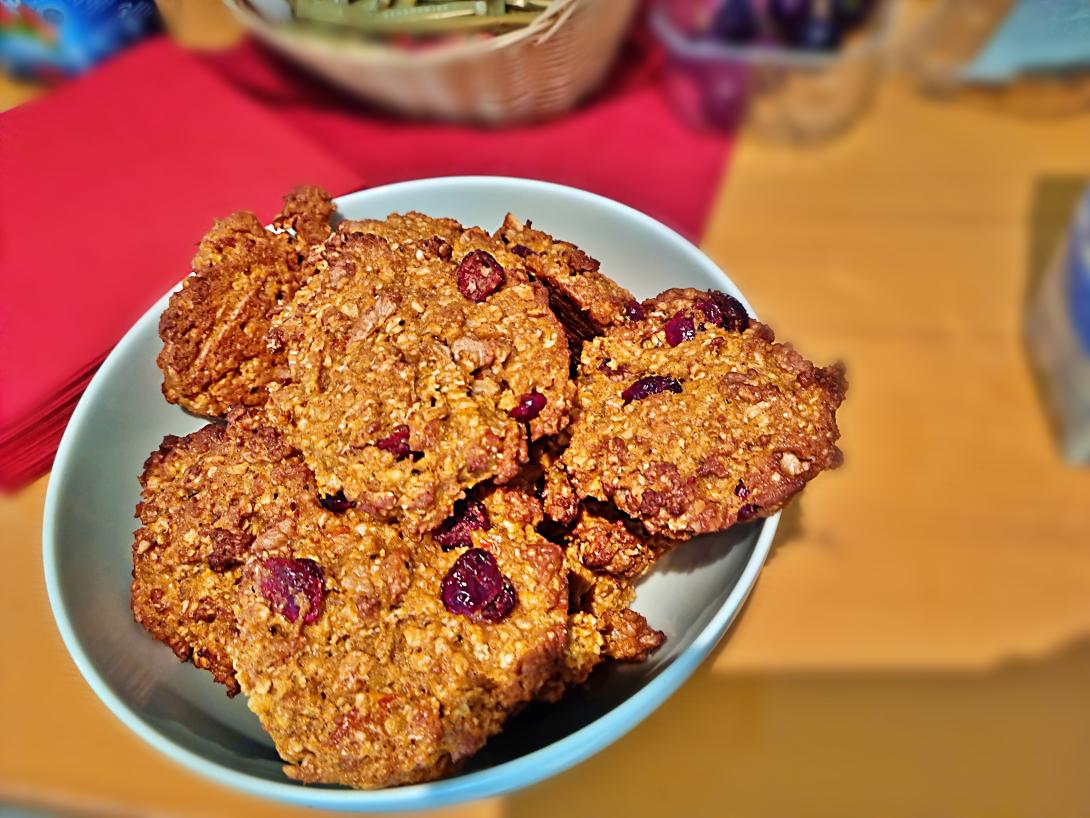
Recipe, not truly mine but modified by me, yet to my misfortune, pumpkin cookies have become a hit, and it's worth sharing this recipe.
My version of the recipe primarily differs in using less sugar than the original and substituting vanilla with aromatic oils. I also handle the dough differently by adding resting and binding time.
The recipe originates from the book "Vegan with a Vengeance" by Isa Chandra Moskowitz, a vegan chef, activist, and restaurateur, known for the TV show (broadcast on Manhattan and Brooklyn cable) "Post Punk Kitchen" https://youtu.be/s4I9CHOrve8
INGREDIENTS:
200 g wheat flour
120 g oat flakes
1 teaspoon baking soda
3/4 teaspoon salt
1 teaspoon cinnamon
1/2 teaspoon ground nutmeg
200 g sugar
150 ml sesame or peanut oil, or a mixture of both
250 ml pumpkin puree
150 g dried fruits and nuts
PREPARATION:
In a bowl, mix together flour, oat flakes, baking soda, salt, and spices.
Separately, mix sugar with oil and pumpkin puree. Gradually add and mix the dry ingredients into the wet ones.
Let the mixture rest in the refrigerator for at least 30 minutes, preferably even for a few hours. This allows the oat flakes to absorb water and bind the dough. Recently, I made the dough on Friday and baked the last batch on Sunday.
Scoop the dough onto a baking tray using a spoon, preferably using something like a small pierogi ring (mine is 5.5 cm in diameter).
Bake for 20-30 minutes at 200°C with convection, or reduce the temperature to 180°C after 20 minutes.
You can support my work on the recipes by leaving a tip.
Preparing these recipes takes time, effort, and money (especially for testing and ingredients that aren’t cheap). Your support encourages me to continue.
VARIATIONS:
Cookies and similar treats are not my specialty, so I won't come up with many variations. However, in the original recipe, the type of wheat flour wasn't specified, leaving room for experimentation.
Similarly, with the type of flakes, but I would definitely recommend using thick flakes for a more interesting texture.
For dried fruits and nuts, I usually use a half-and-half mixture of raisins and coarsely chopped walnuts. Cranberries work well, and almonds can be used instead of nuts.
NOTES:
I always say that every oven is different, and it's better to monitor the cookies during baking for the first time. They should be well-baked and crispy but not burnt.
One drawback of these cookies is that they absorb moisture very well, so if you bake a larger quantity, it's best to store them in a sealed jar or container.
SERVING:
Best served warm. Alternatively, pair them with seasonal fruits, apple compote, fruit sauce, coconut cream - the possibilities are numerous.
I've written about culinary copyrights several times before, most recently in the context of a recipe for seafood salad.
But it's worth discussing and reminding. In short, copyright is part of intellectual property rights, along with patent and trademark rights (or broader industrial property rights). Culinary recipes are not protected by any of these rights.
A culinary recipe, in this sense, is an idea, a concept not subject to legal protection. The protection applies to its RECORDING. The photo and how the recipe is written down. If someone takes their own photo and writes the recipe in their own words, it's legally fine.
The only legal form of recipe protection might come from the laws against unfair competition, protecting trade secrets. But as the name suggests, this is only possible for a production recipe in a restaurant or a production kitchen. And even then, only if secrecy protection procedures were implemented, like restricting access to the recipe to selected employees.
Misunderstanding this has led to recurring disputes about "recipe theft" and publishing them as one's own, whether by a blogger or even a commercial network.
This is also one of the reasons why chefs rarely run culinary blogs or write cookbooks (in addition to the lack of time). They protect the ownership of their recipes.
And rightfully so. Their guests pay for the value of dishes made according to those secret recipes. And that should be respected, especially considering the immense experience and hard work in the kitchen.
It's not uncommon in gastronomy to bribe employees, steal recipes, or debate the ownership of a recipe - does it belong to the restaurant or to the chef who prepared it.
However, when you decide to publish a recipe, it practically becomes part of the public domain. And anyone, in any way, can use it. Including commercially.
But creating new recipes involves costs.
It's not like, for example, I (or I have) a subscription to Legimi and write book reviews. Whether I write 10 or 30, my financial costs are the same. But a recipe also involves costs like electricity, water, equipment usage, but primarily ingredients. And here's the "survivorship bias" at play. Because no one publishes all those failed dishes that ended up in the trash. Or all the tested variations while creating a dish.
When you dine at a restaurant, you're also paying for these costs in the price, as well as the costs incurred in preparing the dish.
In hospitality, the best motivation is a good tip.
If you enjoy what I write, feel free to support me with a tip
- Zaloguj lub zarejestruj się aby dodawać komentarze