The cuisine of northern Germany is not among the most refined in the world. Bratwurst with potato salad and red millet allow for a different perspective on World War II. If you were fed like this every day, you'd also prefer to hop into a tank and invade Poland. And eat Polish dumplings and soups.
I wonder to what extent such cuisine, like in Poland, is a result of historical gastronomic policy, and whether the real cuisine of northern Germany was like in Poland, a cuisine of the poor with meat as a delicacy and privilege of the wealthy. Up until the 19th century, it was based on cereals and grains, not potatoes. But from ancient times, we only knew recipes from the tables of the wealthy because those were the recipes contained in the first cookbooks. And nineteenth-century figures like Lucyna Ćwierczakiewiczowa in Poland, and in America Maria Parloa, also did not describe the peasant cuisine but rather that of the middle class.
I don't know this area, but just like in Poland, I suspect that after WWII, for most Germans, meat became an everyday food. Another specialty I mentioned, Katoffelsalat, is sliced potatoes with vinegar and mayonnaise served with, for example, fried sausage. Well, these are not very refined dishes.
However, there are regional specialties, and local vegetables like kale, which is eaten here hot, stewed, or fried. Of course, with a lot of sausage.
Just as some say Poland should have onions in its coat of arms, Germany should have sausage. But not just any sausage. Bratwurst! And what is a certain historical irony is that among sausages, the Krakauer, or Cracow sausage, is commonly considered the best, the Uber-sausage, is widely regarded as Polish.
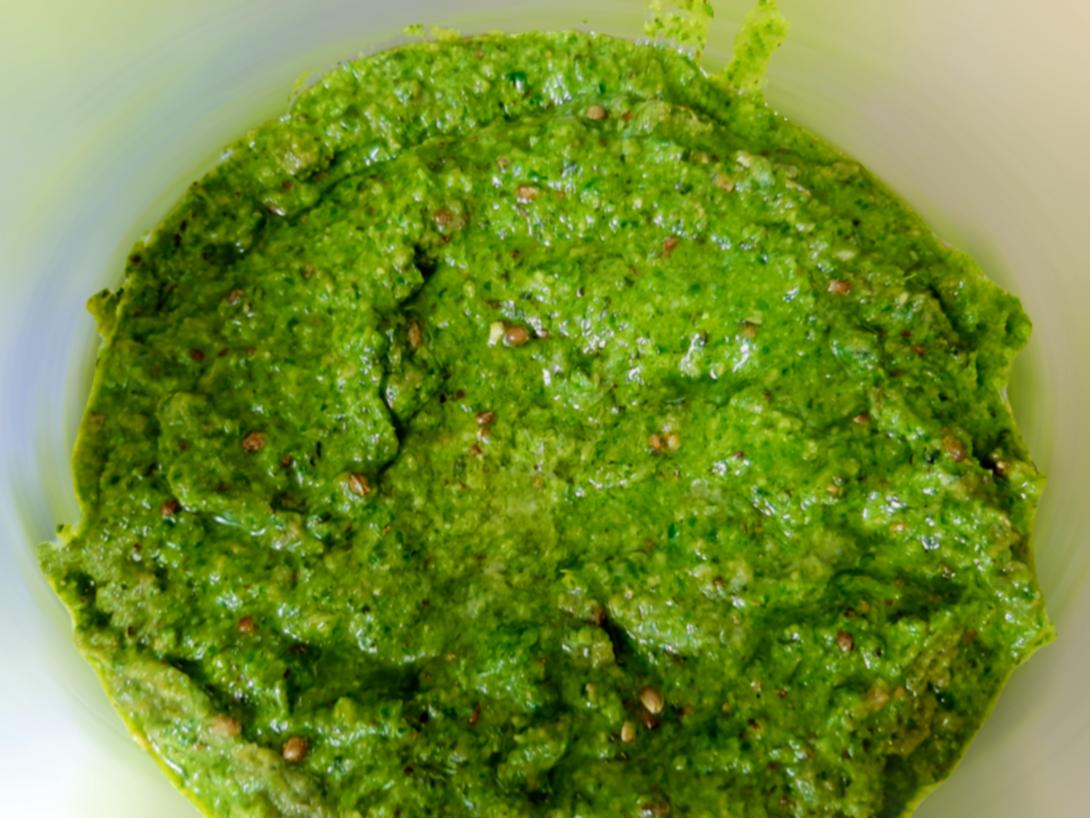
Another regional delicacy I mentioned, and as I say, the best thing about living in Lower Saxony is wild garlic.
Ingredients:
100 g wild garlic leaves
50 g parsley
150 g pumpkin seeds hemp seeds
25 g yeast flakes
150 g olive oil
20 g lime juice
10 g sugar
Salt
Preparation method:
Toast the pumpkin and hemp seeds together in a dry pan. Set aside to cool.
Cut the garlic and parsley into large pieces and blend together with the seeds, olive oil, sugar, lime juice, and a pinch of salt.
Add the yeast flakes and blend for a little while longer.
Notes:
If the pesto is too thin or too thick, adjust by adding more olive oil or yeast flakes accordingly. Remember that the pesto will thicken once refrigerated.
Serving:
Serve with pasta, as a topping for sandwiches, toast, and in many other ways.
Contrary to what I wrote above, disparagingly, northern Germany is a wonderful region, distinctly agricultural, where the potato heart of Germany beats. Near Lüneburg, below Hamburg, there is even a German Institute for Potatoes. Interestingly, it's not somewhere in Prussia, considering that King Frederick II of Prussia was a promoter of potatoes in the German Empire. And that this Prussian delicacy has taken root here, because as we know, Prussians are worse even than Bavarians. Because at least the Bavarians make good beer.
Because, what may seem strange, from Hanover it was closer for a long time to London than to Berlin. For over a hundred years, the Kingdom of Hanover and the United Kingdom were in a personal union that ended with Queen Victoria's ascension to the British throne because Hanoverian law did not allow women to inherit the throne. This doesn't change the fact that Queen Victoria was partly German.
Northern Germany is also the Hanseatic League. I tell you truly. Of all the cities, the best are port cities. Among port cities, the first are the Hanseatic cities. And among the Hanseatic cities, the Free and Hanseatic City of Hamburg shines like a pearl in the crown.
Here is a whole culinary field, which I won't taste for obvious reasons, but browsing recipes and descriptions, it's nothing extraordinary either. Polish Kashubian cuisine, which I remember from about 20 years ago when I worked summers for a few years in Hel, is much more interesting. Starting with soup from scraps, i.e., leftovers like fish skeletons left after filleting.
Traditionally, it was a large region in Europe, from southern Scandinavia and the Baltic countries, through Poland through northern Germany to France, where a similar peasant cuisine was enriched throughout Central Europe with fish, the closer to the sea, the more fish.
In regions like Lüneburger Heide in Lower Saxony, the cuisine was also richer due to the abundance of forests. Quite a few of these forests remain to this day.
Folk cuisine was enriched with treasures of wild flora. Something like wild garlic, which only recently began to be cultivated.
Here remains the historical question of land ownership, meadows, and rivers. Germany was a mosaic of literally hundreds of smaller and larger states and city-states (such were the Hanseatic cities), each of which had its laws, also in this matter.
Because it's worth remembering that the nobility punished the rabble when it ventured onto their land to collect or hunt something to eat, so as not to die of hunger.
So marveling at the old times and dynasties, it's worth remembering that their power, wealth, and rule were based on the crushed, beaten, and often exploited not much less than slaves, peasants, and all sorts of rabble.
And you can see it very clearly even in those few artistic representations of peasants and other riff-raff that have survived from past centuries. Thin and stripped. Just put them next to portraits of richly dressed and overfed kings, princes, and counts.
Germany was a country where the peasant and labor resistance movements were strong. This is also part of German tradition, at least since the time of the 16th-century peasant war of Thomas Müntzer, also sometimes called in German historiography the "revolution of ordinary people," who demanded, among other things, the return of forests to the peasants, which meant access to wild garlic. And generally to such goods as forest food and fuel.
The revolution of ordinary people failed, and Thomas Müntzer was beheaded, but the tradition of resistance survived in German history. It sounds strange today to call Germany the "country of philosophers and poets" of the 19th century. And these were poets and philosophers who were revolutionaries and socialists, supporting the Polish fight for independence.
But the cuisine is definitely not revolutionary.
If you're still not eating meat, you're left with "pommes frites" in local cuisine altogether. But...
Firstly, there is the Wochenmarkt tradition and great appreciation for everything local and plenty of local agricultural products. If you're traveling to these parts (or to Germany in general, for a short or long time), I recommend checking out, and searching online for when the Wochenmarkt is held.
At the Wochenmarkt, you'll, of course, find seasonal vegetables and fruits, but there are also, for example, bread stalls. Germans love bread in very different varieties and forms. Especially rye bread.
And don't be surprised if you see stalls with baklava and halloumi cheese. Or Asian specialties.
There's almost always a stall with spices in a wide variety.
Sometimes at such markets, you can also find stands from bio/eco farms, which have had a tradition here for over 150 years, since the time of the Lebensreform (Life Reform) movement, precursor to the New Age and today's return to organic products and localism.
Similar abundance can be found in big cities. Bio/eco stores, primarily Reformhaus stores (working for 150 years) and the much cheaper Alnatura. Interestingly, Alnatura, at least in Hamburg and Bremen, locates its stores in rather poor districts.
Viertel in Bremen, where the Alnatura store is located, is a district for foodies altogether. Full of shops with food from different regions, shops with Syrian sweets, for example. And of course, many eateries. Including Yalla Yalla, the best falafel I've had in Germany.
On the way to get falafel, you can also buy drugs. In one of the side streets of Viertel, I came across a crew smoking crack. I don't recommend it. But be prepared for such sights and young people asking if you want anything on the street. And they're not offering wild garlic, to be sure.
In sum, I'm surprised I haven't seen wild garlic falafel anywhere yet. Maybe that's a niche for me?
Did you like this text? Do you want more similar ones? Support my blog
- Zaloguj lub zarejestruj się aby dodawać komentarze