It’s amazing how context changes everything.
Take, for example, the phrase: “I got a mushroom from a friend.” Sounds very different coming from a chef than from someone into swingers parties, doesn’t it?
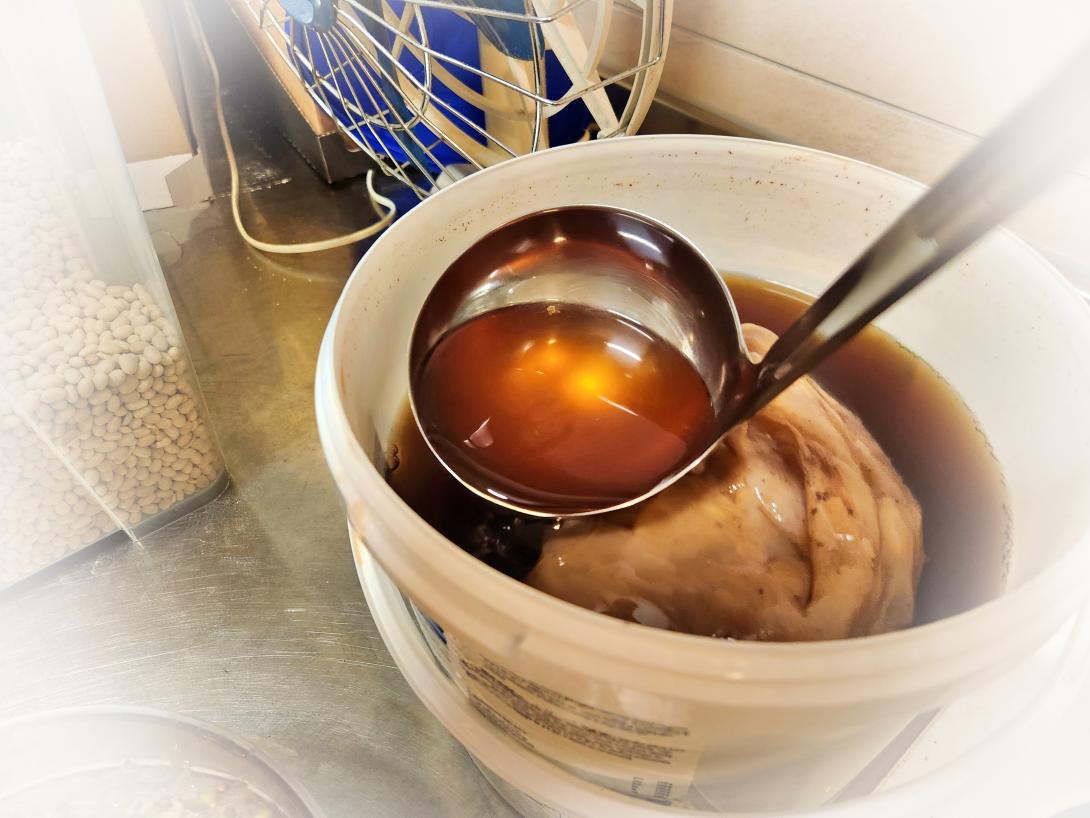
In my case, the “friend” was my Translator Friend (from my work), and the “mushroom” was a kombucha SCOBY (not Candida). Since then, it’s grown impressively, as you can see in the photo.
This mushroom is a complex symbiotic colony of various bacteria and yeasts that ferment the tea. The health benefits of kombucha remain questionable and often disputed, but when it comes to taste, it’s the holy grail of beverages.
Depending on the specific mix of microorganisms and the type of tea used, the flavor can vary greatly. Kombucha fermentation involves three types of fermentation: lactic, alcoholic, and acetic. Finished kombucha typically contains a small amount of alcohol, usually negligible, but in some cases, it can be up to 2%. That’s because some of the microorganisms in the SCOBY oxidize alcohol into aldehydes and carboxylic acids (like acetic acid, which is how “sour wine” or apple cider vinegar is made).
My favorite blend is half black tea and half green sencha. But the real hit? Kombucha brewed with Alnatura Earl Grey.
Recipe:
– 2 tea bags + 2 tablespoons sugar per liter of boiled (then cooled) water
– Let it cool, then add the SCOBY. The warmer it is and the larger the SCOBY, the faster the fermentation — sometimes it’s ready in just 1–2 days.
Kombucha made with Earl Grey is a bit like iced tea, only better — tangier, with a hint of pleasant bitterness and citrus notes, and slightly fizzy.
If you have a yogurt fermenter, it also works great for kombucha in colder weather.
I’ve only tried making kombucha with yerba mate once, and it turned out terribly. But once the summer madness of work calms down, I plan to experiment with other liquids — some people even make kombucha with fruit juice. Technically, the only requirement is sugar.
I haven’t yet tried using kombucha in cooking*— in place of water, for soups or sauces — but I imagine the results could be interesting.
You can now easily buy a kombucha SCOBY (Symbiotic Culture Of Bacteria and Yeast) in health food stores or online.
Just be careful not to confuse kombucha, the fermented tea, with Japanese kombu tea, which is made from seaweed. It’s a bit like the confusion surrounding the term “curry.”
The current popularity and availability of kombucha remind me of not-so-distant times, before I left Poland in 2019, when such products were rare and hard to get. And it also reminds me of the problems caused by the Northern world’s obsession with exotic products.
Perfect examples include avocados or quinoa. Their popularity in wealthy countries deprives local Andean farmers of their own staple foods. Even products like coffee and cocoa often involve exploitative labor — and in some cases, even slavery — while local growers earn the least.
But unlike quinoa, avocados, coffee, or cocoa, using a kombucha SCOBY doesn’t rob locals of anything.
What we’re taking isn’t the physical product (except the first SCOBY someone brought to the West) but information — genetic information.
In theory (though not yet in practice), with just the full genetic sequence of the bacteria and yeasts, we could recreate a SCOBY without using a single physical cell.
And even when we do use an actual SCOBY, we’re not taking it away from anyone. It naturally grows (theoretically endlessly), and taking a piece doesn’t diminish the original — it keeps growing too.
Unlike physical fruit or other goods, information can be reproduced endlessly.
And that’s the secret big corporations don’t want you to know.*
Because it applies to more than just food.
If I take your car (though I have no idea why I’d want to), you no longer have it. Obvious.
If I borrow your book, it’s mine forever, as we all know, nobody ever returns borrowed books (all my books are borrowed, by the way).
But what about an ebook? Or even better: what if the book is about how to make kombucha? The fact that I have the book doesn’t prevent you from knowing how to make kombucha. And I can pass it on to someone else, who passes it on again, and again, ad infinitum. The information spreads freely and endlessly.
I have several gigabytes of books on my hard drive. I can give or share any of them — and still keep a copy. That’s how humanity has learned, how we’ve built civilization and culture.
So can we really call that “theft,” as entertainment corporations claim, while making massive profits under absurdly strict copyright laws?
Especially when, for example, I can buy a piece of software but not actually own it. I can’t install it on two computers because I don’t own it — I only license it. It’s like buying a book but being told I’m not allowed to lend it to someone or even read it twice.
The contradictions of so-called “intellectual property” laws are just one example of many modern ideologies that dominate our lives without us even noticing, like an invisible web ensnaring a trapped animal.
“The ruling ideas of each age have ever been the ideas of its ruling class: that is, the class which is the ruling material force of society, is at the same time its ruling intellectual force”.
In hospitality, the best motivation is a good tip.
If you enjoy what I write, feel free to support me with a tip
- Zaloguj lub zarejestruj się aby dodawać komentarze