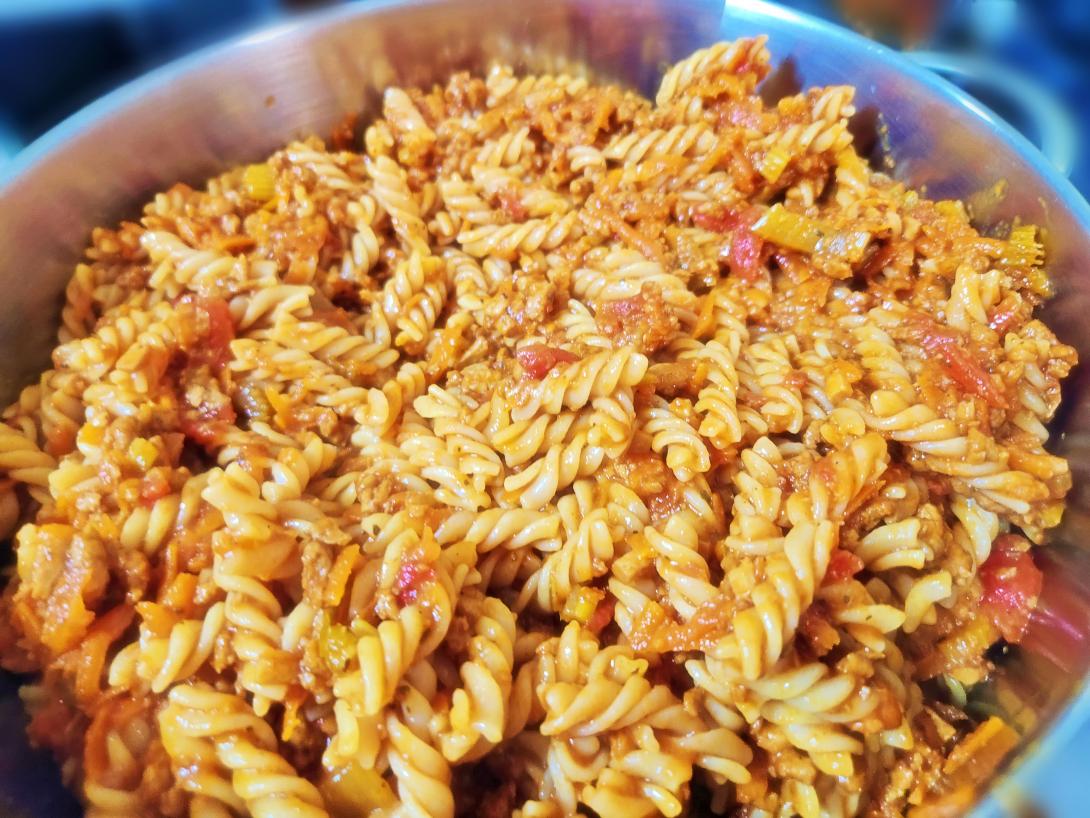
A very specific aspect of my work, stemming from cooking at a Buddhist center, is the presence of religious dietary restrictions.
Many religions have such rules, obligations, and prohibitions… no meat on Fridays, no pork, no beef, no blood sausage, hot dog buns without hot dogs on Fridays (yes, that's a real rule), no masturbation, no playing Diablo…
In Buddhism, these restrictions are much looser or more flexible than Christianity.
In most schools, there's not even a strict ban on meat (contrary to what many Europeans believe), or it applies only to monks.
However, certain meditation practices and rituals require specific dietary rules, including a ban on meat.
But also a ban on radish. That's manageable - I won't serve radishes.
But also - and this is tragic! - a ban on onions and garlic.
You can live without garlic, maybe… but onion? Onion is a basic vegetable that boosts, deepens, and enriches flavor.
Recently I served veganese, a plant-based version of bolognese with two types of TVP (textured vegetable protein) - made from pea and sunflower.
This market has grown a lot in recent years. In Germany, you can now buy TVP not only from soy but also from pea, lupin, or sunflower.
Pro Tip:
If you're cooking plant-based, try to combine at least two types of plant proteins in one meal.
Which is actually easy - just eat hummus with wheat bread or any other gluten-containing bread. Gluten is protein, the protein that pretty much fed humanity, because it makes possible the spongy texture of bread.
To achieve a rich taste without onion, I started by frying spices with a bit of ground dried mushrooms left over from making a mushroom sauce recently.
Pro Tip 2:
Dried mushrooms (even dried champignons) are a good source of umami, which is often translated as "rich and savory" (or even "meaty").
Then I sautéed chopped celery, added carrot and tomatoes, soy sauce, Worcestershire sauce, and Marmite - also umami-rich ingredients.
Pro Tip 3:
I also added crema di balsamico. It adds both flavor and sugar, essential for the Maillard reaction - that's what creates those crispy, aromatic crusts on bread, cutlets, roast meats, or cakes.
What matters is the equation: time × temperature. The higher the temperature, the faster the Maillard reactions. But they happen even at lower temps.
For example, marinated tofu left for 2–3 months will develop a completely new depth of flavor.
To get that comforting roasted flavor effect (like from frying or baking), where temperature is high and the reaction is strong, we reduce the sauce very slowly, over very low heat.
That's also why bigos (Polish hunter's stew) gets better the longer it cooks.
But the biggest challenge was something that seems the simplest - hot sauce!
In which onion and garlic usually play a major role. So I had to make a totally different kind of sauce.
The only things it shared with this one were tomatoes and chili.
This time, I added roasted (almost burned) bell pepper and Worcestershire sauce.
Next time I make it, I'll try to write the recipe down - because the result was absolutely worth it.
Stay tuned!
In our line of work, the best motivation is a good tip. If you like what I write here, you can leave me a tip
- Zaloguj lub zarejestruj się aby dodawać komentarze