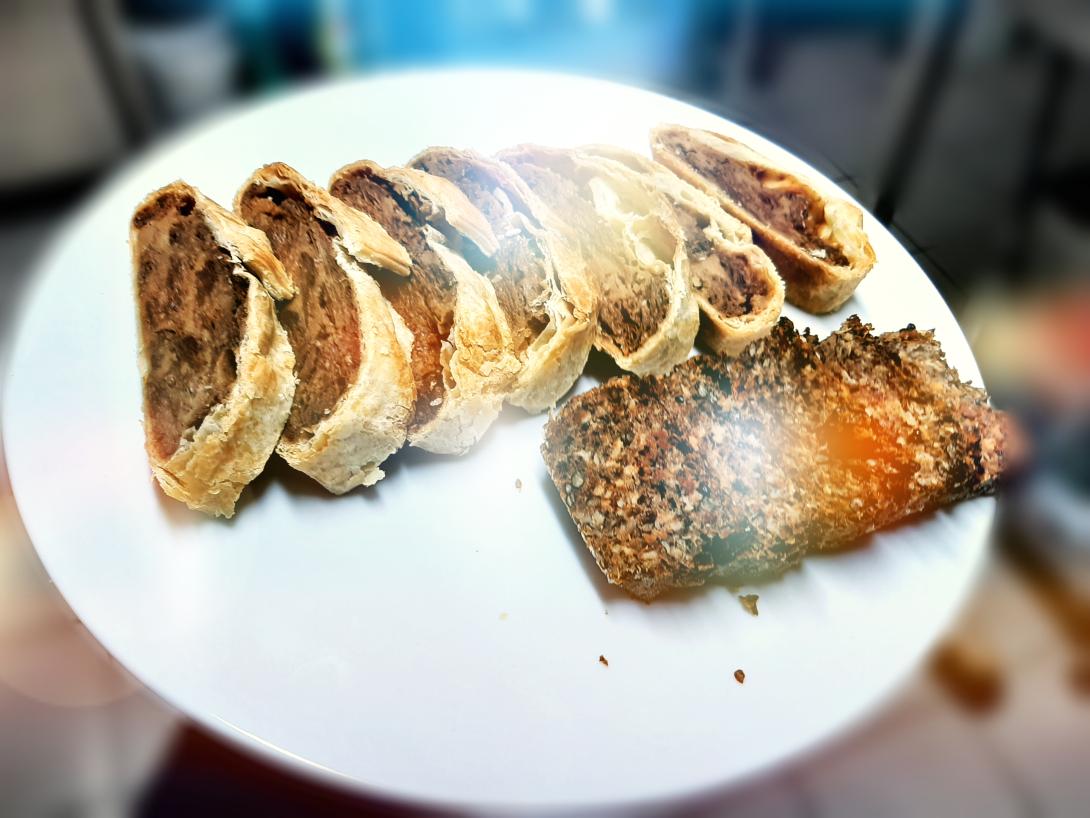
The subject of pâté is fascinating — surely worthy of a treatise… That’s how it might begin. Imagine a cookbook penned by Czesław Miłosz. If “The Year of the Hunter” had a culinary appendix. What cuisine would he have described?
Most likely Lithuanian, naturally — perhaps specifically the dishes from the manor in Šeteniai, where he grew up. A Polish-Lithuanian cuisine of the borderlands.
It probably wouldn’t be peasant food, since Miłosz was raised in his mother’s family manor, and on his father’s side belonged to an old noble family. Still, they weren’t ultra-wealthy magnates. His father earned a living honestly, building roads and bridges.
— -
Black Lentil Pâté
INGREDIENTS:
- 500 g black lentils
- 200 g canned or cooked chickpeas
- 30 g dried porcini mushrooms
- 1 stale large bread roll
- 2 onions (approx. 150 g net)
- 150 g sun-dried tomatoes, drained
- 50 g sun-dried tomato oil
- 30 g coarse oat flour (I grind it myself)
- 50 g fine oat flakes
- 1 tsp smoked paprika
- 1 tsp ground coriander seeds
METHOD:
Cook the black lentils for about 30 minutes. They’re quite specific — they take longer than other varieties and hold their shape well, which makes them perfect for chili sin carne, for example. Let cool.
Soak the porcini in hot water, let cool, strain, and save the soaking water — it’s rich in umami.
Soak the bread roll in water and squeeze out excess liquid.
Grind the lentils, onions, mushrooms, chickpeas, and sun-dried tomatoes in a food processor or grinder.
Add the tomato oil, mushroom water, oat flour and flakes, and spices. Mix thoroughly. Let it rest for an hour.
Grease the inside of your baking tins and dust with breadcrumbs to prevent sticking. Cool before removing from the mold.
I got three pâtés from small 500 g tins.
Bake at 180°C (356°F) for about 45 minutes.
— -
SERVING SUGGESTIONS:
Like any pâté, serve hot or cold. It’s excellent pan-fried in a bit of olive oil. It's perfect with horseradish sauce, wasabi, or cranberry sauce.
You can support my work on the “Ritual Year” project by leaving a tip.
Preparing these recipes takes time, effort, and money (especially for testing and ingredients that aren’t cheap). Your support encourages me to continue.
I’ve never delved deeply into Miłosz’s biography, but I suspect his life after university was much less sweet than his childhood. And even in those wealthier days, the family table was likely that of moderately well-off nobility or the emerging middle and professional class.
Pâté was certainly part of that table — an important element in the Polish noble tradition, particularly during holidays.
The first Polish pâté recipes come from *Compendium Ferculorum* (1682) by Stanisław Czerniecki, chef to Prince Aleksander Michał Lubomirski. That was haute cuisine for the 1%, but like many such dishes, pâté trickled down to the peasant kitchens over time, gradually becoming less and less meaty.
Meat, a hundred or even less than a hundred years ago, was still a sign of wealth. The poor only ate it on holidays, if at all. Incidentally, such a diet, when balanced, is among the healthiest. Much like the Mediterranean diet, considered the gold standard in evidence-based nutrition.
At some point, the puff pastry crust disappeared — too labor-intensive and expensive due to its high butter content.
And it’s worth noting that what we often call pâté nowadays doesn’t quite match the original “pâté” as defined by the “Dictionnaire de l’Académie française”:
“A culinary preparation of ground meat or fish encased in pastry and baked.”
This year, I made something similar with pulled soy protein.
But it wasn’t truly a pâté, because pâté, by definition, requires the ingredients to be ground and then baked.
That said, I could easily imagine forming a single base mixture into both pâté (baked in a loaf pan) and burgers (pan-fried).
No meaning, taste, or form of our dishes is eternal. The way something looks or is prepared is always arbitrary. It isn’t the result of divine (or natural) law, but of someone deciding to make it that way.
Which means someone else can decide to make it differently.
The results, though, are not arbitrary. They’re influenced by biology, chemistry, and our evolutionary programming.
Which is why we crave sweet, fatty, crunchy things.
That same programming defines what a cutlet or a pâté “should be” in a meal: a source of protein.
That’s why lentils, beans, or chickpeas make ideal bases for plant-based pâtés. Gluten, TVP, tofu, hemp seeds, or nuts are great additions.
Grains like millet or oats (which, by the way, are decent protein sources) serve as binders.
That’s a crucial distinction: meat binds itself when baked, often helped along by egg.
In plant-based pâtés, we need a binding agent. But it should be a supplement, not the main ingredient — if the dish is to retain its nutritionally programmed role.
A beetroot and millet pâté won’t fulfill that role. It might be delicious — I’ve had such pâtés and they’re lovely on occasion — but they shouldn’t be staples.
Combined with bread, potatoes, or grains, you’re getting carbs with carbs — instead of with protein.
So when modifying traditional recipes — especially when veganizing them — keep that in mind.
You can support my work on the “Ritual Year” project by leaving a tip.
Preparing these recipes takes time, effort, and money (especially for testing and ingredients that aren’t cheap). Your support encourages me to continue.
- Zaloguj lub zarejestruj się aby dodawać komentarze