Have you already accepted into your heart our Lord and Savior, the Easter Bunny?**
Well, I had to. Even though I know not everyone shares my religious sense of humor.
But the Easter Bunny is not so far removed from the Sacrifice of Christ—and that doesn't diminish Christ; quite the opposite. But more on that later, because there are truly important matters at hand. Namely: eggs.
Smoked, plant-based eggs.
I’m not sure if they’ll be cheaper—though that’s possible with current egg prices—but they’ll definitely be an interesting culinary experience.
I didn’t aim to recreate 100% the taste and texture of an egg. I wanted to offer something new. Less obvious. A bit rarer: a smoked egg.
Unlike a regular egg—cheap or expensive—this isn’t something you can grab in every supermarket or corner store.
---
**INGREDIENTS:**
- 100 g smoked soft tofu
- 50 g cooked chickpeas (or canned)
- 400 g oat cream
- 1/2–2/3 tsp Kala Namak (black salt)
- 1–1.5 tsp mustard
- 4.5 g agar agar
---
**INSTRUCTIONS:**
Blend the tofu, chickpeas, salt, and **half** the cream until smooth. The smoother, the better. Add the remaining cream and blend again briefly or mix thoroughly.
You should end up with 500 ml of thick liquid.
Pour the mixture into a small pot and **gently heat** to **80°C (176°F)**, stirring constantly. That’s enough—don’t boil.
Dissolve the agar in 2–3 tablespoons of hot water.
Add a few spoonfuls of the egg-free mixture to the dissolved agar, stir, then mix it all back into the pot. Stir for 2 minutes, then pour into egg molds.
Let cool completely.
This amount gave me five 100 ml molds.
---
**VARIATIONS:**
Cream is key for richness and to mimic the fat found in eggs. You can use soy cream instead of oat. I saved coconut cream for sweet versions.
Feel free to play with flavor and fillings. Add herbs, make veggie jelly eggs, or tint tofu-based eggs with beet juice for color.
---
**NOTES:**
The mustard is important. Just plain yellow (like Polish sarepska). It should enhance the eggy flavor without overpowering it—like in a vegetable salad.
Tofu matters. I use soft smoked tofu from the “Food for Future” line at Penny (Germany). If you can’t find it, try soft tofu with a dash of liquid smoke.
The softer the tofu, the better. And chickpeas should be cooked until soft—like for hummus.
**Agar varies in strength.** Check the label. Don't confuse it with “agartine,” which is also vegan but has a different texture and is better for sweet jellies.
Use slightly more than what's on the label. I used 4.5 g instead of 4 g for 500 ml.
---
**TO SERVE:**
Endless options!
Serve with mayo, various dips like cashew–ramsons (wild garlic) green sauce or wasabi mayo. Add sprouts.
Use a chickpea + black salt paste as a “yolk” — here’s a recipe:
[https://rudekitchen.pl/niezle-jaja-czyli-sztuka-iluzji-kulinarnej](https://rudekitchen.pl/niezle-jaja-czyli-sztuka-iluzji-kulinarnej)
Or make a thicker yolk-like sauce.
Think of this smoked egg not as a replica, but as a homage to the flavor of eggs—something new, interesting, and less obvious.
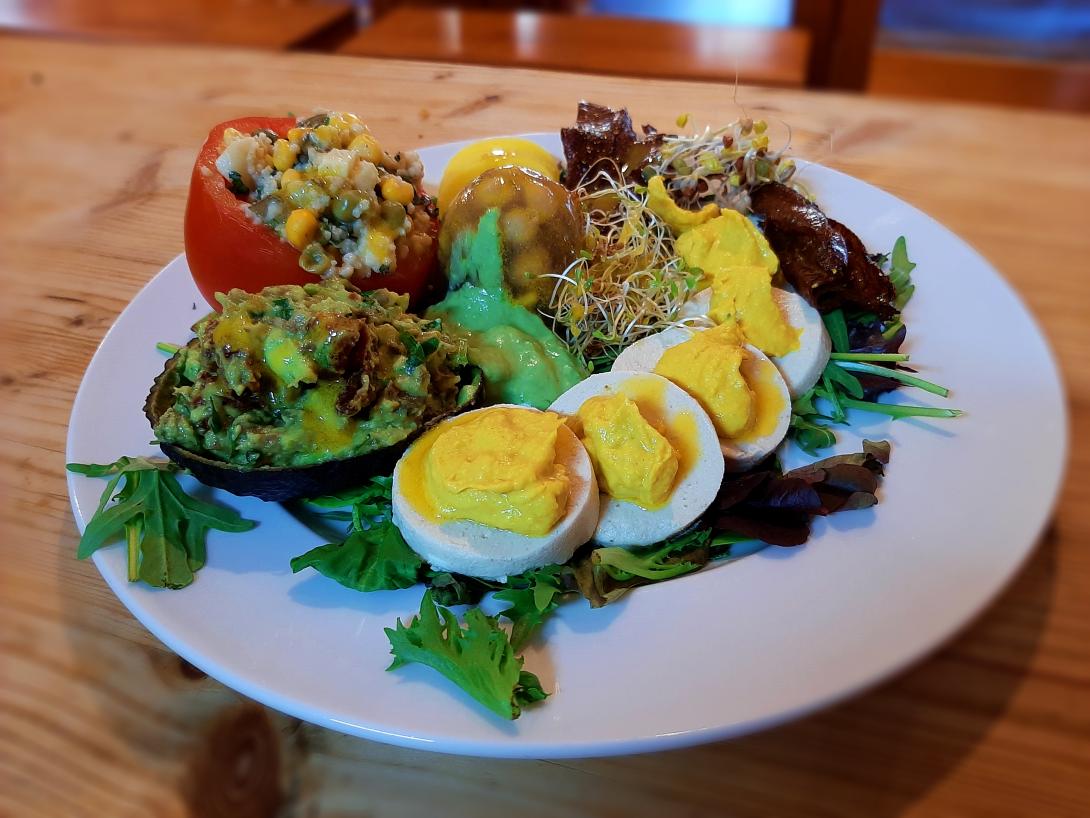
In the photo: sliced plant-based eggs with yolk sauce, jelly egg, tomato stuffed with couscous salad and wild garlic–caper guacamole, served on a salad mix with sprouts and green ramsons sauce. Add seitan and soy protein in puff pastry, and you've got a complete vegan Easter breakfast plate.
---
**Now, if you’ve seen my video working on this year’s Easter menu, you might have spotted two mythical figures essential to Easter: the Goddess Ostara and the Sacrificial Year King, here embodied as the Easter Bunny.**
Whether these archetypes (or deities—does it matter?) are rooted in pre-Christian traditions or are 19th-century inventions, like Jacob Grimm’s Ostara, is less important to me.
Much of modern paganism is a form of religious reverse-engineering.
But what fascinates me most is the figure of the **One-Year King**—the god-man or man-god sacrificed at the dawn of the agricultural year to ensure a bountiful harvest.
Over time, this became symbolic or mythological. Many myths tell of gods offered as sacrifice.
To be clear: this in no way diminishes Christ's sacrifice or any religious traditions, Christian or pagan.
But as I often say in social and political contexts: **power begins at the bottom of the pot.**
Religion too, it seems. Maybe not in the pot, but in the field.
The origins of religion are also tied to the need for nourishment.
That, in essence, is what Easter is about.
Whether it’s literal food, like in the rituals of the One-Year King, or the heavenly bread offered by Christ.
At my house, there will be tofu eggs and something extra for guests on Easter Sunday.
Surprising, maybe, since it will be an all-Buddhist breakfast. Guests from various parts of Europe, and one from Canada.
And I’ll be nervously wondering how they’ll like my new ideas. When a dish “hits,” I light up like a kid.
The kitchen is the only place where I truly feel at home…
---
**You can support my work on the "Ritual Year" project by leaving a tip.**
Preparing these recipes takes time, effort, and money (especially for testing and ingredients that aren't cheap). Your support encourages me to continue.
And if you tip over 20 zł, you’ll receive a monthly email with new recipes and book excerpts.
You can support my work on *The Ritual Year* project by leaving a tip.
Preparing these recipes is not just time and effort — much more goes into it than what you see. Most recipes take many trials and tests, and also cost money, sometimes for pricey ingredients.
Your support will encourage me to keep working.
- Zaloguj lub zarejestruj się aby dodawać komentarze