For the past few weeks, when the guests leave and I finish a thorough cleaning — together with, or rather first of all washing the extractor hood, something no one likes to do — I’ve been working on a collection of recipes, my interpretation of Christmas Eve cuisine, mainly Polish.
Pro Tip: This is precisely the problem — since no one wants to or likes cleaning the hood, and so no one cleans it, when someone finally does (in restaurants, often only after a health inspection), it’s hours of work with a thick layer of grease and dust.
There’s a straightforward solution. I clean the hood after every event. If you clean the hood regularly, it will be easier and quicker. A tough sponge, preferably a scourer (though with plastic domestic hoods, the scourer might scratch them), plus a good glass cleaner liquid will do the trick. Spray it, leave it for 10 minutes, especially if the grease or dirt is hardened. At home, it’s best to clean it now as part of pre-holiday tidying and then again right after the holidays, following the intense Christmas cooking.
Now the work in the kitchen is done, and it’s time to write down the recipes from my notes.
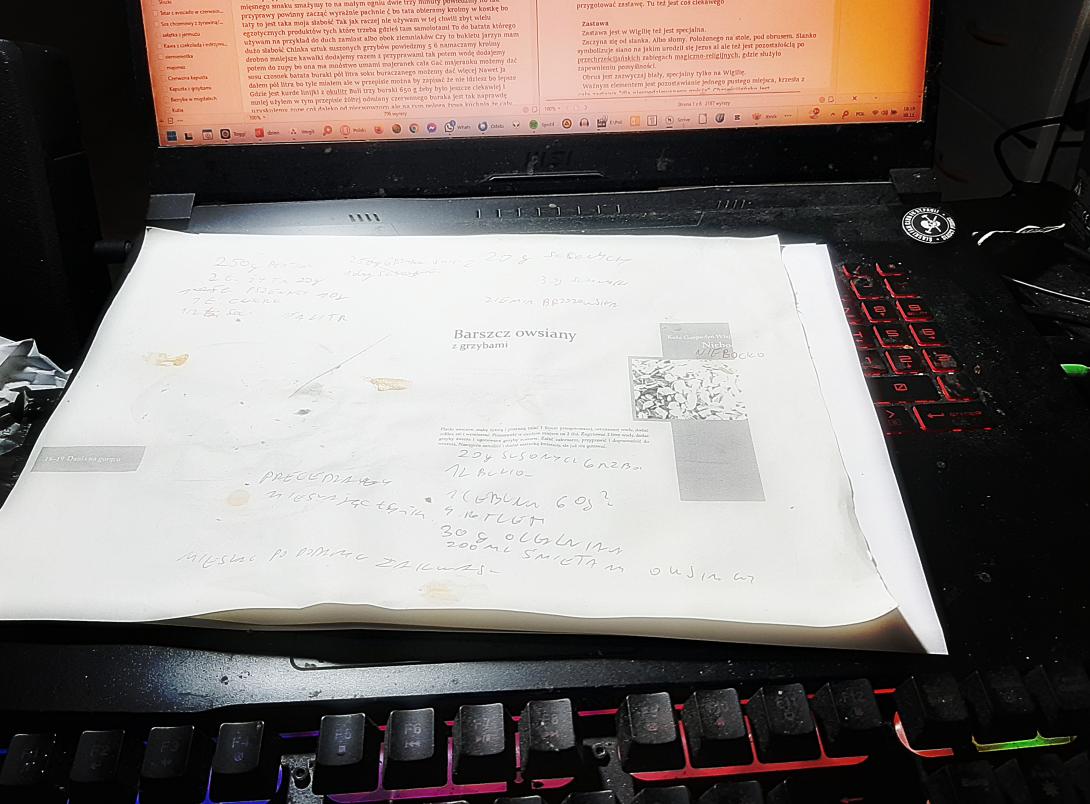
I rarely write recipes down on paper. Sometimes I do for those I’ve “veganized” or made gluten-free; I print them out and make notes on the printouts.
The best way to take notes is in a multi-platform app, allowing access to a laptop and smartphone/tablet.
My go-to app in the kitchen used to be Google Keep. Nowadays, I only use it for shopping lists. I write, or rather dictate, notes and recipes in Asana. In its paid version, it’s a powerful project management tool; in the free version, it’s a simple, intuitive, multi-platform program perfect for creating a collection of recipes, e.g., for a Christmas Eve menu.
The downside of the free version is that you can’t set the creation date for tasks.
In the kitchen, I use what I call a “workbook” — an old TCL 10 Nextpaper tablet (great for reading e-books) — but practically any tablet will do. The cheaper, the better. I strongly advise against using a smartphone. The kitchen environment (temperature, humidity) is highly damaging to such devices (especially their batteries). Plus, a phone we use daily in various situations (including “on the toilet”) shouldn’t be used in the kitchen at all. If you must, it’s best to disinfect your hands after using it. Along with money, phones are the most microbiologically dirty items we touch daily.
On my laptop, I’ve been using Scrivener for several years — the best editor for lengthy texts, collections of texts, books, and all kinds of publications. Unfortunately, it’s paid (there’s a 30-day trial), and worse, it’s gotten more expensive — it now costs €69, whereas I paid €49 pre-pandemic. I know I only use a fraction of the program’s capabilities, but even that fraction is worth the money and makes working on any collection of interrelated texts much easier.
It’s incomparably better than Word and similar text editors.
The downside is that it doesn’t have an Android version and isn’t great for syncing across different computers. It’s definitely a program for stationary work at a desk.
The program does, of course, have a spell-check feature that highlights errors and suggests corrections. However, my dyslexia and the number and type of mistakes I make can overwhelm any spell-checker. Sometimes I stare at a red-underlined word, wondering what’s wrong with it.
Or I stare at a red-underlined word, wondering what’s wrong, and end up randomly rearranging letters until I get it right. Or I look at what I’ve written and at the suggested word and see no difference at all. Its horrible and because of this for additional corrections, I use Grammarly. Everybody knows, I think/
From the initial idea — sometimes a vague one — through planning, notes on the idea, shopping, multiple attempts (it often takes several tries before a recipe is ready; some are never published at all) to writing it down and publishing, the right tools are essential. A knife, a measuring cup, scales, a cutting board, a blender, pots, note-taking, and text-editing apps. Then there’s the matter of photography.
But the most important tool every chef has is between their ears. That tool is… the mind or brain.
And it’s not just about the fact that our perception of taste happens in the brain, not on the tongue and that certain neural pathways in the brain make sweet and fatty foods pleasurable or make us enjoy spicy, burning hot chili.
It’s about much more than that. Polish culinary critic and culinary historian Robert Makłowicz once said that you can’t talk about food without talking about culture.
And every chef has all that culture in their head, which strongly determines their cuisine, their flavors, and their way of cooking.
I’m writing down several dozen Christmas Eve recipes — these specific ones, in this quantity — because my fundamental, almost inherited culinary heritage, instilled in me during childhood, was the traditional Polish Christmas Eve supper. Twelve specific dishes, each with its symbolism.
Without that foundation — without what Christmas Eve means in Polish tradition and culture, even in godless families like mine — these recipes I’m writing down wouldn’t just be different; they probably wouldn’t exist at all.
Aside from my version of Kemm’s Kuchen, which is a typical German Christmas cookie. But I still incorporated it into the traditional Polish, or more precisely, Silesian recipe for makówki.
I’ll try to publish the Kemm’s Kuchen recipe tomorrow, as it’s a “Hamburg gingerbread” that needs to mature for at least a week. But it’s fantastic. And the makówki with it… BOOM!
Did you like this text? Do you want more similar ones? Support my blog
- Zaloguj lub zarejestruj się aby dodawać komentarze