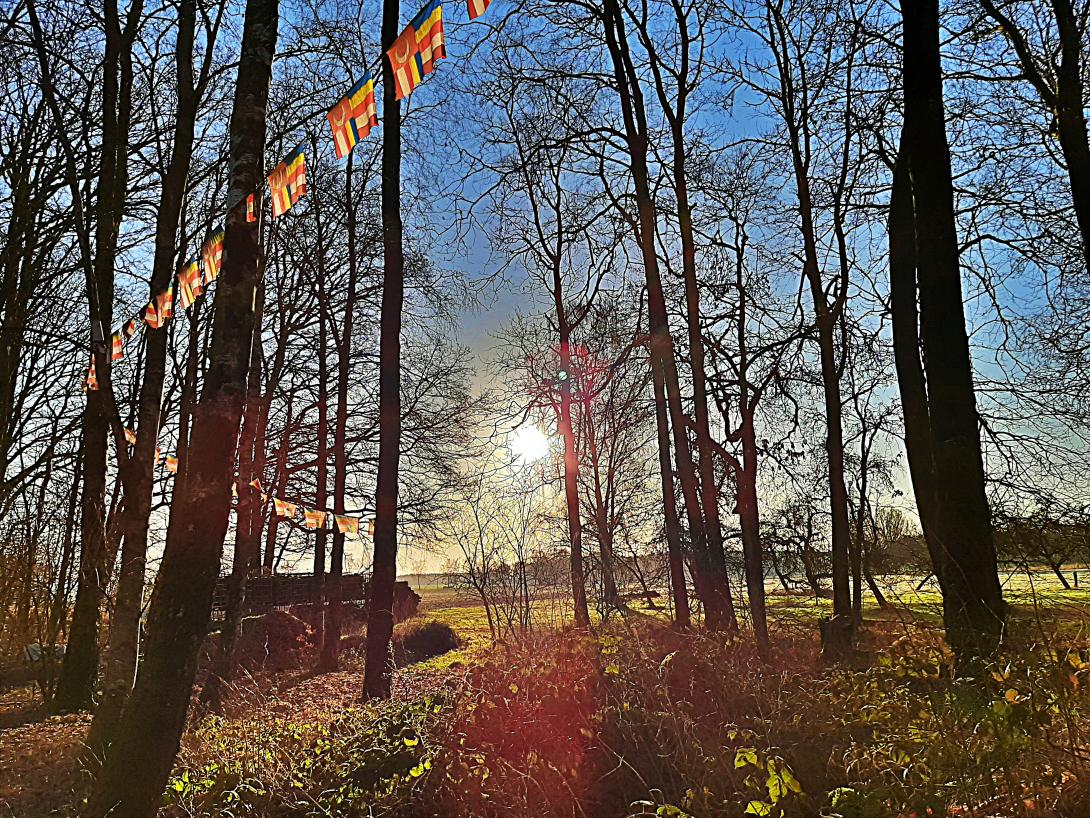
For five and a half years, I have been living and working in a Buddhist center in Germany. It’s 1.5 km to the nearest village, 600 m to the closest neighbor, and 300 m to the nearest nature reserve.
I’m a bit like a dog living off altar scraps — almost literally.
For instance, I eat what’s left over from the guests’ meals. Not that it’s bad food — it’s actually very good. I know, because I’m the one who cooks it.
Since this work has effectively made me a professional Buddhist, I’ve become less and less interested in the formal and ritual aspects of Buddhism. All the exotic elements feel almost boring to me now, and I distinguish Buddhist teachers by what they like to eat. Buddhist holidays, for me, are often just periods of increased workload, as guests come for special holiday meals. If there are no guests, the holiday passes me by — just like Christian holidays do. I notice public holidays, though, because buses to the city don’t run on those days, the same as on weekends.
One of the four most significant Buddhist holidays is Lha Bab Düchen. Celebrated according to the lunar calendar, like all Vajrayana (Tibetan Buddhism) holidays, it falls on the 22nd day of the ninth month (in 2014, November 22). It commemorates the Buddha’s return from Indra’s Heaven, where he had spent three months teaching the Dharma to his mother, Māyādevī, who had died a few days after his birth, and to the 33 gods of the desire realm (the number 33 may hold symbolic significance, meaning “a great many”).
After much urging and pleading from his close disciple Maudgalyāyana, he decided to return to the human world to spread the Dharma. The Buddha’s descent was accompanied by the gods Indra and Brahma, who manifested triple stairways of lapis lazuli, gold, and crystal to honor him. They also held parasols over him as a gesture of gratitude for the teachings given to the gods. The descent took place in Sāṅkāśya (modern-day Uttar Pradesh).
It must have resembled today’s state visits or celebrity appearances, complete with elaborate ceremonies, crowds of paparazzi, and groupies. After all, the Buddha was famously handsome — like Keanu Reeves, of course.
There were herds of elephants brought by dignitaries, pickpockets bustling in the crowd, and vendors selling hot dogs and Coca-Cola. All the city’s accommodations were filled with pilgrims. A boon for the hospitality industry.
Amid the gathered crowds stood rulers and princes with their retinues. In the throng was a simple nun named Utpalī, who vowed to be the first to greet the Buddha.
However, a humble nun couldn’t compete with the mighty for a place near the Enlightened One. But through the sheer force of her devotion, she manifested herself as the “ruler of the world,” complete with a royal entourage. In this form, she easily secured the right spot to bow to the returning Buddha first. Witnessing her immense devotion, the Buddha prophesied her future enlightenment.
Upon his descent, the Buddha performed another miracle — “opening the worlds.” Looking up and down, he caused the realms of gods, humans, and hell beings to become visible to one another.
Just as the Buddha’s birthday is the Buddhist equivalent of a Western Children’s Day, Lha Bab Düchen is the Buddhist Mother’s Day.
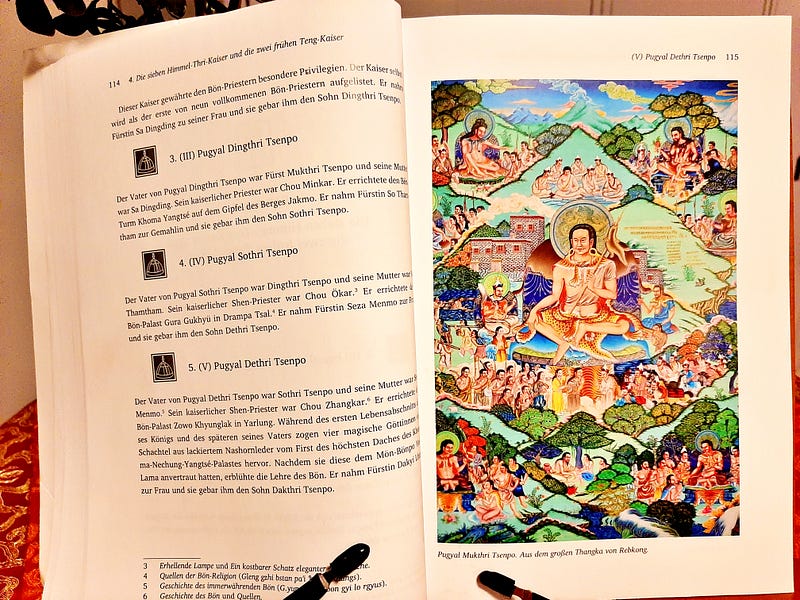
How Many Heavens Are There?
The first question worth addressing is the obvious one: if it’s Indra’s Heaven, does that mean there are other heavens too? And how many?
The answer is both very simple and very complex.
The Buddha’s teachings describe six basic realms and types of beings: the realms of hell beings, hungry ghosts, animals, humans, demi-gods (asuras), and gods.
It would be more accurate to use the plural here, as these realms encompass many different worlds.
For example, there are cold hells and hot hells, each corresponding to different forms of anger. And it is the mind and its afflictions — various mental states — that create these worlds. The realm of hell beings is shaped by hatred and anger; the realm of hungry ghosts (beings with enormous stomachs and throats narrower than a needle’s eye) by desire/craving; the animal realm by ignorance; the demi-god realm by jealousy; and the god realm by pride.
As this view of reality shows, even the gods are samsaric beings just like the rest of us. Even the most refined, formless gods of the highest heavens are still trapped in samsara. When their good karma is exhausted, they fall to lower realms.
Only the human realm offers the possibility of liberation from samsara. Beings in other realms are too consumed by their mental states — suffering in the realms of hungry ghosts and hell beings, ignorance and foolishness in the animal realm, jealousy and attempts to conquer heaven in the asura realm, and pride and the pleasures of life in the god realm.
Humans, unique among all forms of existence, are not dominated entirely by a single emotion. Instead, all emotions exist within us in a mixed and dynamic way. This allows for the potential to free ourselves from them and turn our minds toward the Dharma. Some also say that curiosity — the desire for knowledge and growth — is a uniquely human trait.
The Buddha’s teachings speak of the “precious human body” and the “precious human rebirth.” Whenever you have the chance, go to a meadow or forest. Sit quietly and contemplate the multitude of life, the countless sentient beings around you. Carefully lift a patch of turf and observe the myriad creatures living beneath it (remember to replace the turf afterward — these beings have all been our mothers and fathers, and we should treat them with gratitude and love).
Around us are countless sentient beings from the animal realm. Modern scientists estimate there are about 1⁰¹⁸ insects — over 140 million insects for every human. And that’s just insects. What about other arthropods? Vertebrates? And how many beings inhabit worlds we cannot see?
This is why the Buddha once used the metaphor of a turtle and the ocean. Imagine the entire world covered by a sea, a pan-ocean enveloping the planet. Floating on the surface is a horse yoke. In the depths, an immortal sea turtle dives and resurfaces once every thousand years to breathe. And as often as that turtle happens to surface through the yoke, that’s how rare it is to be born as a human!
Thus, the human body is extraordinarily precious and valuable, and it’s vital to take care of it so it serves us as long and well as possible. Anything that destroys, harms, or shortens life — be it a sedentary lifestyle spent at a desk with a phone glued to one’s ear, a toxic and harmful diet, substance abuse, or environmental pollution through selfish consumption — is contrary to the Dharma.
In this human body, we can experience and create all six realms in our minds, through the emotions and mental states we experience — anger, greed, dullness, jealousy, pride… The teaching of the six realms can be seen as a metaphor or map of the human mind, illustrating the interplay of our emotions.
It is worth stopping and reflecting for a moment on the symbolic meaning of the fact that the Buddha did this to repay all the kindness he had experienced from his mother.
Queen Maya died just seven days after the birth of little Siddhartha, so for a European, it may seem strange to speak of the great goodness that her son received from her.
In Tibetan tradition, the mother occupies a special place. It is no coincidence that “lama” means “highest mother,” and in numerous metaphors, comparisons to unconditional goodness and love, to the mother, are used, and it is recommended to treat all beings as one’s own mother.
In traditional Tibetan society, it was almost unimaginable for a mother not to love her child, for children to send their parents to old age homes, and for contact to be limited to the day the pension arrived. An example of such love (and obedience) is even found in the life story of Milarepa, who took on criminal, black magic actions out of love for his mother. And then he became the greatest yogi in Tibetan history. Let’s be honest — there were not many career paths for a young man from a poor family in Tibet. It was a feudal theocracy, with rulers who lived forever, because when one died, he immediately reincarnated.
Regardless of our views on abortion, we know that these nine months of pregnancy are a difficult time for a woman.
Let alone childbirth. That’s why the mother, the relationship between mother and child, was (and is?) in Tibetan culture a symbol of goodness and love.
There is a certain story from the life of the Buddha about how, while walking with his disciples, he saw a woman eating fish. The woman was holding a small child in her arms and putting chewed pieces of fish into the child’s mouth, while at her feet a dog tried to catch what fell to the ground, being brutally driven away by the woman.
The Buddha then said to his disciples that this was the saddest sight he had ever seen.
When they asked him why, he explained that the fish had been the woman’s mother in a previous life, the dog her father, and the child an enemy who had killed her.
Thus, treating all beings as one’s own mother is not just a metaphor but a consequence of what has actually occurred in the endless series of our incarnations. We are reborn for an infinitely long time, and all sentient beings have already been our mothers. At least that’s what Buddhists believe.
The rational Western mind often has a problem with such stories. While Buddhism, reduced to some form of “just sitting,” to use a Zen term or the increasingly popular mindfulness, is something completely acceptable and understandable to the West — heck! even something to practice — the question arises whether this “light Buddhism” is not becoming just another method of personal development, some other form of mambo-jumbo-new-age-light-easy-and-pleasant. Sometimes it is so “cleansed of cultural influences” that there’s not much left, like in an old Polish comedy: “How much Buddhism is there in Buddhism?”
This domesticated Buddhism, embraced by the rational mind, is reduced to the conventional level described in Buddhism.
In simple terms, we can speak of two levels of perceiving reality: the ordinary conventional level, accessible to ordinary beings, on which things are what they are, or how we perceive them.
But there is also another level, accessible at a certain stage of spiritual insight. However strange and esoteric it may sound. Since all of reality manifests from the Nature of Mind, it is inseparable from emptiness, a play of appearances, what could hinder any phenomena from manifesting through the Buddhas?
At the conventional level, the Jataka stories, the story of the journey to Indra’s Heaven, the arrival in Tibet by air through Guru Padmasambhava, or sitting on sunbeams by Drugpa Kunley and defeating a demon with his penis are myths, at most serving to convey teachings. But at the absolute level, there’s nothing stranger in these phenomena than in a cup of coffee, in the fact that the grass is green, the sky is blue, and the sun rises and sets…
But from another perspective… When we treat stories of miracles and extraordinary deeds by the Buddha, Milarepa, or Padmasambhava only as metaphors, just like the six realms (and especially the lower ones), it’s reminiscent of those Christians who believe in heaven, but not in hell, and choose which commandments they will follow and which ones are “outdated” and not worth worrying about (somehow the sixth is the most unfashionable).
Similarly, reducing Buddhism to just a technique destroys the foundations, such as faith and devotion to the Three Jewels, the Five Precepts, or the Four Noble Truths. It’s worth asking oneself whether what I am doing is in line with the Dharma, whether I am breaking the Refuge commitment, whether I follow the Five Precepts. If I reach for various esoteric, magical methods — and furthermore, use them for my benefit or to show off to others — is this in line with the Dharma? Am I not breaking my commitment to taking Refuge in the Three Jewels and not samsaric deities and activities? The Buddha also clearly pointed out occupations or jobs that a practitioner of the Dharma should avoid. Returning to these basics, continually contemplating them, whether during formal practice sessions or daily activities, is more valuable than venerating Buddhas and bodhisattvas. Fully adhering to them is difficult in our times due to the incredible entanglement and interdependence that exists in our civilization and culture. One of the occupations that a Dharma practitioner should avoid is working in the production and sale of alcohol. Simple? It seems so. But what if I work in a store that sells alcohol, in the bakery section? Or in a marketing company that runs a beer advertising campaign? Or when I appear in an advertisement for that beer?
And these are not theoretical considerations. The same question applies to my work. If I cook in a place where there is alcohol, is that appropriate?
I don’t know… I just cook and wash dishes.
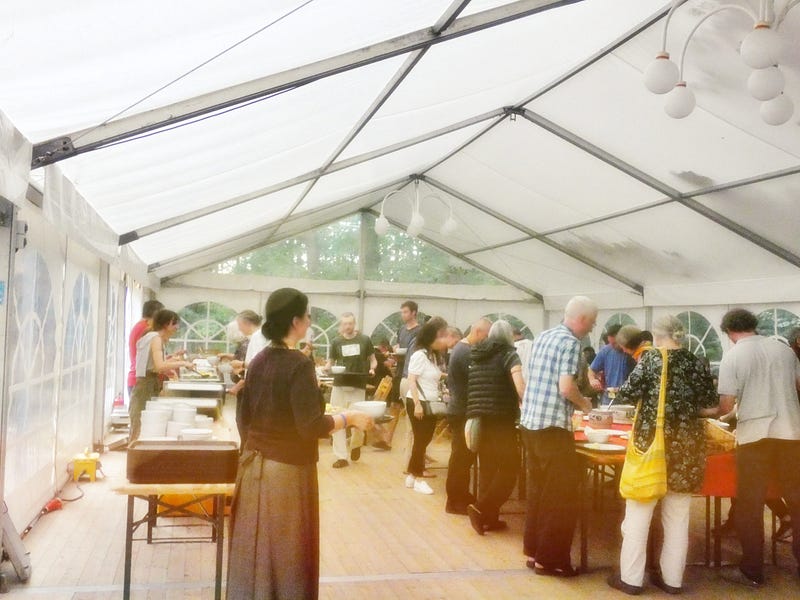
I’m like a dog eating the leftover offerings from the altar or a cockroach eating the crumbs of bread eaten by the Master. There is always someone in the temple who cleans the meditation halls and someone who cleans the toilets, and someone who cooks, and someone who washes dishes. Once a year, we have a two-week event for 150 people. I see all of this from the kitchen. And such an event means, for me, above all, a huge amount of work and stress.
In the morning, the kitchen is cold and dark, still before dawn. I turn on the lights, put on a hat and apron, and get to work. I start the oven to bake bread, it gets warm. I’ve already had my coffee. One a day, in the morning, but it’s the kind that really kicks you awake… When I finish, I clean, sweep, wash the floor, turn off the lights, and leave. A normal working day, the same in the kitchen as any other.
Working in the kitchen has many ritualized elements, more in the style of Zen than Tibetan Buddhism. Just as the holy time of Lha Bab Duchen is a time recreated in a special ritual, so every place where a ritual is performed becomes a sacred place and time. The kitchen during work is such a place. In this metaphor, the cook is the High Priest, the offerer, and the offering at the same time. The most perfect form of practicing this is the mind present here and now. The kitchen fosters such concentration. Nothing reminds you of mindfulness more than grabbing the oven door heated to 500°K or cutting a piece of your finger while chopping onions (I always wonder then whether that onion is still vegan).
I work alone. When there are a lot of guests, I start as early as 4 in the morning. The term “head chef” is imprecise because I don’t have a team, but it’s accurate in that I perform all the duties of a head chef and even more. I handle deliveries and orders, create menus, new recipes, cook, bake bread, run service, and at least do one dishwashing shift.
I’m the dog living off the leftovers from the altar. And contrary to appearances, this is a very good position. A position literally from the kitchen. From the back.
From a Buddhist point of view, it’s hard to imagine a better place for such a madcap and prodigal person. When you feed someone, you create strong karmic bonds with them. Considering how many Masters I have fed, I’ve got some pretty strong karmic “backing” for the next rebirth.
The Enlightened, in their infinite compassion, gave us many skillful means, like a rope or lifeline thrown to a drowning person.
Many realized Teachers made vows, for example, related to their mantra names, such as Padmasambhava or Chenrezig, who vowed that whenever someone recites their mantras with faith and devotion, they would immediately come.
Similarly, I assume, the Buddha established 4 important Holidays, 8 sacred places — so that we could hold on to them like a drowning person grabs a lifeline in the ocean of suffering that is samsara.
10,000,000 times multiplied karmic effects — this means that one mantra has the power of 10,000,000 mantras, one offering the power of 10,000,000 offerings. It is also a wonderful opportunity to practice mindfulness of body, speech, and mind because of how powerful the karmic effects are on such a day from our thoughts, emotions, words, and actions.
And this, I think, is the most important teaching brought by Lha Bab Duchen — to treat every day as if it were a Holiday when the power of our actions, words, thoughts, and emotions multiplies 10,000,000 times.
The author does not claim to represent the pure Buddhist point of view, he is just a dog lost in samsara, who decided to share his experience in the hope that it will be beneficial to someone.
If you enjoyed this article, you can treat me to a virtual coffee.

- Zaloguj lub zarejestruj się aby dodawać komentarze