TVP: texture vegetable protein. Until recently, only TSP, or “textured soy protein,” was available on the market. These are all those products like dry soy cutlets (affectionately called “sawdust cutlets”), pieces, granules, steaks — large, rectangular cutlets with a fibrous texture.
TSP products had their time, at least in Poland, in the 1990s, when they were pretty much the only vegan/vegetarian product available on the market, even tofu couldn’t be bought in Poland then. For young people, it sounds like a horror movie. But here’s a fun fact: for a time, even palm oil was available in regular grocery stores, at the price of the cheapest frying fat. I used it at the time to make vegan lard, frying it with onions, apples, and adding spices.
In recent years, TVP has made a bit of a comeback, at least in Germany, on the wave of the popularity of plant-based and flexitarian diets and the search for new, more balanced, and environmentally friendly food. In Germany, besides soy protein, I use products made from pea and sunflower protein.
It’s worth mentioning how TVP is made. This product, developed 60 years ago, fits perfectly into the currently popular ideas or trends of sustainability and zero waste. Because it’s a product made from waste. From the leftovers, the so-called press cake after oil production. The press cake is passed through special nozzles under high pressure and at high temperatures. In a process called extrusion. Thanks to this, they acquire a spongy texture.
The process was developed by technologists from Archer Daniels Midland, interestingly as part of an initiative by the US government, which was looking for alternative sources of cheap protein. In 1971, TVP was even accepted by the government as an ingredient in school meals.
How to prepare vegan protein?
According to the instructions on the package. Bring to a boil, set aside, drain. But thanks to this preparation, the cutlets get the affectionate name “sawdust cutlets.”
We need to add flavor by properly seasoning the liquid in which we cook the vegan protein. Instructions often recommend broth. It’s good to use broth, but it’s not the key here. The key is the right seasoning.
Usually, I do it this way: I bring it to a boil in water with the addition of soy sauce, balsamic cream, and possibly spices.
Most often, I use my signature Magical Mystery Mix (no, I don’t like The Beatles). But you can season it further in the next stages of preparation.
How and with what to season:
1) With spices such as those used for meat. What most people perceive as the taste of meat actually comes from the spices added to it and the processing.
2) Whatever comes to your mind. TSP is a very versatile product flavor-wise and can be directed in different ways. For example, use lime and ground curry (the leaves of the plant with that name, not the pseudo-Indian spice mix) or, more classically, add seaweed to achieve a “sea” flavor.
Umami
Soy sauce is a source of umami, the fifth taste, which is what makes something taste good. In a simplified way.
The word “umami” itself can be translated as delicious, full, or fatty. I like to call this taste meaty, although orthodox vegans will probably want to crucify me for this. The problem is that umami is practically absent in plant-based products. That’s why we need to reach for products like soy sauces, which contain umami created during the fermentation process.
Other good sources of umami are, for example, hoisin sauce (plum-soy sauce), which contains sugar — important for the second crucial component of the deliciousness of vegan protein — Worcestershire sauce, or Marmite.
Umami was discovered and named in the early 20th century by Japanese chemist Kikunae Ikeda. The word “umami” was created by Ikeda from “umai” (うまい), meaning “delicious.”
The lack of umami is one of the main reasons (along with the lack of protein) why many people, after eating a vegetarian or vegan meal, quite justifiably often say, “I don’t feel full without meat.”
The taste of umami is caused by glutamate, which is commonly found in meat and very rarely in plant-based products.
Umami can be provided by, for example, asparagus. Freeze the woody ends of green asparagus and use them later, for instance, in broth, and tomatoes. Dried tomatoes and oil from dried tomatoes are an explosion of umami.
Umami is also found in fermented products. That is, in all good, natural yogurts, in all fermented vegetables, whether it’s Polish/German sauerkraut or Korean kimchi.
Fermented foods are, in general, a phenomenal topic. I recommend everyone to try fermenting. It requires some learning, and for me, it’s still a new subject that I’m learning, so perhaps in the future, there will be recipes for fermented foods.
Umami is key if you want your guests to say “AMAZING.” It’s also important when we talk about emotional, recreational food — food that is meant to bring pleasure, regulate emotions.
Eating, for example, a good roast, provides a certain level of pleasure, and this is largely conditioned by the physiology of our brain, which reacts in this specific way to certain ingredients in what we eat, such as sugar or glutamate. In simplified terms, this happens because, in the past, foods containing these ingredients increased our chances of survival, like high-calorie sugar during times of constant and widespread calorie deficiency (which, from a historical point of view, was practically all the time during human existence).
And when removing meat from the menu, removing meat from a dish, removing meat from a recipe, you need to keep this in mind. And cook these dishes in such a way that they provide at least the same effect, the same level of pleasure.
It doesn’t have to be, there’s no need for it to be a specific taste, of a specific type of meat, or a specific dish. It’s more about replacing animal products with similar “meaty,” “cheesy,” “eggy,” or “fishy” tastes. Umami is the foundation for achieving a “meaty” flavor.
An interesting example is oyster mushroom tripe soup. In Poland, it’s a topic boring enough to make you puke. Well, almost everyone has made it years ago. I left Poland 5 years ago, and even then it was an overdone topic.
But now, I’m in Germany, and here there’s no such association because there’s no such dish as tripe. It’s a very folk and traditional dish, a bit of comfort food in Poland too, because with the increasing wealth of society, it almost disappeared from the menu, and for my generation, it’s most associated with childhood cuisine, with what grandma or mom would make in the countryside.
In Poland, everyone had a grandma in the countryside. Before World War II, three-quarters of the Polish population lived in rural areas, and the great migration to cities began in the 40s/50s with the great constructions of socialism. It was mainly young men who left. The older generation stayed in the countryside. I still remember trips to that older generation from my childhood in the 70s and 80s. And what grandmothers used to cook.
Germans, of course, don’t have this association with oyster mushroom tripe. For them, it’s simply some kind of soup. It doesn’t matter that it imitates an original meat dish, that it’s a modest but culinary illusion.
Maillard Reactions
The second important factor is the Maillard reactions. In simple terms, these are reactions that occur, especially during frying and baking, which are responsible for all those delicious fried and roasted flavors and textures. For the crispy crust on bread, roasts, and cutlets, for the amazing aroma of gravy. These reactions happen faster the higher the temperature.
In addition to temperature, proteins and sugars are needed.
So, to the vegan protein, we need to add something, to put it simply, that will contain sugars.
We can, for example, use fruits. In old Polish cuisine, fruits in savory dishes were very popular, especially apples, and figs and citrus fruits were used by the wealthy. Fruit juices are also a good addition.
A good ingredient would be balsamic cream, which also adds aromas from vinegar, soy-plum sauce, sweet hoisin sauce, agave syrup, or another syrup, or simply a spoonful of sugar. For some time now, I’ve been using the Indonesian duo of sweet soy sauce, Katjab Manis.
What’s important — any sweeteners like stevia, xylitol, or aspartame are out of the question.
So, as I mentioned earlier, I add balsamic cream to the water in which I cook the vegan protein and let it sit for at least a few hours so that the Maillard reactions can take place and add depth to the flavor.
Maillard reactions occur not only during frying, baking, or boiling but also during various types of marination or the process of flavors developing in a salad. However, the lower the temperature, the slower they happen. That’s why long marination or pickling makes sense.
It’s practically a good idea to prepare TSP in the evening for the next day.
It’s also good to prepare TSP for a few days. Once cooled, the vegan protein should be placed with the marinade in a container and kept in the fridge.
The container, of course, should be plastic. Because the hysteria about zero plastic in the kitchen is as foolish as most such hysteria and religions in cooking. There is no safer or more convenient material to use in the kitchen.
If you store products for several or even dozens of days, there’s no risk of microplastics transferring to them. Plastic, unlike glass, is safe and doesn’t react with food. Remember to use plastics that are labeled as suitable for food contact.
In my experience, such vegan protein can be stored in the fridge for about a week. Of course, check its condition organoleptically.
Remember to regularly clean the fridge, even if it’s self-defrosting, to ensure there are no rotting or moldy products. If such products appear, remove them immediately. This way, products in the fridge, which will be microbiologically safe, will spoil less.
How to prepare vegan protein.
Make it however you like, whatever comes to mind. The simplest way: what you do with red meat, you can do with TVP (textured vegetable protein).
A very simple and easy dish to prepare with what we have in the fridge or pantry (if anyone still has a pantry in these degenerate times of ready-made meals and meal prep) is a pan-fried vegan protein dish I make for myself when I don’t have a good idea or many ingredients.
It’s not just one dish — it’s a cooking method. Just like goulash, stew, or eintopf, which can have very different ingredients and recipes, the core is the method of preparation. This method is not a new concept, it’s been used for as long as people have been cooking meat in a pan.
The essential difference is that meat contains umami, which we have to add when using vegan protein.
For the previously prepared vegan protein, lightly drain it and throw it into a pan with hot oil or olive oil.
Alternatively, take it out of the marinade and marinate it in a thick sauce made of ingredients that add umami and Maillard flavor. So, naturally, “meaty” spices like juniper and nutmeg (must-have if we want to recreate traditional Western meat dishes).
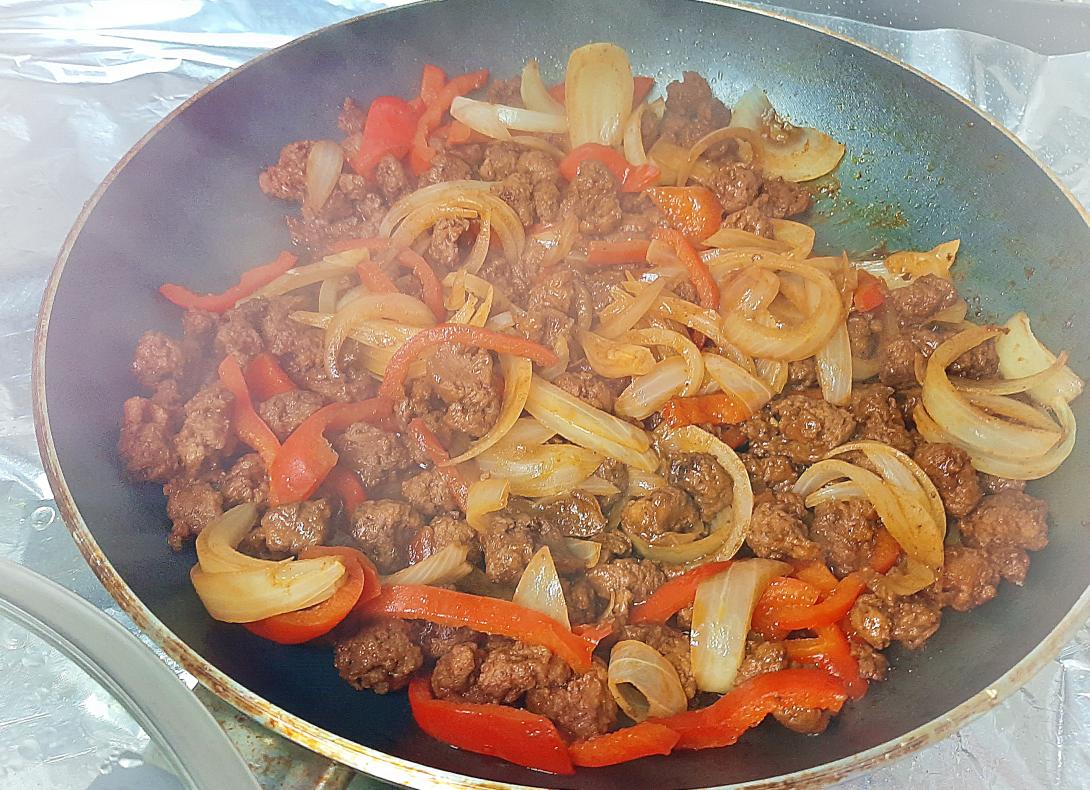
For the dish in the photo, I made the marinade from soy sauce, balsamic cream, paprika paste (tomato concentrate or passata works well too), mustard, cloves, cinnamon (though cinnamon is rarely used in savory dishes in Europe nowadays, unlike in the Middle East, where it’s still common), cumin, and smoked paprika.
Smoked paprika is a fantastic ingredient, one of the best for plant-based dishes when we want to achieve a “meaty” taste and aroma.
The marinade must be thick enough to coat the pieces and, when thrown into the pan, will sear onto the vegan protein.
Important: use very hot oil and add the protein gradually, not all at once, so as not to lower the temperature of the fat. If you do, it will cook instead of fry. The goal is to get a crispy exterior while keeping the interior juicy.
If you didn’t use a marinade, fry the vegan protein just soaked in the liquid. Once it’s seared a little, add soy sauce and balsamic cream and continue frying for a few minutes on low heat, stirring to distribute the ingredients until the liquid is reduced.
Add any vegetables you have. For the dish in the photo, it was bell peppers and onions. Onion is a very common ingredient in such dishes and, when sautéed, really enhances the flavor.
Fry the vegetables with the vegan protein, or cover and simmer on low heat.
If using a variety of vegetables (and many types work well), it’s a good idea to start with those that take longer to cook, like carrots, sliced thin, or in sticks.
Serve with a carbohydrate side. I served it with rice in this case, but potatoes, buckwheat, or even pasta are fine too. And of course, some fresh or pickled seasonal vegetables on the side.
Did you like this text? Do you want more similar ones? Support my blog
- Zaloguj lub zarejestruj się aby dodawać komentarze