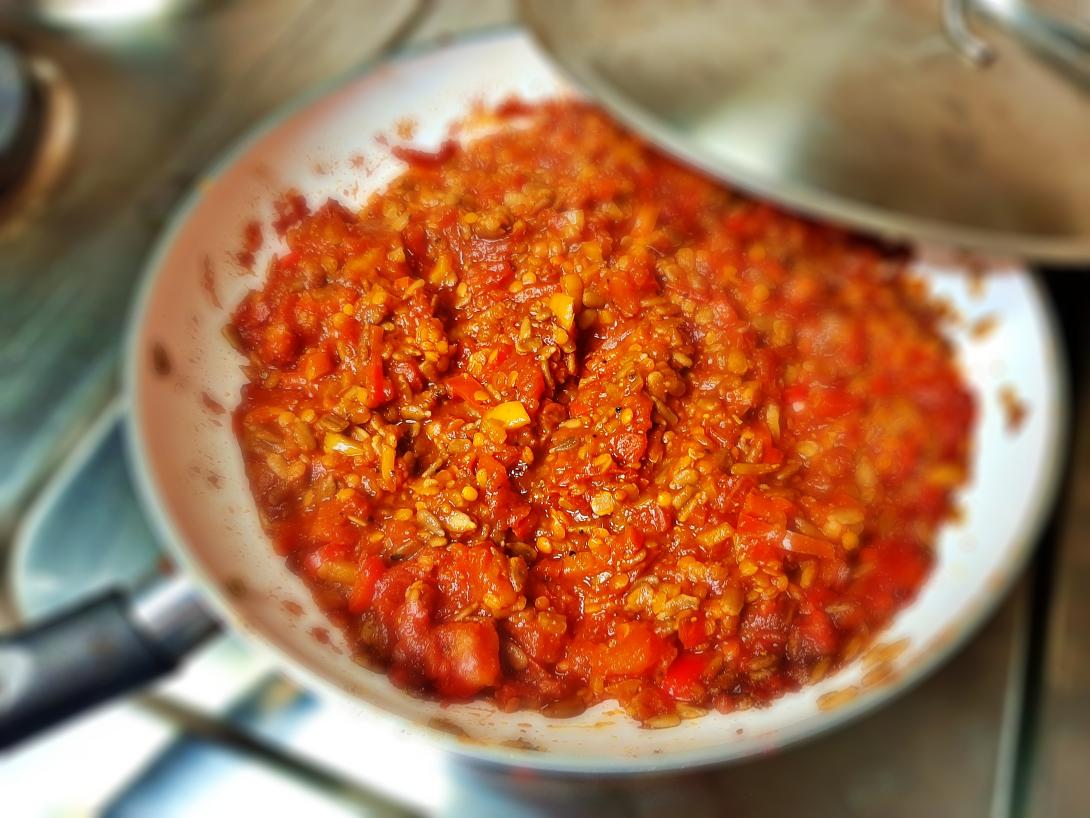
Continuing the kitchen inventory series: Lentils, sunflower seeds, and tomatoes. Still no onions, but when you live in the forest, going to the store is a whole expedition.
INGREDIENTS:
- 2 bell peppers of different colors (about 150–200 g)
- 100 g sunflower seeds
- 50 g red lentils
- 30 g olive oil (3 tablespoons)
- 30 g hoisin sauce
- 1 can of diced tomatoes
- 1/2 teaspoon cumin
- 1/4 teaspoon cinnamon
- 1/2 teaspoon ground garlic
- 1 teaspoon lemon pepper
INSTRUCTIONS:
1. Dice the peppers finely.
2. Heat the olive oil in a pan and fry the sunflower seeds.
3. After a few minutes, when the sunflower seeds start to brown and smell fragrant, add the hoisin sauce, peppers, and spices. Cook until the liquid from the peppers evaporates.
4. Add the tomatoes and lentils, cover, and simmer on low heat for 15–20 minutes, until the lentils are tender. Season with a teaspoon of sugar, agave syrup, or maple syrup if necessary.
5. The lentils should be al dente because they will continue to cook in the hot sauce even after you take them off the heat.
VARIATIONS:
- You can add almost anything to this sauce; grated carrots, celery, onions, or leeks work great.
- You can use tomatoes in various forms, such as combining canned diced tomatoes with passata for a good result.
- Of course, if you have the time and desire, you can use fresh tomatoes.
NOTES:
- The combination of cumin and cinnamon is quite important here, very popular in the Middle East and North Africa. However, this doesn’t mean you can’t season the dish to your liking.
- The dish will change in texture and gradually thicken as the lentils continue to absorb water. The sauce will also continue to cook the lentils in the hot liquid, making it different right after preparation compared to a few hours later or the next day. If the sauce becomes too thick, it’s best to thin it with a few tablespoons of broth.
- If you don’t have homemade broth, which is understandable, use a good vegetable broth.
- When I was in Poland, I used Rossmann broth. Now, I have Biozentrale broth, which I received from a guest. It’s a decent German company producing organic food.
SERVING:
- Serve with pasta or any other starchy side.
It’s simple and quick because if you start boiling the water for pasta at the same time as you begin frying the sunflower seeds, everything will be ready in half an hour or less. That’s why I use canned tomatoes here, as in other recipes. If someone has the time and wants to bother with peeling and deseeding tomatoes, go ahead. But in a restaurant where a meal costs more than a day’s wages for a worker, you can afford such luxuries. Because the price of the meal includes the labor of someone willing to bother with those tomatoes.
And here’s a note for those who are shocked and offended by my overly crude language. Well, pardon my French, but this is the language used in a real kitchen. Not the kind you see in beautiful TV shows or blogs. In a real kitchen, it sounds more like: “Why the hell would you bother with those tomatoes? Just use the canned ones. Are you out of your mind?” Not: “Would you perhaps consider using the canned tomatoes instead?”
Food is emotion. Very deep, primal, and basic, because it’s tied to what’s most important for our survival. And if you want to do something truly authentic in the kitchen, you have to live in those emotions. But that doesn’t necessarily mean you should use fresh tomatoes when you can simplify your life with canned ones.
It’s not about spending your life cooking. It’s about achieving the best possible balance between the cost and effort put into preparing a dish and the final result. And about technological progress, which has tremendously eased kitchen work. Not just thanks to inventions like canned goods and ready-made pasta, but also, and perhaps most importantly, due to the vast array of kitchen appliances. From timers to can openers to blenders, food processors, and multi-cookers.
It drives me crazy when I hear people talking about the “good old days” when everything was supposedly better, including in the kitchen. I would go mad if I had to make hummus by hand instead of with a blender or knead bread dough without a planetary mixer. The good old days are a delusion from pop culture that idealizes the lives of the upper and middle classes, those who dine in elegant salons, not those who toil to prepare the food in the kitchen dungeons.
And statistically speaking, most of us, except for a few descendants of aristocrats and nobility, would have been among those Morlocks slaving away in the kitchen or on the fields in those times.
Did you like this text? Do you want more similar ones? Support my blog
- Zaloguj lub zarejestruj się aby dodawać komentarze