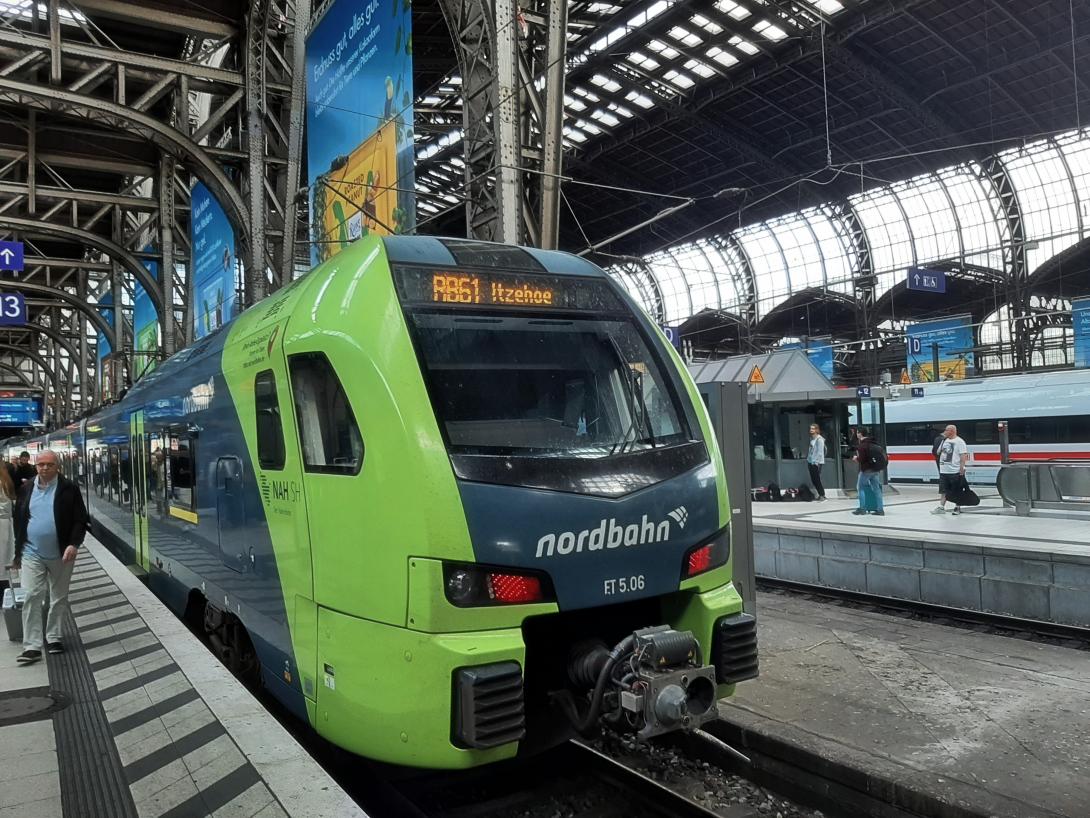
Football players and fans from all over Europe complained about the poor organization of the football championship in Germany and Deutsche Bahn. With the end of Euro 2024, the problems have not ceased; in some areas, they might even worsen. But there is hope for improvement.
Deutsche Bahn, the German railway, has long been a symbol of German solidity, the country of engineers, order, and punctuality, known for solid people and solid products. Euro 2024 shattered this beautiful stereotype. Media across Europe were filled with complaints from fans about the German railway.
UEFA, very rightly and nobly, wanted teams to travel to matches in four different German cities by train instead of flying. For most players, as they reported, this was a shocking experience. They were surprised that they had to travel by train like the general public. However, this noble and rightful idea in practice caused additional problems due to train delays, making teams sometimes prefer to risk a fine from UEFA and fly rather than miss their own match.
There were continuous mishaps. Fans from Vienna arrived at the match against France in the 70th minute after their train was stuck for several hours due to track repairs. The departure arrangements for fans after matches were not prepared, leading to hours of waiting for trains, and when they finally arrived, sometimes they went in the wrong direction.
A group of fans after the Italy vs. Albania match in Dortmund was directed to Bochum, where fans were returning from a concert by popular German actor and singer Herbert Grönemeyer. Interestingly, Grönemeyer is the author of the anthem for the 2006 FIFA World Cup in Germany. However, the atmosphere at the station was not pleasant.
The railway management was also completely surprised that English fans were traveling to Hamburg via the Netherlands, on a route that is already overloaded and delayed during the summer season, with some trains regularly being canceled.
The problems with DB did not start with the Euro. They have persisted and were dramatically exposed after the introduction of the 9 Euro Ticket in 2022. For three months, a ticket for all public transport in the Federal Republic — urban, suburban, buses, trams, city rail, metro, and even the water tram in Hamburg, and above all, train connections outside InterCity and EuroCity — cost 9 euros per month.
The idea was implemented quickly, in a manner completely unassociated with German solidity and planning, rather reminiscent of Polish cavalry and joyful improvisation.
Both the management of Deutsche Bahn and local public transport associations warned about the consequences. The transportation infrastructure, particularly rail, has been underfunded and overloaded for years.
On average, 27 million passengers (about one-third of Germany’s population) purchased the 9 Euro Ticket each month. Based on mobile phone data analysis, there were 42% more trips in June 2022 than before the pandemic in 2019. Almost half more. No wonder the trains were overcrowded, and the railway was dramatically overloaded, causing delays and breakdowns.
While the situation was still relatively normal in June, from August through September to November, every trip with DB was an adventure — you never knew where and when you would arrive.
The situation did not improve with the introduction of the Deutschlandticket priced at 49 euros for all public transport, which is half the price of a monthly ticket in a large German city. Within three months of its introduction in April 2023, 11 million people subscribed to it.
Euro 2024 was just another pebble triggering an avalanche of problems on the already overloaded DB.
Right after the Euro, I traveled to Hamburg twice and had problems both times, with something not running. The second time, unfortunately, it was my last return train, and thanks to Deutsche Bahn, I spent half the night at Hamburg’s main station, which was one of the most dangerous places in Germany last year. It was charming.
Although the station is much safer and calmer than last year, the police have pushed the problems out of the station and its immediate vicinity — drug dealers and users, alcoholics, the homeless, thieves, beggars, all the children of the night. But don’t be surprised to see someone sitting on the sidewalk in the middle of Hamburg smoking crack without a care.
Important are the words of Berthold Huber, DB’s infrastructure director, though somewhat from the category of “the emperor has no clothes”: “The key goal of the railway reform almost 30 years ago was to reduce the burden on the federal budget. That’s why the network was designed for cost efficiency over the years.” This sums up the neoliberal policy towards public services, which has led to the disaster of public services.
However, it shouldn’t look like a story in the style of “Germany is no more.” The everyday reality of traveling by train in Germany is such that the quality has deteriorated, trains are more often delayed (mostly around 15 minutes or less), overcrowded, and canceled, but it is not a catastrophe, as sometimes Germans themselves depict it, in-jokes about “what if Harry Potter were German? Nothing would happen because his train to Hogwarts would be canceled.”
One must also remember that on short routes, like my commute to Hamburg (60 km), trains run frequently enough all day that a delay or even a canceled train is not a disaster. For on the important Heidebahn route from Hanover to Buchholtz near Hamburg, where the train runs back and forth every hour, and Buchholz-Hamburg every 15 minutes.
These delays, platform changes, etc., are more of an inconvenience for visitors, like guests at the Euro, than for locals. If my train is late, I know I have the next one soon, where to transfer, etc.
And here, from the dark picture of misery, despair, and decay of railway infrastructure, we come to the positives.
Both the 9 € Ticket and the Deutschlandticket are wonderful achievements of the German welfare state. Symptomatic was the invasion of punks, and generally the riffraff, for 9 euros, on Sylt, an island in the North Sea near the Danish border.
Sylt is a German resort for the elite, famous for events like a minister’s wedding with a TV star. And recently, a group of middle-class youth having fun with a remix of Gigi D’Agostino “L’amour toujours” to “Deutschland den Deutschen, Ausländer raus,” meaning “Germany for Germans. Foreigners out.” Maybe they were annoyed by the foreign poor who came to Sylt for a day trip thanks to the Deutschlandticket.
Because the Deutschlandticket is a tool for leveling inequalities, especially between small towns and big cities, giving in the price less than a monthly commute ticket the possibility of unlimited weekend travel. This translates to someone, for example, going to the seaside or a big city on the weekend not spending extra money on tickets for transportation and can spend that money, for example, on dining out or sightseeing. This ticket is an investment, like practically all pro-social actions. A social investment.
If, for example, someone living in Hamburg or near Hamburg, in places like Klacken, Buchholtz, Uelzen, wanted to visit Bremen, they would have to pay 60 euros for a round trip and connections within Bremen. Now they pay 49 euros, which is half the average price of a monthly ticket, and have a free trip to Bremen. In the case of a family trip, this becomes a serious amount.
But even for an individual, it’s a few dozen euros that can be spent on attractions. In my case, it will primarily be a meal, but also, for example, visiting a museum or gallery or exploring social outcast neighborhoods.
In Bremen, currently, the neighborhoods of social outcasts start just outside the station, on both sides. Like in many large German cities stations now, it’s not safe, especially in the evening. This is a result of the pandemic and the war in Ukraine.
The result of the Deutschlandticket is a decrease in gasoline consumption in Germany, which translates into less pollution and greenhouse effects and (especially in 2022) lower gasoline prices and reduced inflation.
Despite all the downsides and problems that arose from the Deutschlandticket, it is undoubtedly the most important social investment of the current German government. An investment because by increasing access to cultural goods, entertainment, relaxation, savings in the wallets of the poorest, and reduced gasoline consumption, this ticket brings significant social benefits.
Cheap public transport tickets are both pro-social and pro-climate policy. They open new opportunities for the poorer part of society and reduce greenhouse gas emissions.
However, they come with high costs, currently amounting to 3 billion euros annually, shared equally by the federal government and state governments (Länder). The future of funding is still uncertain, with the federal government yet to confirm funding for subsequent years. For this reason, there are also voices about raising the price of the Deutschlandticket next year to 70 euros, the current price of monthly tickets. Money is a significant point of contention regarding the Deutschlandticket. Critics believe the money should be spent on repairing infrastructure and investing in railway stock.
The costs were further increased by decisions from individual Länder, which decided on additional subsidies. For example, in Hesse, the ticket price for social benefit recipients is 31 euros.
A problem raised in connection with the Deutschlandticket is that the ticket does not have a discount option for students or children and youth. Some Länder also subsidize this option.
In Hamburg, I know that similar (at least discounted) subsidies are also undertaken by other Länder (the Free and Hanseatic City of Hamburg is a separate Federal State of the Federal Republic), from the new school year 2024/2025, pupils and students will receive a 100% subsidy to the Deutschlandticket and will travel for free. Until now, the ticket for pupils and students cost 19 euros.
However, the persistent and worst problem remains the poor transportation communication in rural areas, where buses run infrequently, particularly problematic for evening returns from the city. In my town in Lower Saxony, where I live, connections to Hamburg and Hanover run from early morning until late at night. But the last bus from the town to my remote area and nearby villages runs after 6 PM.
And in this regard, the cheap ticket was a complete failure. First, the 9-euro ticket and then the Deutschlandticket were introduced hastily, at the last minute, and without any prior strengthening of the German railways or public transport in general, especially in rural areas. And the upcoming, overall positive changes that have already begun won’t change this. It will get worse before it gets better.
With the end of Euro 2024, the problems at Deutsche Bahn did not cease; in some regions, they will even worsen. But there is hope. Because with the end of Euro 2024, on July 15th, the largest renovation and modernization program in DB’s history began, set to last until 2030.
The first section to be renovated is the Riedbahn between Frankfurt and Mannheim. Over five months, 117 km of railway lines will be replaced, and 20 railway stations will be renovated. The cost of the renovation is 1.3 billion euros.
By 2030, 4000 km of railway lines are set to be modernized at a cost of over 45 billion euros.
The effects of the renovations are already being felt in Hamburg. At the beginning of August, the first repairs of switches, tracks, and railway bridges on the route to Berlin began. This resulted in more chaos and delays in Hamburg in all directions. A general overhaul, meaning even more chaos, is planned for 2025. Renovation and modernization are necessary on the line, which currently handles 230 freight and passenger trains (Hamburg is still one of the most important import-export ports, including for drugs, in Europe) and up to 30,000 passengers per day.
A problem for the planned modernization is the lack of personnel in the renovation sector, causing experts to be skeptical about Deutsche Bahn meeting deadlines.
It is significantly worse than it was before the pandemic in terms of punctuality, breakdowns, and overcrowding, and it will get even worse for a while. But the overall balance from a passenger’s perspective is positive, and it’s worth traveling. Just make sure to check the Deutsche Bahn app for changes and delays.
Did you like this text? Do you want more similar ones? Support my blog
- Zaloguj lub zarejestruj się aby dodawać komentarze