Some lottery bonus of fate is that I've never been a fan of either sweetened carbonated drinks or those awful sweet Mars bars, Twixes, Pigs, or whatever those brown things with corn syrup and additives are called.
Similarly, fast food. All those pizzas, hot dogs, burgers. Not even pizza. And I never really understood those fans, either. Seriously, do you think a burger with fries is the best thing you can eat?
So when I gave up animal products, I didn't miss those items or seek vegan fast food too much (except for falafel, but Lebanese falafel, I emphasize, is the king of all cuisine).
I didn't miss it too much or feel the need for consumption. I tried various plant-based burgers entering the market just to test them out.
It's somewhat of a professional reflex of mine, and partly my nature, to always try something new. Not just in the kitchen... you'd be surprised at the uses a TV remote can have...
I tried the famous Beyond Burger for the first time in Hamburg in 2019, at Vincent Vegan's. I had... well, if someone likes fast food, that's cool. Not my cup of tea.
I even prefer craft plant-based burgers made according to the local recipe, although it's not my first choice when eating out. But at Nieinaczej in Katowice and Veganbar in Bremen, I'd gladly have them again.
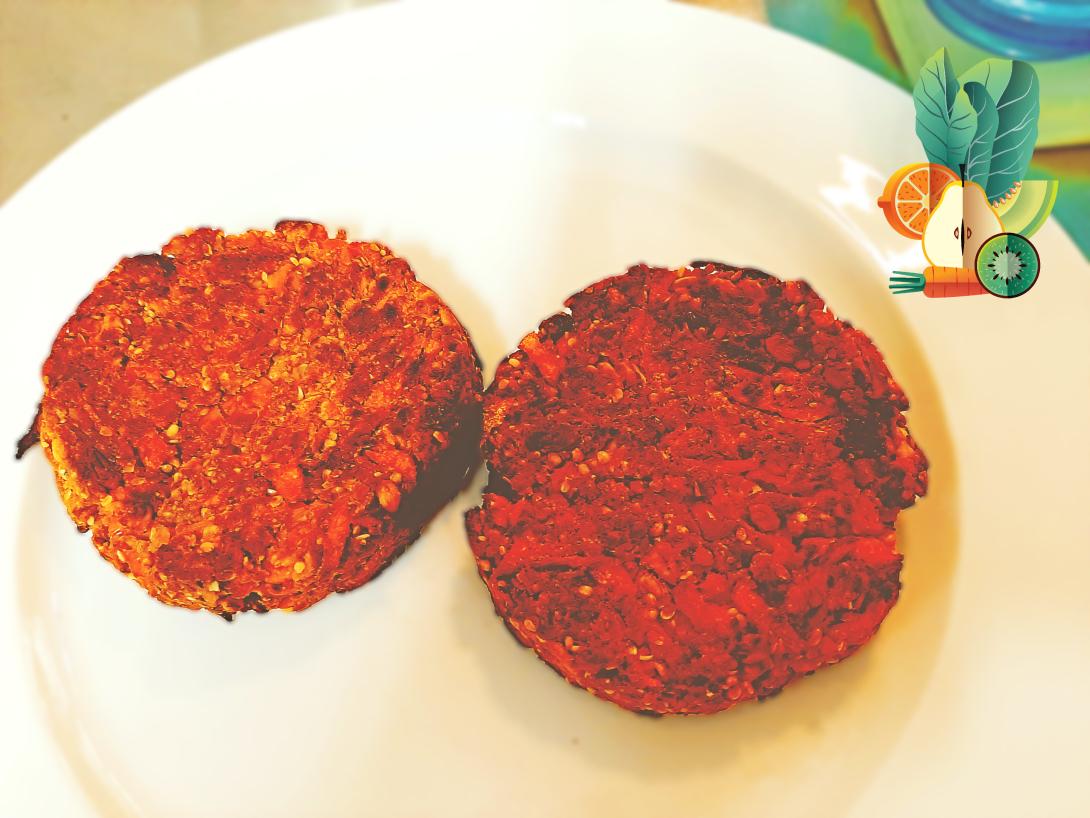
For now, I've come up with my own burger, if you would be so kind as to try it.
INGREDIENTS:
300 g carrots
1 can of chickpeas (or an equivalent amount of cooked chickpeas)
50 g shelled hemp seeds
50 g oil
50 g oats
1/4 teaspoon cumin
1 teaspoon smoked paprika
ground pepper
ground garlic
100 g sun-dried tomatoes in oil (drained)
60 g fig mustard (or other sweet mustard)
3-4 tablespoons potato starch
2 tablespoons ground flaxseed or chia
PREPARATION:
Grate the carrots using a grater with large holes.
Pour hot water over ground flaxseed, mix, and let it thicken for a few minutes.
Drain the chickpeas (you can use aquafaba to make mayonnaise) and blend them with the tomatoes, oil, and spices in a food processor.
Add the remaining ingredients and mix well.
Let it sit for half an hour.
Shape into round burgers using a pierogi ring, for example, and bake in an oven preheated to 470 K/200 C degrees for about 20 minutes.
VARIATIONS:
Burgers are a product into which you can put almost anything into, as long as it grinds well and sticks together.
The key with plant-based burgers is to use ingredients that will "glue" everything together. In classic meat burgers, the meat itself gets the right sticky consistency during cooking, and eggs are often used additionally.
Here, ingredients like flaxseed, chickpeas, potato starch, millet, oats/oat flour are binding ingredients.
It's also important to remember that burgers provide protein, so plant-based burgers should be based on protein-rich ingredients. Legumes, tofu, seitan, hemp, nuts are examples of ingredients high in protein.
NOTES:
It's worth making burgers in larger quantities and freezing them after baking. And they don't have to be just burgers, of course. You can shape them into something more like a meatball or a type of cutlet.
SERVING SUGGESTIONS:
Serve straight from the oven or fry lightly over low heat with a small amount of oil, covered.
Like a typical burger in a bun with fresh and pickled vegetables and sauce, or as a main course.
With some carbohydrates and salad.
For me, it's coleslaw with white cabbage and dumplings made from wheat flour with polenta.
My childhood was primarily a time when my illness began. Around the age of eight or nine, I started showing symptoms of anxiety, which was probably childhood depression. Maybe anxiety that developed into depression? So it wasn't a very joyful period. And because I also had social anxiety, it wasn't a time for building good relationships with peers. Quite the opposite. My superpower is creating maximally toxic relationships.
But one thing was, to say the least, great about my childhood. And I probably owe it to the fact that neither sweetened fizzy drinks nor corn syrup flavored identically to natural ones attracted me. And it trained my immune system and thanks to it, apart from depression, I hardly ever get sick.
The phenomenon of allotment gardens, or as it was called in my childhood, "workers' allotment gardens," was a 19th-century initiative aimed at supporting poor, usually working-class families in Germany, and shortly thereafter in Poland.
These two countries are the allotment garden phenomenon. Germany with almost 900 thousand allotment gardens and Poland with a population half the size, 850 thousand.
The primary goal of allotment gardens was to provide additional calories for the poor in cities. Often initiated or at least supported by factory owners because workers needed less money to survive and were less determined to strike.
The second goal that emerged shortly afterward and made allotment gardens a cultural phenomenon was recreational, promoting healthy active leisure, in nature, first for children and then for entire families.
Such a plot was my father's passion, he grew up in a poor peasant family in the countryside, where there was only one pair of shoes for several children. For me, it was a place where I spent a significant part of my childhood.
And thanks to that, I now have a chance to live to be 100 years old.
Professor Ewa Stachowska from the Pomeranian Medical University, a specialist in nutrition and gut microbiota, and also able to speak in a language understandable to the average person, published a video about "blue zones," regions with the longest life expectancy, the highest percentage of centenarians. She pointed out that what connects these zones are ALLOTMENT GARDENS!
Surely this is influenced by the fact that gardening is a physiological movement, a moderate physical activity recommended by the medicine of lifestyle, but also, and perhaps above all, about... dirt. About digging in the soil, about bacteria. About enriching and strengthening our natural bacterial flora in this way.
My childhood was apples straight from the tree, tomatoes from the bush, strawberries, and stuffing myself to the brim with fresh vegetables and fruits. And my father had a "hand" for it, and everything was of the highest quality. Now these products are labeled as organic, eco-friendly, traditional, and sold for a lot of money.
Of course, off-season, there were also organic, eco-friendly, and craft preserves. Tomato puree, pickled and canned cucumbers, sauerkraut (a treasure for the intestines and one of the few products that, due to its health properties, deserves to be called a "superfood"), jams, juices, and compotes, own dried beans, and dried peas for winter. I probably forgot something.
And it strengthened my health and shaped my tastes and eating habits.
And undoubtedly, the impact of allotment gardens on the population's health, on eating habits, and the quantities of vegetables and fruits consumed is at a level clearly felt by the burden on healthcare.
The fact that some kids, like me, grow up in a garden, eating fruits and vegetables straight from the bush, translates into fewer cases of diabetes, obesity, and heart disease later on, which means shorter queues for doctors, thus better and longer, healthier lives not only for those kids (and their families) but for society as a whole.
There is also another interesting relationship along the way. Because if someone has their own vegetables and fruits, it means they will cook with them. And the more home cooking, the less highly processed food and ready-made meals, so-called convenience food, which means less saturated fats and fats, less salt and sugar, which also means shorter queues for doctors.
Allotments also play another important role. They are regulators of the weather in cities (as are all green areas). In a city that is paved over, there is nowhere for water to go during rain, leading to flooding, and because it doesn't soak into the ground, it's dry and hot in the summer, and a paved square instead of a lawn is a huge insulator, resulting in much larger storms.
Today, there is a housing estate on those plots. In 2009, the neoliberal Polish government tried to eliminate allotment gardens in Poland. In place of allotment gardens at Okęcie in Warsaw, a Business Park was already planned (the word "park" is beautiful here). Social mobilization defended allotment gardens at that time.
Now, after the "return of democracy" and the removal of criminal populists from power, the same neoliberal team is again, this time from behind, trying to eliminate allotment gardens through amendments to the spatial planning law. And considering that the dominant format is convenience stores like Żabka, Polish imitation of the USA will succeed in creating "food deserts" in place of allotment gardens.
Did you like this text? Do you want more similar ones? Support my blog
- Zaloguj lub zarejestruj się aby dodawać komentarze