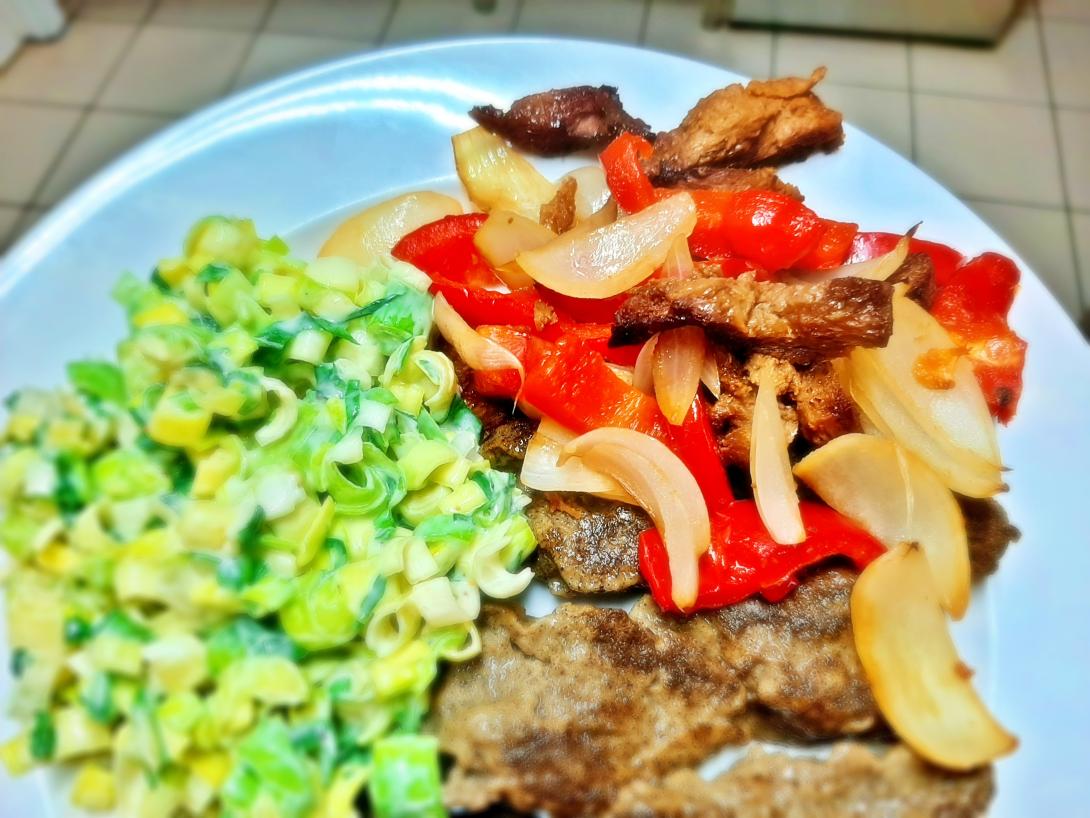
I like the name "Traditionally roasted Soymeat" The fact that something is traditionally roasted (especially if it's wood-fired...) nobilizes what ends up on the plate.
What's funny is that it's part of the mythology of the Golden Age, present in human cultures forever.
INGREDIENTS:
10 previously soaked soy cutlets (see Notes)
2 onions (about 150 g)
1 bell pepper (about 200 g)
marinade (see Variations)
balsamic vinegar
Ketjap Manis sauce (sweet soya sauce)
Soy sauce
hoisin sauce
PREPARATION:
Preheat the oven to 200 degrees Celsius/ 290 Fahrenheit.
Drain the soy cutlets and cut them crosswise.
Slice the onions into strips.
Cut the bell pepper into quarters, remove the seeds, and slice into strips crosswise.
Mix the ingredients for the marinade in roughly equal proportions, with more hoisin sauce, which will thicken the marinade.
Mix the soy cutlets with two to three tablespoons of the marinade, spread them on a baking sheet lined with parchment paper, and place in the oven.
Bake for about 15-20 minutes until all the liquid evaporates and the soy cutlets begin to brown.
Add the onions and bell peppers to the baking sheet, mix, and bake for another 20 minutes.
VARIATIONS:
In dishes like this, fried or baked, a good marinade/seasoning is the key to flavor, and the ingredients are quite flexible.
The essence of the marinade is to provide flavor, especially umami, and the sugar needed for the Maillard reaction and caramelization, crucial processes in the browning and flavoring of fried and baked dishes, all those roasting flavors and aromas.
Additionally, vinegar balances the sugar flavor and adds its own aromatic substances, its own flavors. So, intense-tasting and aromatic vinegars will be best, such as matured balsamic vinegar (also providing additional sugar), and fruit vinegars, led by popular and common apple cider vinegar.
For the marinade, you can also add tomato puree or paste as another source of umami.
Of course, you can add spices such as smoked paprika, ground garlic, cumin, juniper, ground nutmeg. Generally, the same spices are used in similar marinades for meat.
Hoisin and Ketjap Manis sauces provide sugar; instead, you can simply add a teaspoon of sugar, preferably Dark Muscovado, or use some syrup.
For some time, I used various homemade syrups from dandelion, elderflower, white mulberry, apple with onion. Such homemade or good-quality natural syrups will also go perfectly with the marinade.
NOTES:
Prepare the soy cutlets according to the instructions on the package. More or less. It's best to cook them in water with the addition of soy sauce and spices such as juniper, nutmeg.
More about "soy cutlets" in this article
SERVING SUGGESTIONS:
Serve as a typical, classic main dish, with potatoes, dumplings, and salad.
I served them with black dumplings made with hemp flour and leek salad.
But on the second leg, the next day, it went with rice for burritos, and along the way, it worked as a cold platter.
And the baked soymeat is ready. For me, which I recommend to anyone with a mini oven. An interesting thought, I think, is the link between the popularity of mini ovens and the collapse of the traditional family model. A mini oven is a product for singles and families of a maximum of three people (the dog doesn't count, pets are not family, they are slaves).
But let's get back to the traditionally roasted...
Was it really so great when food came from the oven, especially if it was wood-fired, or worse, with coal, wood, or cow dung? Was it really better?
We're not talking about mortality, malnutrition, or social issues, but purely culinary.
The food was of dramatically poor quality; a common problem was food adulteration, adding gypsum or sawdust to bread, milk was commonly diluted and colored with chalk or gypsum.
Today's sanitation rules were unknown, as were concepts like "bacteria" or handwashing. Poisonings were common, especially since people commonly (out of poverty and food shortages) ate products that today we throw away as spoiled, stale, or stinking.
Do you know what botulism is? Or poisoning with ergot? Do you know anyone who has had such poisoning?
No. Same with salmonella. Salmonella poisonings still occur, but they have ceased to be common. They are now more of an exception than a norm.
And the oven itself? Fired with coal. Wood. Cow dung as was done in some regions of the world. Is this such a great kitchen appliance? Is it the best baking technique?
Better than a convection-steam oven, where I can precisely set the temperature and humidity and maintain it consistently. And for a set time?
For example, I set the oven for 30 minutes, 180°C, convection (an additional option that those mythical "wood-fired ovens" didn't have), and I can set a specific humidity level (was a bowl of water in the oven better?)
I set it, turn it on, it bakes bread for me for an hour. It turns off and beeps. I take out the bread; I don't have to watch it, supervise it, add fuel.
And the baking process is exactly repeatable, it proceeds in the same way, so the result is the same.
With old equipment and techniques, often other dishes and flavors were made. Many of those old dishes would be unappetizing to us today. Tastes, flavors, and culinary habits have changed.
Two hundred years ago, I would have written recipes in ink on expensive paper, carefully and slowly (because corrections were a pain, even in the days of typewriters). And there are certainly enthusiasts of such manuscripts, beautifully calligraphed, with ornate capitals, drawings instead of photos of products and dishes.
I understand this sentiment perfectly. I have, for example, a hundred-year-old "Ich fann kochen," printed in Gothic script. A beautiful collector's item, an ornament of my cookbook collection. But nothing more. As a highbrow being, I could photograph myself against these books. But it's definitely better, more comfortable, faster, more efficient, and tastier to write them on a computer.
Of course, one can measure the value of cookbooks by their collector's value, collect album editions such as Hildeman's books (also an ornament of my collection, because these books are unlikely to be reissued). When I was little, many of my friends collected "Hot Wheels," tiny scale models of cars; there were those who collected beer and soft drink cans, others pictures of actors, footballers, rock stars.
Of course, traditions (because there is no single culinary tradition, e.g., Polish or German) are valuable, and anyone who dismisses them has no place in the kitchen.
But the kitchen is not a reconstruction of the Battle of Mahon. Historical reconstruction and the same sentiment as the "wood-fired oven" about our imagination of the past. What's missing are such details from the past as burning villages, raped peasants, children, trampled crops, infectious diseases, diarrhea, severed heads, hands, legs, gutted intestines...
But it would be interesting if reconstructions were enriched with such things, such as the invention of mayonnaise during the Battle of Mahon. And rapes of peasants.
My favorite old dish, which my guests also liked, is flatbreads.
In a multiculti style, for example, with guacamole, but also my favorite with pulled soy. And even omitting what I put on the flatbreads, I generally don't give a damn about tradition. And I bake flatbreads on a large pan with a thick bottom, not on stones.
Faster, easier, and simpler than on stones. And I definitely don't miss the times when flatbreads were baked on stones, not on an electric stove.
The story of the good old days is not a story about what was once. It's about what we want it to be.
The longing for a "wood-fired oven," for the good old days in the kitchen is a longing for good food. That's why the popularity of locality or slow food is increasing.
This element from the past, which actually matters here, is the scale of production. What positively distinguished old food was the scale of production. We don't long for food from the oven or for the good old days that never existed but for good, craft food. For the production "on a human scale," for food produced with the assumption "that a person matters" and not just profit indicators. I mentioned once about "culinary Marxism," the invention of some blogger with no clue about cuisine and cooking.
But here we come to a point where it checks out, and "culinary Marxism" turns out to be an important element of food trends, appreciating local flavors and cultural diversity of food, against thousands of McDonald's with the same menu worldwide. It's a communist idea—the right to taste.
Carlo Pertini, the creator of the idea and name slow food, was a communist culinary critic in "Il Manifesto" and "l'Unità," a member of the Communist Party of the Proletariat's Unity. The whole current trend towards local, sustainable cuisine is partly a communist legacy. And the groundbreaking point of the birth of Slow Food was a demonstration against the opening of McDonald's on Piacca Navona, near the Spanish Steps in Rome, in the historical, protected part of the city, in 1988.
It's very significant how slow food has been castrated and commodified by global, especially lifestyle, media, as an attraction for tourists. This is a contradiction to Petrin's ideals and slow food, which opposed phenomena such as touristification and globalization.
Pertini's basic work "Slow Food. The Right to Taste" is a critique of the global food system. It is also from the very bottom a critique of the current neoliberal turbo-capitalism, where every activity and every aspect of life undergo acceleration, productivity pressure, and growth.
Slow eating, celebrating (and that's communal, what a waste of time! which could be spent on building the boss's wealth in his corporation) shopping, cooking, and table, not as anonymous, depersonalized, and degraded consumption (not for nothing did Slow Food start with a protest against McDonald's, which is a symbol of this pathology of the food system) but as building community, society, enjoying pleasure, and wasting time. This is a contradiction to the Protestant capitalist dogma of salvation through hard work.
There's an anecdote from here to Munich with a beard.
An American came to Greece and met a fisherman who sat in the port, doing nothing.
-Why aren't you doing anything? If you worked more, you could buy a second boat, hire people, then you'd have a whole fleet of boats and employees. And you could lie down and sunbathe.
-But I'm lying down and sunbathing
The wise Greek nation with the wisdom of its great philosophers, I would see Krates's influences here.
I lie down and sunbathe, and that's what slow food is about. Not about getting a fleet of boats so you can do nothing, but about doing nothing and enjoying life. Or doing the minimum needed to enjoy life. And it's not about the individual choice of someone who leaves the corporation, nor is it a story about another fad like workation.
It's about every cleaner, tram driver, all of us working as little as possible. So that we have time to devote our lives to what really matters. To our loved ones, family, relationships with others, relation with the world, enjoying life.
And this is not possible without a profound systemic change, a change called socialism. Food socialism alongside culinary Marxism will probably be from today my favorite term to describe my cooking style.
Did you like this text? Do you want more similar ones? Support my blog
- Zaloguj lub zarejestruj się aby dodawać komentarze