Easter, somewhat in opposition to the Polish Christmas Eve tradition, is a difficult topic to tackle in a plant-based kitchen, with meats, cold cuts, and eggs dominating the table.
Creating a plant-based menu for Easter is much more challenging and requires more creativity than for Christmas Eve, where in many dishes there is no need for more than minimal changes like replacing gelatin with agar.
Also, the egg on the Easter table is very difficult to replace due to its symbolism, both Christian and much older, reaching even to such distant from Christianity places as Tibet, where according to ancient beliefs, the universe was created from a cosmic primordial egg. Which is actually quite a common belief. The egg is a symbol of both the birth and rebirth of life after winter, as well as the resurrection of Christ.
But surprisingly, there has been one product on Polish Easter tables for centuries that carries a somewhat similar symbolism. And which, in Polish folk tradition, is an essential ingredient of Easter Breakfast. A product that is 100% plant-based.
Various spring vegetables can also serve as a direction for a plant-based Easter menu. Easter was traditionally a time (in the era before greenhouses and before imports from Peru and Morocco) when the first young vegetables landed on the table, and all of them corresponded perfectly with the holiday character.
Particularly interesting is the radish. Today available year-round, just a few decades ago it was only available in two short time windows in autumn and spring, precisely around Easter. So why not reach for radish leaf pesto or other greens such as parsley, young nettle (after blanching), or wild garlic.
But Easter cuisine is not just about meat and eggs. It's also, at least for me, various cold sauces for those eggs and meats, sauces that I loved in childhood. In my family home, tartar and horseradish-based sauces based on mayonnaise were dominant.
And it's these sauces that I referred to. Another important element of the Easter table was horseradish. Important not only culinarily but also symbolically.
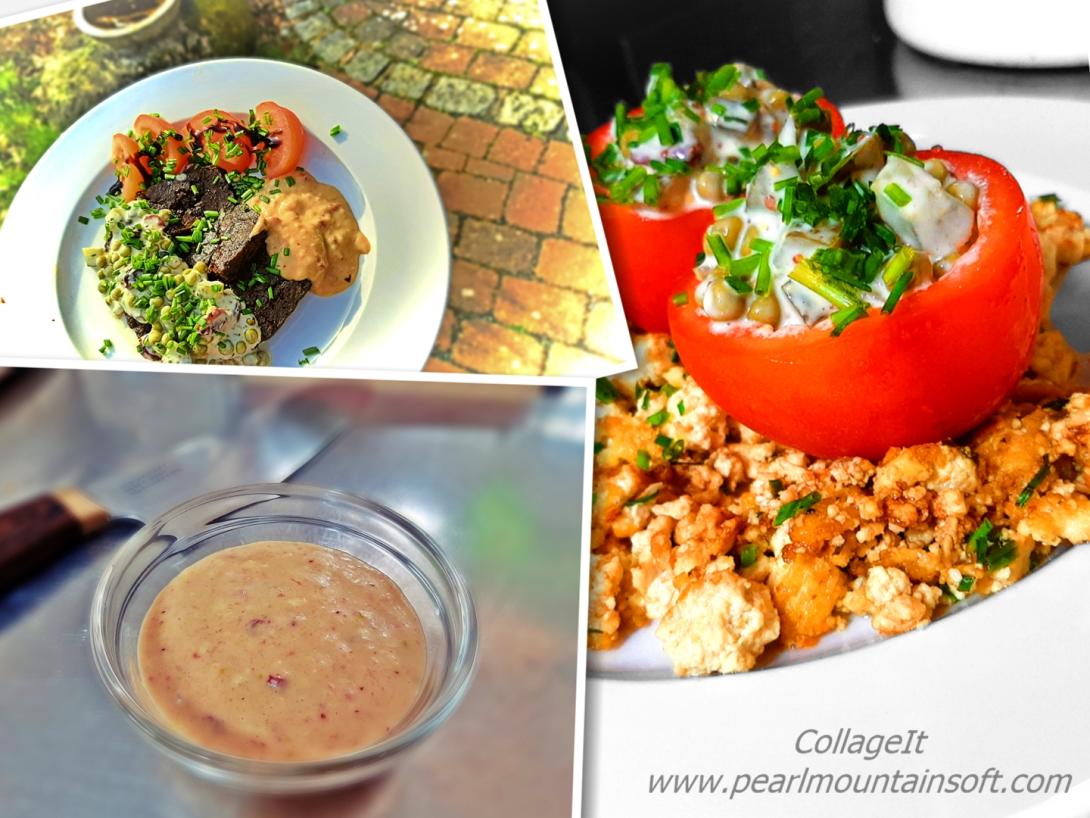
Mayonnaise sauce
INGREDIENTS:
1/2 can of peas
100 pickled cucumbers (3 medium)
two teaspoons of green pepper from the brine
150 g mayonnaise
30 g (heaped tablespoon) mustard with mustard seeds
60 g dried cranberries
PREPARATION:
Drain the peas and green pepper from the brine
Cut the pickles into cubes
Mix all the ingredients and refrigerate for a few hours to allow the flavors to blend
If necessary, season with sugar or lemon/lime juice
VARIANTS:
This sauce is quite modest in its version. You can add various spring novelties to it, like chives, radishes, wild garlic.
NOTES:
In this sauce, it is important to balance the sweet taste with a weaker third note, the sharp taste of mustard.
Two horseradish sauces with cranberries
I made the sauces in the style of "culinary Marxism" (I love that term) and combined Polish and Japanese ingredients, so to the traditional horseradish, I added Eutrema japonicum, also called Japanese horseradish or wasabi.
What is important with wasabi—it gives a very nice green color.
The third ingredient in both sauces is cranberries.
This is a tradition in both Asian and Polish cuisines. Combining salty, sour, spicy tastes with sweet ones, with fruits. Interestingly, in old Poland, figs were popular, of course, among the nobility. The poor were satisfied with dried fruits like apples, pears, and plums (still popular in Poland), often smoked, which is a typical Polish specificity.
If I were to name the most important contribution of Poland to world culinary art, it would be the use of smoked fruits. It works excellently in plant-based cuisine in any dish where we want to achieve a meaty and smoky taste.
For warm use
It may not appeal to everyone. The combination of strongly coconut cream and horseradish may be strange for some, but a friend on whom I conducted tests said it was excellent and would also be suitable for a sandwich instead of butter or lard.
INGREDIENTS:
100 g horseradish
50 g wasabi
30 g creamed coconut
50 g dried cranberries
100-150 g coconut milk
lemon juice
PREPARATION:
In a small pot, melt the creamed coconut over low heat, add wasabi and horseradish, and fry for a few minutes, stirring constantly. Add coconut milk and cranberries
On low heat, stirring constantly, bring to a boil and cook for a few minutes.
Season with lemon juice and remove from heat. If necessary, season with lemon juice and sugar to balance the flavors.
For cold use
100 g horseradish
50 g wasabi
1000 cranberries (jam)
1000 g mayonnaise
lemon juice
PREPARATION:
There is no philosophy here, except that wasabi can be difficult to mix.
It's best to start by thoroughly mixing the wasabi with part of the mayonnaise, then add the rest of the ingredients. And of course, let it marinate to meld the flavors.
VARIANTS:
Of course, there are other versions to try with different proportions. So that the sauce is thicker/thinner, spicier/milder
Instead of cranberries, you can use, for example, dried currants.
NOTES:
Creamed coconut is a paste made from ground coconut pulp, solid at room temperature, and of good thick cream consistency when melted.
A lot of the recipe depends on the horseradish used. The recipe refers to a fairly typical "jarred" horseradish. Of course, it's nice to use freshly grated horseradish, but who really does that?
And I don't think we should lament over every such commodification of another element of food production.
Products like ready-made pasta played a huge role in the process of women's emancipation. Social development is a derivative of the development of productive forces.
So there is no need to either make pasta yourself (and I remember that from my childhood) or grate horseradish.
Wasabi protip: Wasabi is often available in plastic tubes that are impossible to squeeze everything out of. Just cut the tube with scissors to make it easy.
I used exactly 120 g of coconut milk, but the kinds of milk vary greatly, more or less dense. It also depends on how thick you want the sauce to be. In proportion to 120 g, after chilling, the sauce can be spread on bread.
SERVICE:
The simplest way is, of course, to serve the sauces in bowls. You can also make them part of a larger dish, e.g., serving with seitan or filling with mayonnaise sauce, e.g., a tomato.
With horseradish and a spicy flavor, it burns, stings, but we like it. Because a spicy taste is not a taste.
We recognize five tastes: sweet, salty, sour, bitter, and umami. And spicy is pain. Spicy spices do not stimulate taste receptors; they stimulate pain receptors.
Therefore, symbolically, it was widely available, even for the poor when chili and pepper were imported from Asia and very expensive, hundreds of years ago, it was a symbol of the Passion.
And a deeper symbol than was probably commonly understood at the time.
Because we like spicy taste because pain stimulates the secretion of endorphins. in short, natural narcotics, painkillers, and euphorics. A little high. In religious language, it is called elevation or ecstasy.
And this transformation of suffering into ecstasy is an excellent metaphorical telling of a story as old as mankind, and according to some, older, because it comes from the Neanderthals.
About the sacrifice of a dying and resurrecting god. This is what the Spring Festival is about, called Pascha in Christianity
This can be, as in the original cults described in the Golden Bough, purely physical, the king's sacrifice serves good harvests
And it can be, as in Christianity and in tantra, a sacrifice leading to spiritual rebirth or realization. After all, they are just words; they can mean anything, but you don't cook soup in a pot with words or cut onions with them.
The story at the heart of the Spring Festival "It's all garbage" if it's just a story and not a living experience, a living experience. Just like cooking and tasting soup.
And the tradition of sacrificial feasts present at all levels of religious development is an important element aimed at bringing this experience closer.
Whether through the Buddhist sensation of one taste or the experience of suffering in the taste of horseradish.
Did you like this text? Do you want more similar ones? Support my blog
- Zaloguj lub zarejestruj się aby dodawać komentarze