I try to manage the products during events in a way that produces as little waste as possible. Reducing food waste was one of my goals last year and still remains high on the priority list.
Of course, there's always something left, and for a few days after the event, I build my menu largely from what's left and what ideas I come up with. And from that perspective came the inspiration for pancakes for breakfast on the first day of the first vacation of the year. I had my vegetable base for soup and canned kidney beans, from which I used aquafaba for mayonnaise.
Additionally, I remembered a can of lupine flour among my products to be tested. Ever since I discovered lupine yogurt in Germany and became interested in lupine, I've been increasingly fascinated by it.
INGREDIENTS:
- 100g lupine flour
- 100g chickpea flour
- 100g root vegetables grated on thick holes on a grater (see Notes)
- half a teaspoon of black salt
- 300-350ml soy milk
- 100g red kidney beans
- 100g squeezed soy granules (see Notes)
sauce
- 100g tofu
- 20g coconut milk
- 20g soy yogurt
- lemon juice
- salt
-dried dill (fresh also obviously fits)
- ground garlic (see Notes)
- a pinch of black pepper
PREPARATION:
Mix the flours with black salt, add soy milk, and mix into a uniform dough slightly denser than pancake batter.
Mash the beans with a fork, as small as possible, add to the dough, add vegetables, and mix thoroughly.
Heat a small amount of oil in a pan and spoon the pancakes onto it, lightly pressing each pancake down to make it thinner after placing it.
When after a while, the bottom part solidifies, cover and continue frying on both sides, covered, over low heat, so that the pancakes also cook inside.
sauce
Blend tofu with yogurt and lemon juice, season with salt and dill. The sauce should be thick enough so that it doesn't spill too much when applied to the pancakes. It should be sour and slightly salty.
VARIANTS:
There are legion variants. Starting from combinations of lupine and chickpea flour in different proportions or using only one, or enriching the mixture with hemp flour (staying on the topic of high protein content).
Also, the used vegetables can vary. For example, you can use grated zucchini. Then you need to add more flour because the watery zucchini will dilute the dough.
You can make rosti, i.e., potato pancakes from coarsely grated potatoes with flour, chickpea/lupine.
Similarly, kidney beans and soy granules can be replaced with tempeh, tofu, or other protein products.
NOTES:
As I wrote above, this dish was inspired by what was currently available and needed to be consumed, combined with an approach that favors high-protein dishes.
I used a specific type of TSP, much larger than granules but much smaller than any cubes or soy chunks. If you don't have this form, use granules or patties or pieces cut into small cubes.
I used vegetables that remained from my soup base in the composition: 2 parts carrots, 1 part celery, and 1 part parsley root. Parsley root, is quite popular here, I use it instead of parsley, which in my opinion has lost its old sweet taste, which is definitely more noticeable in parsley root.
You can use fresh garlic, then the sauce will be sharper. Also in the smell from the mouth.
SERVING:
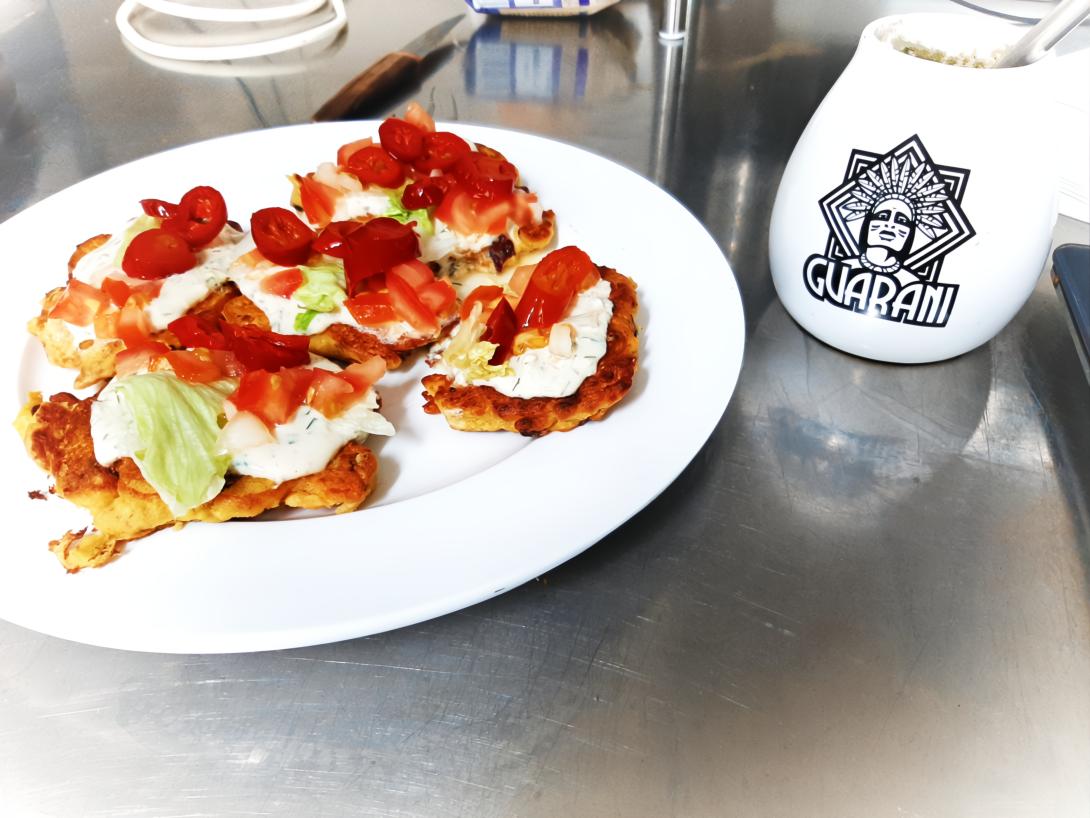
Serve with dips, dips, fresh, pickled, and marinated vegetables. Depending on what we have, what is in season. I added tomatoes with white onion and with lemon juice. Because that's what I had. And lettuce, which I had left over from the event.
NUTRITIONAL VALUES:
(rough data)
100g of pancake batter has 12g of protein and only 134 calories.
for a portion like in the picture: five 50g pancakes, I used 20g (2 tablespoons) of oil which gives us a total of 514 kcal and 30g of protein.
In addition, 70g of sauce and we have about 580 kcal and 35g of protein.
Lupine was domesticated over four thousand years ago in the Mediterranean basin and independently, one and a half thousand years later, in South America. The South American line of lupine cultivation practically disappeared under Spanish occupation.
In Europe, lupine has been cultivated since antiquity, also as fertilizer and animal feed. Partly because it was a low-maintenance plant and not necessarily tasty and safe for humans. In old varieties of lupine, alkaloids were contained, causing a bitter taste and in the case of incomplete rinsing, posing a risk of poisoning.
At the turn of the 20s/30s of the 20th century, low-alkaloid varieties of lupine were developed in Russia and Germany, called sweet lupine, and these are currently widely grown both for fodder and for human food.
And this lupine is a superfood. It contains 36g of protein. What is this content? It's the record, not only in terms of plant products. It is also the only plant product next to hemp seeds containing all essential amino acids, meaning all those proteins that we need to supply to the body with food because our body is not able to produce them on its own.
In addition, it has a lot of fiber and a very low glycemic index. Both translate, in a nutshell, into lower body weight and overall better health and longevity.
In Germany, several companies use lupine as a base for vegan yogurt alternatives, meat, cream cheeses, or tempeh production. A package of lupine seeds is coming to me and before the end of my vacation, especially since the weather is promising Tippischenorddeustches, I plan to create something from it.
Did you like this text? Do you want more similar ones? Support my blog
- Zaloguj lub zarejestruj się aby dodawać komentarze