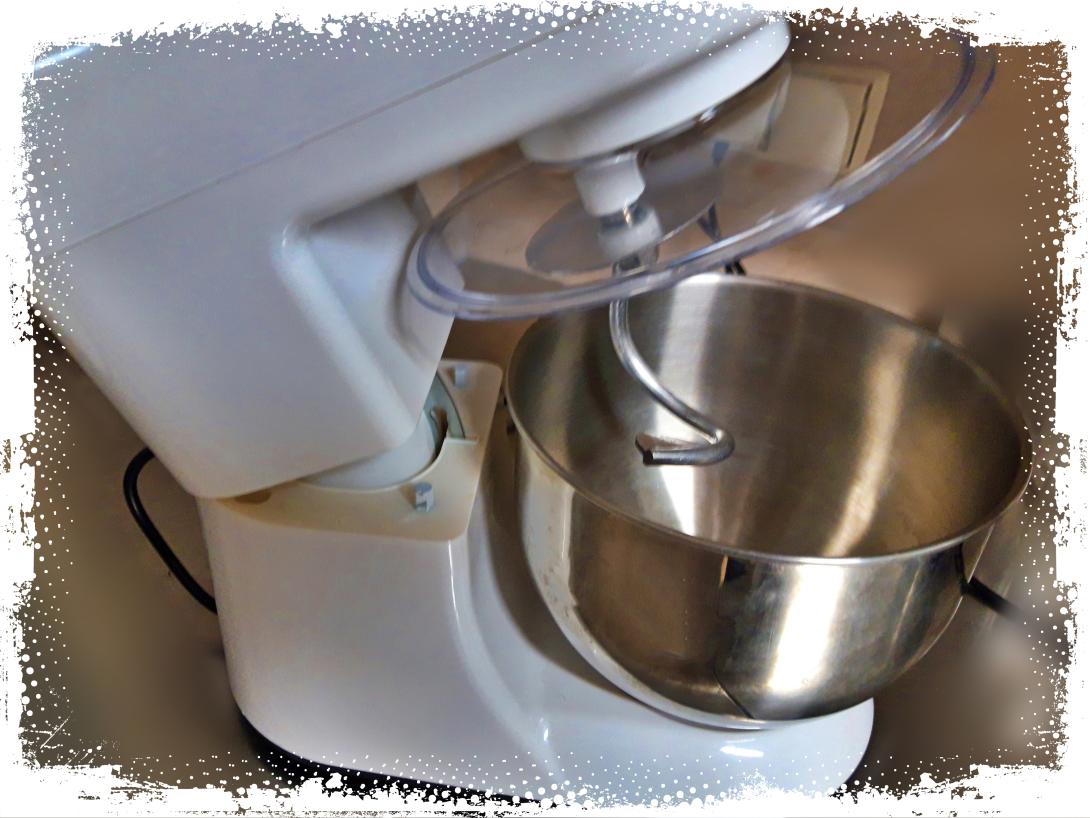
One of those conveniences, one of those devices without which, after some time, you wonder how you ever lived.
Unless you practice zen while kneading dough for 20 minutes. But, quoting a classic, for that you need a lot of phlegm in you — and “in me there’s nothing but fury.”
If you make dough, bread, angel wings (faworki), or anything that needs long kneading, a planetary mixer is something you need.
You can buy a cheap mixer for around 300 zł, and in Germany, even below €100, up to several times that price. I’m talking about home equipment.
At the low end, it will usually be a mixer with only the basic functions. At the high end, you’ll find machines with a dozen attachments — for example, slicing attachments (which, for me, are completely unnecessary because I use such discs in my cooking processor), touch screens, and apps.
These apps usually contain ready-made recipes.
The question is: will you actually use them, or do you already have your own recipes?
My cooking processor came with an entire cookbook. I used it once.
When choosing a machine — apart from the size of your wallet — it’s worth thinking about which functions you’ll actually use.
Planetary mixers can:
mix, stir, whip foam, chop, grind, mince meat, grate, slice, dice, cut fries, or squeeze juice.
Each function requires a special attachment.
And at home, you don’t really need such an all-purpose tool.
Because if I need to grate one carrot, it’s better to take a hand grater than install an attachment on the machine and then wash it.
You’ll wash a grater in 6.5 seconds.
Same thing if you want to cut a few slices for sandwiches for two people. If you’re cutting for twenty, then sure.
There’s no point in overpaying for something you won’t use. When choosing a mixer (or any device, not only for the kitchen), ask yourself two damn important questions:
- How much can I afford to pay for it?
- What do I actually need and what will I really use?
And I warn you against thinking that if you buy a planetary mixer — or any device — you’ll suddenly start baking cakes or whipping egg whites.
A tool only makes sense if it makes work easier than you would do anyway.
And the third question — which really applies to all kitchen equipment:
Where will it stand?
Both when you are using it and when you are not.
This is especially important in modern apartments, which seem to be built for people who live on pizza delivered by Uber. These are not kitchens — they’re a fucking tragedy.
In my case, the planetary mixer is used mainly for making bread.
Which means the only attachment I use is the dough hook.
Bread: 10 minutes of kneading.
Rolls: 13 minutes.
And during that time, instead of kneading by hand, I can do something else.
That’s an important criterion when choosing kitchen equipment.
Is it kitchen plug-and-play?
A device where I throw in the ingredients, switch it on, and forget about it — ideally with a timer that switches it off by itself.
Or is it something that requires constant attention, like when making hummus with a hand blender, which you have to hold the whole time — while with a processor you switch it on, forget about it, and do something else.
When choosing a mixer, pay attention to the size of the bowl.
For home use, smaller is usually better than bigger.
If the bowl is too large compared to the amount of dough you’re kneading, it won’t knead properly.
But when it comes to power, go for as much as possible — over 1000 W.
- Zaloguj lub zarejestruj się aby dodawać komentarze