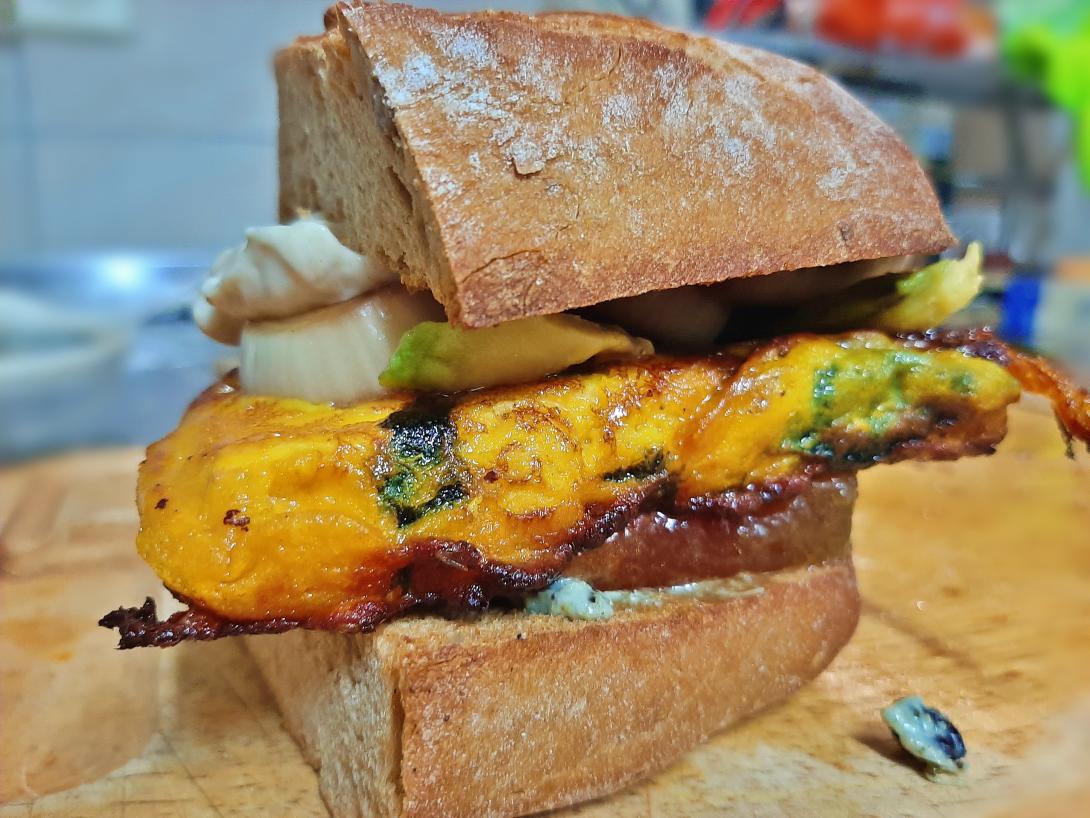
Christmas Eve in Poland means fish flavors.
Even if it’s just herring and carp, there must be fish.
Herring, the basic fish of Hamburg and North German street food (Fischbrötchen, the classic fish-in-a-bun), is a people’s fish — staple food for fishermen and villagers along the Baltic and North Sea coasts for centuries.
In plant-based cooking, the essential way to achieve a fishy — or, as I call it, “oceanic” — flavor is to use seaweed.
The most basic and commonly used seaweed is nori — those square sheets used for sushi, available in almost every supermarket.
And importantly, they’re affordable.
And that’s perfectly enough.
If you’re hosting a vegan or vegetarian for Christmas Eve and you serve them a fishless dish seasoned with nori, they’ll be delighted.
Especially if it’s not that unfortunate celery-fish.
The oldest — and unfortunately still the most popular — method of making vegan fried “fishless fish” is the celery cutlet:
Boil a slice of celery. Cool it. Wrap in nori. Bread it. Fry it.
Don’t do this!
The nature of celery is to be... bland. It’s like a singer who sounds fine as a backup vocal, but as a frontman — absolutely not.
And boiling it (the celery, not the singer) does not help its case (although there are many singers I’d prefer boiled rather than singing… same with some vocalists).
Even if you boil it with seaweed, its texture doesn’t absorb flavor well. And its natural taste and structure have nothing to do with fish.
So what instead of celery?
But of course — soy cutlets. My favorite ingredient.
More precisely, cutlets made from TVP — textured vegetable protein.
I most often use rectangular soy steaks, which have a more interesting texture — more like land animal meat than fish, admittedly — but they work beautifully.
A crucial step is proper preparation: cooking and marinating them in the right broth.
Marinade
- 1.5 L water or good vegetable broth
- 2–3 tbsp soy sauce
- 2–3 tbsp Worcestershire sauce (optional)
- 1 sheet of nori
- 5 g kombu
- 5 g wakame
- 5 g bladderwrack (fucus)
- 1 tbsp crema di balsamico
- Soy cutlets
Put all the ingredients into cold water or broth, bring to a boil over medium heat (CAUTION: it bubbles intensely), and leave it until the next day.
Nori is the basic seaweed, as mentioned. But if you can — and if your budget allows — it’s worth using a mix of different seaweeds.
Besides nori, I use bladderwrack and wakame. For some dishes, I add spirulina as well.
Be careful with spirulina — it gives a strong blueish color, depending on the variety.
I like this color — it evokes the sea again, and therefore those “oceanic” flavors.
Because of the chemical reactions that deepen and strengthen the flavor, the marinated TVP needs to sit for at least a full day. You can refrigerate it and keep it for 3–4 days before cooking.
And ideally, cook it one day before Christmas Eve so it develops even more flavor after frying.
Finishing the “Nofish”
Remove the cutlets from the marinade and gently squeeze them.
Gently — it should be juicy.
Heat the oil in a pan until very hot.
Linseed oil is great, or a linseed–rapeseed mix. Peanut oil also works beautifully with oceanic flavors.
Tear nori sheets along their folds to match the width of the cutlet.
Wrap the moist cutlet in nori.
Bread it however you like — you can check out my examples.
For instance, almond-crusted fishless cutlets are a nod to old Polish Christmas culinary tradition.
- Zaloguj lub zarejestruj się aby dodawać komentarze