The vegetable most closely associated today with the celebration of Dziady, Samhain, Halloween — call it what you will — is the pumpkin.
INGREDIENTS
Filling:
- 300 g pumpkin purée
- 100 g sunflower seeds
- 1 tsp smoked paprika
- ½ tsp cumin
- ½ tsp ground coriander seeds
- 3 tbsp nutritional yeast
- 1 clove garlic
- salt
Dough:
- 500 g wheat flour
- 250 ml hot water (>60°C)
- 50 ml oil
- 1 tsp salt
METHOD
Filling
Pour hot water over the sunflower seeds and leave them for a few hours to soften.
Add them to the pumpkin and blend.
Add nutritional yeast and spices, and mix well.
Dough
Add water, oil, and salt to the flour and knead until smooth — ideally using a stand mixer. If kneading by hand, wear kitchen gloves to avoid burns.
Wrap in cling film and let rest for an hour.
Dust your work surface (or countertop if you don’t have a pastry board — stainless steel works great, ha ha) with flour.
Cut off a piece of dough (about ⅓–¼) and roll it out to about 2 mm thickness.
If it’s too thin, the dumplings will fall apart; too thick, and the dough will overpower the filling.
Cut out circles using a cutter (like this one: https://rudekitchen.pl/ring).
Place a portion of filling on each circle, fold, and seal the edges tightly with your fingers.
Boil for a few minutes, preferably in broth (even store-bought — just make sure it’s good quality).
From the given amount of filling, I got 23 dumplings using a 9 cm cutter.
VARIATIONS
You can make the dumplings with regular wheat dough (boiled) or use store-bought puff pastry and bake them instead.
NOTES
The exact thickness and texture of the dough depend largely on the flour. Unfortunately, this is something that can’t really be conveyed in words — you just have to develop a feel for it.
It’s like that old joke:
“How do you get to the National Opera?”
Practice, practice, practice.
SERVING
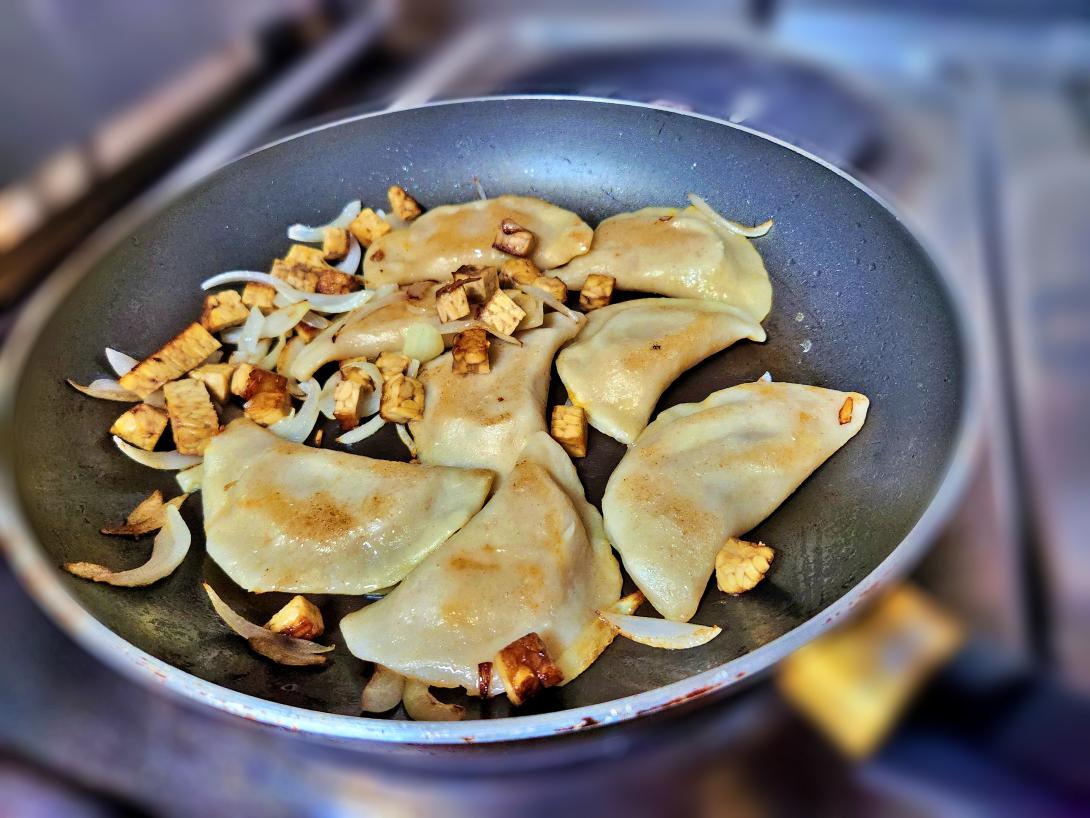
Serve straight from the pot (optionally with sautéed onions or other toppings), or pan-fry them for extra flavor.
Hollowed-out pumpkins, glowing from within with a candle or small light, have taken over the world — more as a part of American pop culture than as a religious or folk custom.
Jack-o’-lantern. Jack the Lantern. At least, that’s what the folk legend says.
Long ago in Ireland, there lived a drunkard known as Stingy Jack. Jack even tricked the Devil himself (probably originally some local spirit or demon) into turning into a coin so Jack could pay for his beer. But once the Devil became a coin, Jack put him in his purse alongside a small cross, preventing him from changing back.
Jack had many such adventures with the Devil — and that’s nothing unusual. Similar figures (though not always drunkards) who outwit the Devil appear in the folklore of many nations. Poles, Germans, Italians, Silesians — all have their legends of a poor man who tricks the Devil.
In these folk tales, the Devil often represents the nobleman, the rich master — while the peasant or miner (as in Silesian stories) is the trickster, a symbol of resistance, the power of the powerless. These tales reflect how peasants tried to cheat those who exploited them — their so-called “betters.”
Only the Irish, however, connected this archetypal figure with the mysterious flickering lights — the will-o’-the-wisps that appear over peat bogs and swamps due to the spontaneous ignition of gases.
In Irish legend, this was the lantern carried by wandering Drunk Jack.
The carved pumpkin with a candle inside was his lantern, lighting his way.
Too sinful for Heaven, too clever for Hell, Jack was doomed to wander forever between worlds.
That’s why he appears during Samhain, when the gates between worlds are open and spirits roam the earth.
A pumpkin lantern placed in front of the house also served to ward off evil spirits — or even the Devil himself, who had been outwitted and imprisoned by Jack several times, and thus preferred to stay away from him and his symbol.
Some say the custom is relatively new, dating back no earlier than the 18th century. Others trace it to much older Celtic and druidic traditions.
The indigenous religions of Europe were so effectively “replaced” by Christianity that we can now only speculate — reconstructing fragments of what once was.
This is what modern pagans attempt to do, using methods from comparative religion and sometimes through revelation — as with Robert Graves, who claimed to have been visited by the Great Goddess, or the Icelandic poet and shepherd Sveinbjörn Beinteinsson, to whom the Norse gods of Ásatrú appeared, inspiring him to revive the native faith on the Island of Ice.
Whether one believes in them or not, it’s hard to deny the effectiveness of those Norse gods — Beinteinsson managed to have Ásatrú officially recognized not only in Iceland, but also in Denmark, Norway, and Sweden.
And after all, if you can strike a power plant with lightning and cut off electricity in Reykjavík, it’s hard to deny your power.
That really happened. In 1973, as Iceland’s Minister of Justice and Ecclesiastical Affairs, Ólafur Jóhannesson, was considering the pagans’ petition for official recognition, a storm broke out. A bolt of lightning struck a power station, causing a blackout in Reykjavík.
It’s said the minister himself took it as a direct sign from Thor — and legalized Ásatrú.
If you’re interested in Icelandic (or broader) paganism, they have a Facebook page:
https://www.facebook.com/asatruarfelagid
Modern pagans can be remarkably modern — without losing the essence of their faith. I speak from experience.
There’s only one catch… Anyone who knows a bit about food history and geography knows the original Celtic or Irish tradition can’t have used pumpkins.
Pumpkins reached Europe in the 16th century, after Columbus encountered them on one of his voyages — probably in Cuba.
And here’s perhaps the most interesting part:
Originally, a Jack-o’-lantern wasn’t a pumpkin. Given the size of that vegetable, it would’ve been impractical anyway.
It was a turnip.
The original Irish tradition used hollowed-out turnips.
Only in the 19th century, during the Great Famine of the 1840s–1850s, when millions of Irish emigrated — many to the United States — did the custom evolve.
And practically speaking: try hollowing out a turnip, then try a pumpkin. It’s no wonder the Irish switched.
Pumpkin lanterns replaced turnips, and the Americanized version of the tradition eventually made its way back to Europe as part of American pop culture.
And now, especially in Poland, every year it triggers hysteria among conservative politicians and religious fanatics.
It’s an immense joy to witness such panic at the mere sight of a pumpkin. 🎃
In the industry, the best form of respect and motivation is a tip.
So if you like reading what I write, feel free to tip me too
- Zaloguj lub zarejestruj się aby dodawać komentarze