My latest culinary fascination is… German cuisine.
Yes, the very same German cuisine I regularly bash.
More precisely, something I consider to be a true German specialty.
And no, it’s not Bratwurst or oatmeal.
It’s Brotaufstrich!
Which means all kinds of spreads and pastes for bread.
INGREDIENTS:
- 200 g canned or cooked chickpeas
- 50 g capers
- 50 g onion
- 100 g smoked tofu
- 1 tsp smoked paprika
- About half a bunch of fresh coriander
- 75 g mayonnaise
- 1 tsp cumin
- 1 tsp smoked paprika
- 1/2 bunch coriander (see notes)
PREPARATION:
Mash the chickpeas with a fork.
Drain the capers (reserve the brine — it’ll come in handy) and chop them.
Grate the tofu on a fine grater.
Finely (really finely) dice the onion.
Finely chop the coriander.
Mix everything thoroughly. Add mayonnaise
and 2–3 tablespoons of caper brine, and mix again
VARIATIONS:
Not everyone is as crazy about coriander as I am, so you can use fresh parsley or other herbs instead.
If you must, you can replace cumin with caraway — of course, ground.
NOTES:
I used a lot of coriander because I love it. I know not everyone is a fan, so I didn’t give an exact amount — adjust to taste.
Caper brine serves two purposes: first, it adds flavor; second, it helps bind the mixture with less mayonnaise. I agree Mayo is awesome, but it’s basically pure fat. Even though it’s unsaturated fat, it’s still fat — so better to keep it in check.
SERVING:
The classic way: on bread, preferably with fresh or pickled vegetables — tomato, lettuce, radish, cucumber (fresh or fermented).
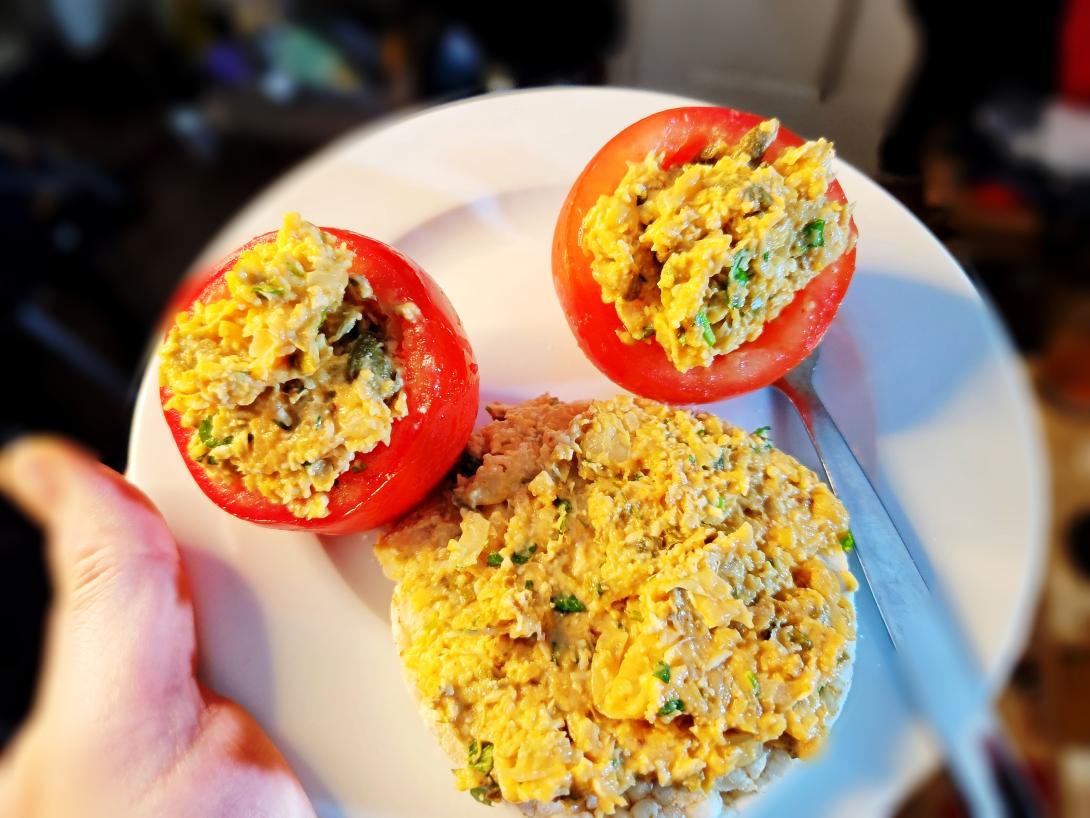
This spread also works perfectly for stuffing tomatoes. In that case, make the spread a bit saltier so it pairs well with the tomato.
NUTRITIONAL VALUE:
100 g of spread contains about 130 kcal, 5.5 g protein, 7.5 g fat, and 8.5 g carbohydrates.
Culinary associations with Germany are usually not very sophisticated — Bratwurst, Currywurst mit Kartoffelsalat (potatoes with vinegar and/or mayo), kale stewed with meat. These are typical German specialties.
There’s also sauerkraut and potatoes, shared with Polish cuisine.
And then there’s something that may not be obvious to non-Germans: bread.
Apparently — and I have no idea how much of this is true or just a culinary legend — Germany has 300 types of bread. The story goes that in the 17th century, during the peak of the fragmentation of the German states, there were 300 German states, each with its own bread.
I wouldn’t be surprised if there were just as many different Brotaufstrich varieties in Germany. You can spot a true native German by their ability to pronounce the word correctly.
Vegetable, meat-based, lard with cracklings, butter, liver sausage, jams, butter, and margarine — all of these fall under this single word.
For Germans, it’s probably self-evident, as invisible as the prevailing ideology or the air we breathe. But for an outsider, it’s a fascinating phenomenon.
And in my opinion, the best thing in German cuisine.
In the industry, the best form of respect and motivation is a tip.
So if you like reading what I write, feel free to tip me too

- Zaloguj lub zarejestruj się aby dodawać komentarze