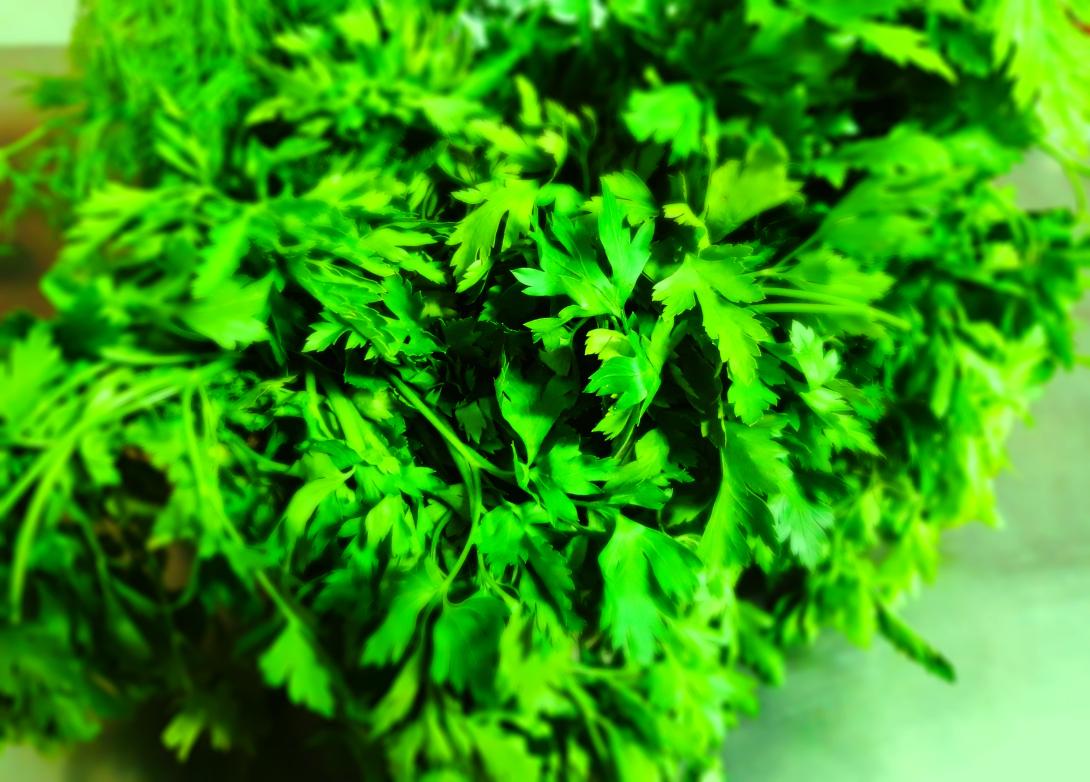
Parsley is an excellent source of iron if you’re on a plant-based or vegetarian diet, or if you eat little meat. The best source, incidentally, is… young nettle — but only in spring, when the shoots are fresh. It makes excellent pesto.
However, this is non-heme iron, Fe³⁺ (remember that from middle school chemistry?), which must be reduced to the divalent form, Fe²⁺ — called heme iron — before it can be absorbed. The key point in the kitchen is that non-heme iron is much less readily absorbed.
Heme iron is found only in meat, so if you limit or avoid meat, you need to be mindful of this. The simplest solution is… lemon. Once the dish is on the plate (because vitamin C is destroyed by high heat), drizzle it with lemon juice.
And here’s the advantage of parsley: it contains both iron and vitamin C! The iron in parsley is the most easily absorbed of all plant-based iron sources. The same applies to pesto made from parsley or radish leaves (also a good source of iron) — always add lemon juice.
On my site, you can find a recipe for wild garlic and parsley pesto, but whether you’re using parsley, radish leaves, or young nettle, the same proportions apply:
https://medium.com/one-table-one-world/pesto-with-wild-garlic-148fd4182e92
Selected plant-based iron sources (mg per 100 g):*
* Nettle — 19
* Flaxseed — 17.1
* Pumpkin seeds — 15
* Quinoa — 8.9
* Soy (dry) — 8.9
* Blue poppy seeds — 8.1
* Amaranth — 7.8
* White beans (dry) — 6.9
* Pistachios — 6.7
* Sesame seeds — 5.9
* Red lentils (dry) — 5.8
* Parsley leaves — 5.3
* Millet — 4.8
* Rolled oats — 3.9
You may be surprised at the low iron content of spinach, which my generation was force-fed as a source of iron and strength. This was most likely due to a transcription error in which a decimal point was moved one place to the right — until the study was repeated.
This is also a reminder that a single study doesn’t mean much; strong evidence comes from meta-analyses of multiple studies.
Pumpkin seeds are an excellent source of iron, and pumpkin seeds are part of my pesto recipe. They work well in salads, slaws, or toasted and added to soups, stews, and other dishes — just like other seeds and nuts. But remember that while they’re rich in protein and nutrients, they’re also high in fat, meaning they’re calorie-dense.
For legumes and quinoa, keep in mind that the listed values are for 100 g of the dry product — after cooking, the weight at least doubles. So the iron content of a 200 g portion of cooked quinoa on your plate isn’t nearly 18 mg, but about 7 mg.
Also, avoid drinking coffee or tea with iron-rich foods, as they reduce iron absorption.
The main source of data in this text is the website of the National Center for Nutritional Education. All dietary information I share is always based on EBM (Evidence-Based Medicine) nutrition science.
- Zaloguj lub zarejestruj się aby dodawać komentarze