Why is a scale in the kitchen so very important?
For the same reason, I usually give recipe quantities in net grams.
Because tell me:
How much is one cup? And how much is one tablespoon? And have any of you checked whether the cup you measure with and the spoon you measure with actually have what you think they have, that is, 250 ml and 10 ml?
And in the case of loose products, for example, spices, when we talk about adding a teaspoon or a tablespoon, do we mean completely level or a bit heaped?
And if you have in a recipe: add 3 tablespoons of this, 2 tablespoons of that, 2 and 1/2 cups of something, the result can get completely out of line with the author's intention. And surprise you. Not necessarily pleasantly.
A basic scale used in the kitchen has a range from 1 g to 5 kg
And like with any kitchen equipment, you have to ask yourself what you will really use this scale for.
I use it for writing down recipes, for making new dishes that I don't yet know by eye, for baking, for weighing ingredients, and for the finished product (dish)
The cheapest ones cost a few euros, although there are also over-the-top models many times more expensive.
You may decide you need a smart dietary scale with Bluetooth and an app, and probably soon with artificial intelligence.
A bit like from Lem (I think), but do you want your kitchen scale to give you a bollocking for eating unhealthily?
What you definitely need, though, is one that has a tare function. And by no means is this about doing laundry with a washboard. Nor about the Buddhist "goddess" Tara.
Tare is the difference between net and gross.
That is the mass of the packaging (bowl or pot standing on the scale), which, when subtracted from the gross mass (product + packaging), gives the net mass (product).
In practice, the tare button on the scale is used to zero it after placing a container on it
Many models have a bowl attached. And I strongly advise against that.
Because on such a scale, you won't place a pot into which you will be throwing subsequent ingredients, nor the bowl of a cooking or planetary mixer.
But if I were to buy a new scale today, I would pay attention to two things.
Progress in new technologies also translates into such everyday devices, and the progress in recent years is astonishing.
First, sensitivity. Standard kitchen scales have a range from 1 g to 5 kg. Currently, you can buy, and not expensively, because I found, for example, for 20 euros, a scale that goes from 5 kg down to 0.1 gram. There are also dual scales, meaning there is a larger platform with a range up to 5 kg and a smaller one up to, I think, 500 g, but down to 0.1 gram.
Which would eliminate the second type of scale I use in the kitchen, or not a dealer scale?
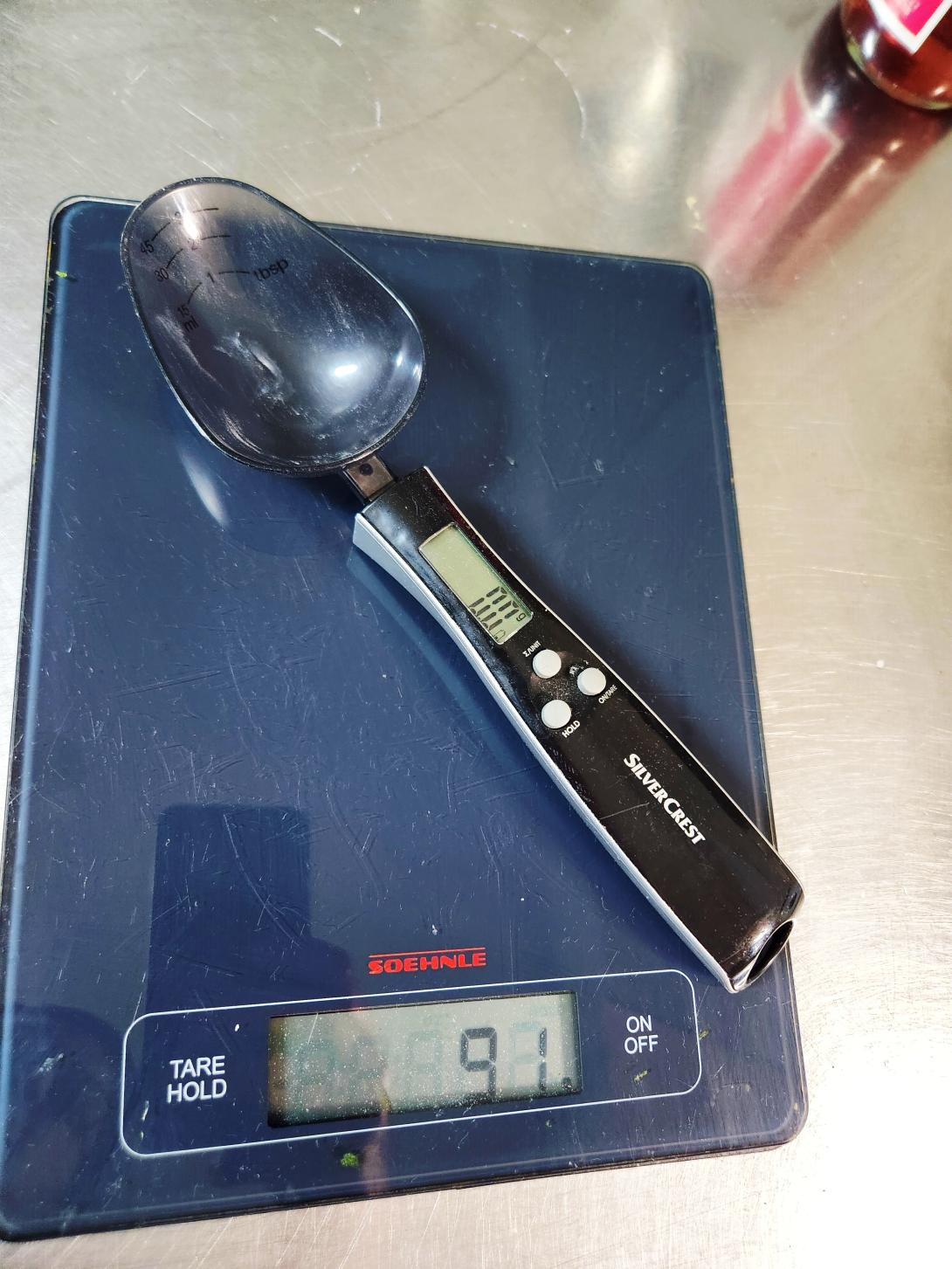
Currently, the most popular are small square scales. I still have, bought in Poland more than 7 years ago, a spoon-shaped scale like that. In the kitchen, it is useful for weighing spices, for weighing agar, some confectionery recipes have quantities calculated meticulously, like in a pharmacy, and here the "dealer scale" is also useful.
The second thing: it is worth paying attention to. And I have mixed feelings about this.
The basic kitchen scale I use is also over 7 years old and is powered by two R6 batteries.
Currently, kitchen scales often have a built-in battery charged via USB. And at first glance, this may seem like a big simplification and convenience.
However, my experience with using electronic equipment. There is so much of it in the kitchen that the battery fails very quickly due to humidity and changing temperatures.
- Zaloguj lub zarejestruj się aby dodawać komentarze