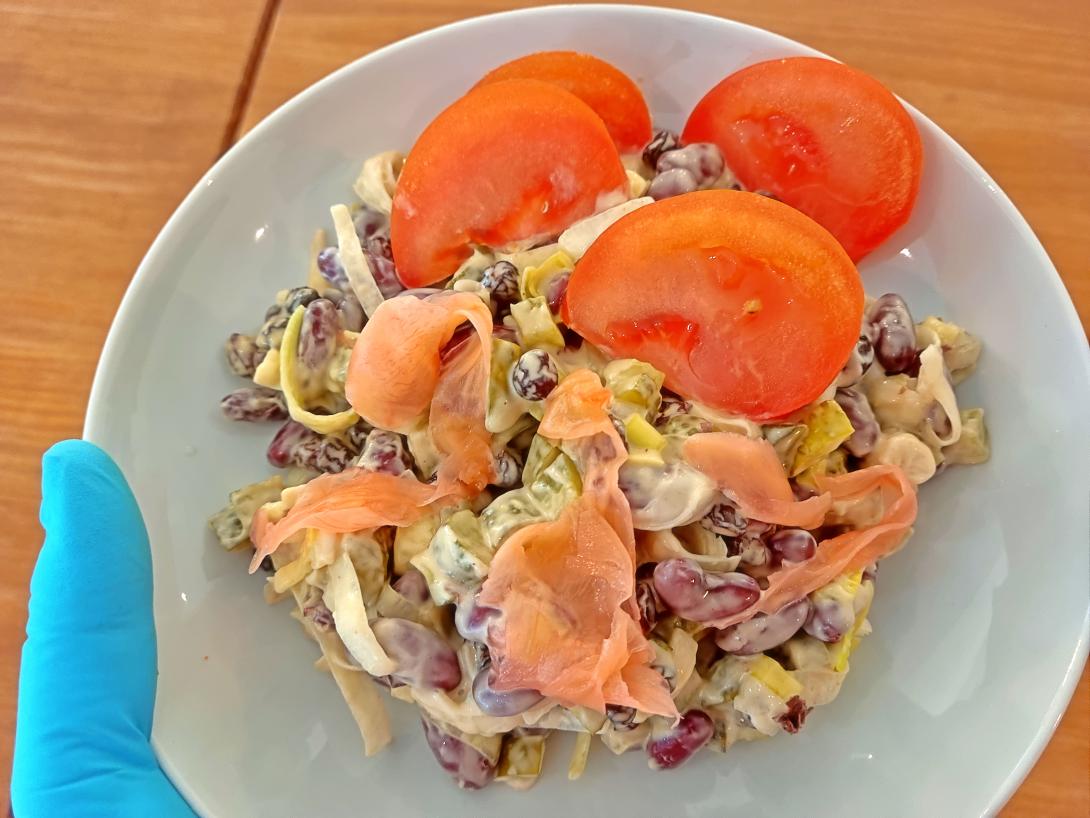
Sequel to the Bean Epic. This time it's Kidney beans from a can.
I feel a bit like the guy from that old joke:
- Doctor, everyone says I'm abnormal because I really love pancakes.
- There's nothing abnormal about that. I love pancakes too.
- Well, then come to my place. I have two closets full of pancakes.
Well, I have two closets full of beans. And a third one with soymeat.
INGREDIENTS:
1 can of Kidney beans
1 white part of one leek (100 g)
50 g dried currants (see VARIATIONS)
100 g pickled cucumber
100 g mayonnaise (preferably homemade)
50 g yogurt (I used soy yogurt)
10-20 g spicy mustard
PREPARATION:
Slice the white part of the leek lengthwise and cut it into half-moons.
Drain the beans. The drained aquafaba can be used to make mayonnaise.
Cut the pickled cucumber into medium-sized cubes.
Mix the beans, leek, currants, pickled cucumber with mayonnaise and yogurt, season with mustard, and let it marinate for at least a few hours or preferably overnight.
VARIATIONS:
It may be difficult to find dried currants, and a readily available alternative is dried cranberries. You can also experiment with other dried fruits or use fresh ripe or canned pineapple. Using sweet apples or pears can also be interesting.
NOTES:
Here, I used mayonnaise with yogurt primarily to reduce the dish's caloric content (mayonnaise is mostly oil, which is high in calories), without sacrificing flavor. If you use good yogurt, it can further enhance the taste. More flavor, less weight!
This dish is based on the combination of sweet taste (currants), sour taste (pickled cucumber), spicy taste (leek), protein (beans), with fat (mayonnaise), and sugar (currants). It's a comfort food combination that appeals to us evolutionarily, as well.
NUTRITIONAL VALUES:
100 g of the salad (made with my homemade mayonnaise, as the caloric content of different mayonnaises can vary greatly - contains approximately 135 calories, 4 g of protein, 6 g of fat, 12 g of carbohydrates, and almost 7 g of fiber.
The serving in the picture weighs 270 g, providing 360 calories, 11 g of protein, 16.8 g of fat, 33 g of carbohydrates, and 19 g of fiber.
The nutritional values are approximate, based on data from the Fitatu app, where you can also find the recipe.
SERVING:
Serve with bread, preferably large croutons or toasts. It pairs well with tomatoes; you can use cherry tomatoes (unfortunately, I didn't have any, and the nearest store is 6 km away, requiring a three-hour trip), or add something spicy. I used pickled ginger for sushi, but you can also use pickled jalapeños or fresh chili.
What is wonderful about salads is their versatility. If we have good mayonnaise or some salad dressing, we can put almost anything in the salad and modify an existing recipe endlessly.
And that is the truest and best "zero waste" kitchen, as it is trendy now. There is no such thing as zero waste. It's another nonsense, a fashion created by greedy smart alecks to make money off you with products made from waste and worthless workshops and manuals. Worthless because they are unnecessary and impractical. It's a status game of the middle class, munching on chips made from potato peels and going on trips to a store on the other side of town because they don't use plastic there. That trip consumes more resources (especially considering that fans of such trendy nonsense usually drive SUVs) than a plastic package of groats or tofu.
Of course, wasting food is a crime not only against the environment but also against our humanity, just like hyperconsumption and status consumption (SUVs). But to limit that, we don't need more products to consume (workshops, books, and special "zero waste" products), we need to start thinking in the kitchen, contemplating. Do I need this large package from the promotion? Or maybe it's about screwing me over and selling me something I won't eat anyway, throw it in the trash, and then buy more and throw them away again? Take a moment to think about what and how I can use these tired vegetables, leftover cream, and potatoes from dinner (soon I'll share a fantastic recipe for potato dumplings).
And salads, as well as soups, are excellent ways to do that. Also, reach back to the wisdom of our ancestors, to what our mothers or grandmothers used to do decades ago. But the most important thing is to be creative in the kitchen. Because you won't reduce the amount of wasted food if you strictly follow recipes. Even if they are recipes for dishes like Swedish pitty-panna, where the original recipe said: take leftovers, dice them, add onions, and fry them in a pan.
And I'm not talking about "intuitive cooking" (the name itself is silly), intuition is a myth. Intuition is the result of a "prepared mind perspective," internalized knowledge and experience in the kitchen that allows you to create dishes from seemingly random ingredients almost on autopilot because there is an unconscious thought process about what to combine with what and how.
To learn that, you can't limit yourself to cooking from recipes. You have to change them and understand better why we do this with that and fry this while slowly reducing that. By the way, I include in my recipes all those explanations about Maillard reactions or why we add lemon juice to desserts.
An open and learning mind is the most important thing in the kitchen. Besides competence, of course. But it is precisely this kind of mind that allows us to acquire knowledge. Learn and have fun with what you do in the kitchen, especially when it comes to cooking.
- Zaloguj lub zarejestruj się aby dodawać komentarze