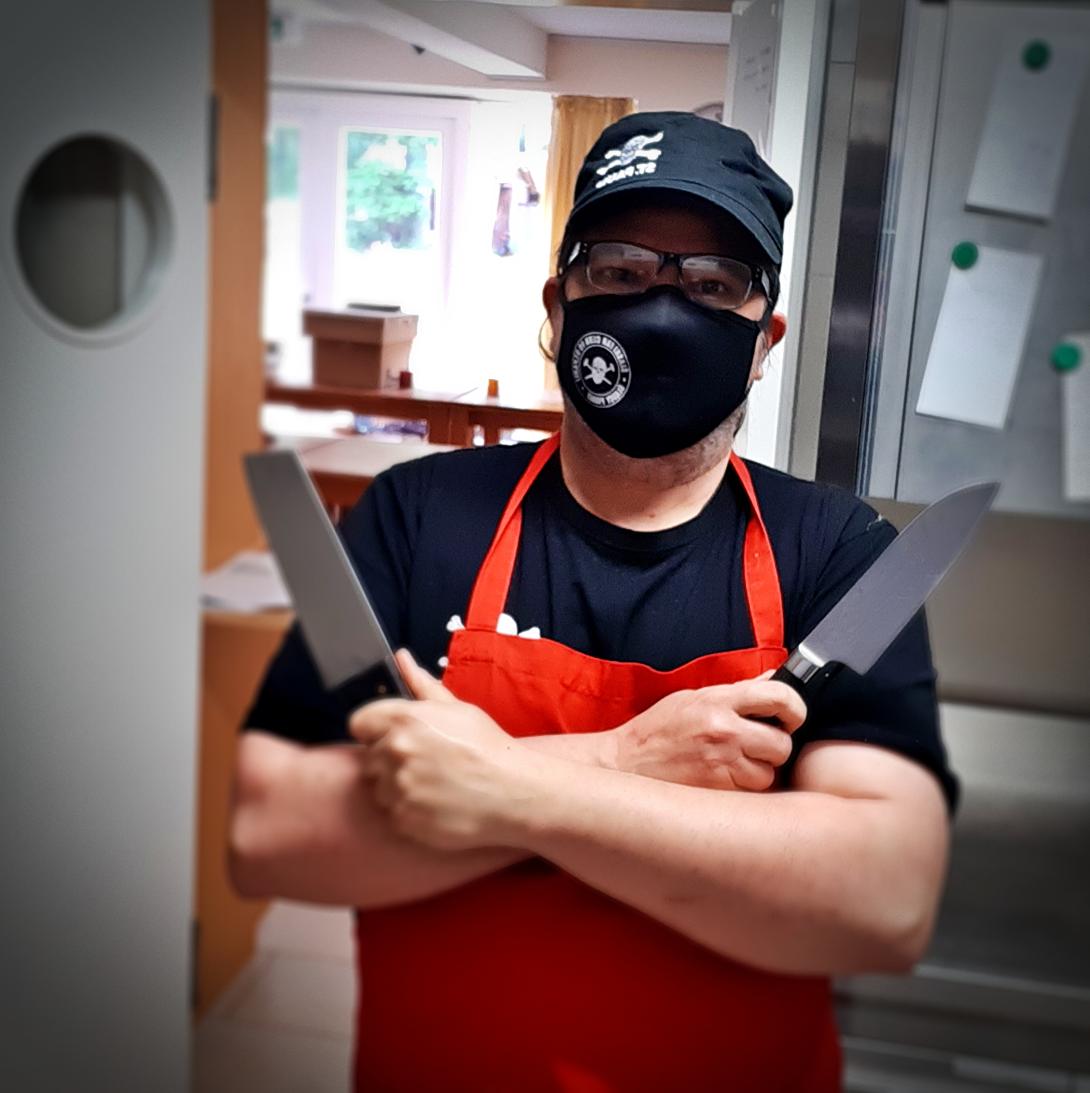
1. You’re on your feet all the time. Your legs and spine feel it.
During a workday, depending on the nature of your position, you might easily walk 10 to 20 kilometers. Often carrying heavy loads — in my case, it’s usually up to 20 kg, but hauling 50 kg bags of vegetables is nothing unusual in this job.
2. It’s hot and humid.
Summer is the worst, of course, because the kitchen is always several degrees hotter than the outside air. The summer of 2019 was brutal for me — nearby in Lower Saxony, the temperature reached 42.5°C, and I had 41°C… outside.
A friend of mine once fainted from the heat during a shift in Warsaw. Dehydration is an obvious result of working in such conditions. I now try to be mindful of staying hydrated, but I’ve often felt hungover simply from dehydration.
3. Constant exposure to food leads to eating disorders.
The brain doesn’t distinguish between what we imagine and what we experience. It can become confusing if you’re surrounded by the sight and smell of food all day. And the taste — you have to try dishes (and sometimes even the thought of tasting makes you feel sick).
You’re surrounded by food, but you’re not eating. Evolution hasn’t prepared us for this. So, no wonder it messes with your head.
This can manifest in different ways — from aversion to food and lack of appetite, to intense cravings for particular things (and usually not the things you’re cooking all day), all the way to binge-eating episodes.
4. Toxic work environment and bullying.
If no one’s yelling or swearing in the kitchen, something feels off.
Once, while working with a fantastic team, we catered a vegan wedding at a wedding house. The head chef there was surprised: “It’s so calm with you, nobody screams.”
This job makes it easy to lose your temper. Mistakes have catastrophic and irreversible consequences.
I once cursed out an assistant in two languages because he was supposed to strain a fruit broth (for what was probably a jelly), and he threw away the broth and kept the boiled fruit.
That’s not a typo in an email — that’s something tangible and gone. You can’t get that broth back. Making a new one means another hour of cooking, and there’s no time for that.
Like in "The Bear", "every second counts." If lunch has to be served at 12:30, the pasta and sauce must hit the plate just before that.
Too early, it turns to mush. 2–3 minutes late and everything’s off schedule. If anything in the timing fails, it all falls apart. You can’t uncook overcooked pasta, and no amount of plating will cover that.
5. The hours destroy your social life and wreak havoc on family and romantic relationships.
When I worked in restaurants in Warsaw in Poland, I remember arriving at parties in Warsaw when I had finished work, at this time when parties were ending.
Back in Silesia, I’d often pass a friend heading to work as I was coming home from a night shift behind the bar.
And these are only five points. I’m sure many people in hospitality could add others — like wages — but I wanted to focus on what happens directly in the kitchen.
Of course, it’s not all doom and gloom. Not every place where you go out to eat is a nightmare, with an underpaid crew that hates their job but needs to survive.
But sometimes it is.
Summer is peak season for holiday spots — and it’s a brutal time for food workers. People sometimes work one, two, even three months straight without a day off, often 12+ hours a day.
I just want you to keep in mind that these people work under incredibly difficult conditions.
And when they mess something up — which happens, especially when the place is slammed in high season — just be a kind, respectful customer.
Because if you’re on holiday right now, there’s a 90% chance you have an easier, better-paid job than the people serving you.
And of course, don’t forget the tip. In the industry, the best form of respect and motivation is a tip.
So if you like reading what I write, feel free to tip me too:
- Zaloguj lub zarejestruj się aby dodawać komentarze