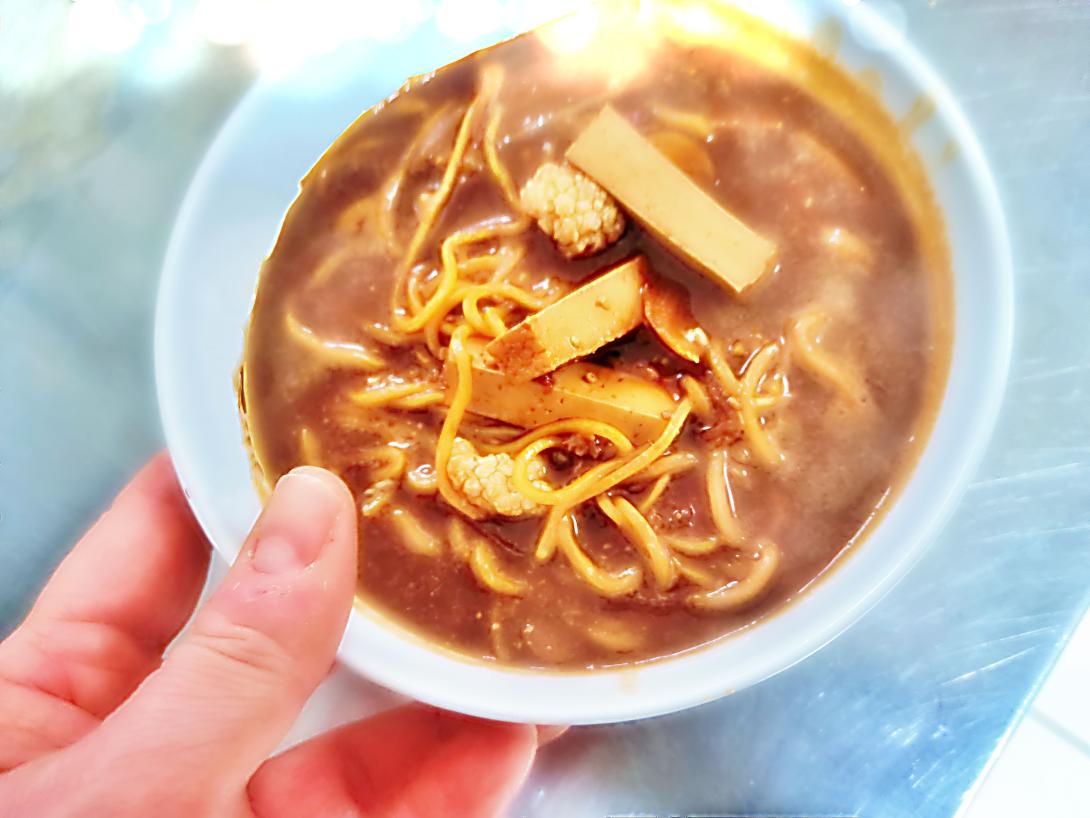
What connects Poland and Korea? Fermented foods. Fermented cabbage, to be exact. Fermented cabbage that saved the lives of our peasant ancestors. Fasting soups made with fermented vegetables like sauerkraut and sour rye soup were a staple of the Polish peasant diet.
Miso and kimchi are Asian fermented foods similar to sauerkraut and sour rye soup. They are used in traditional fasting soups of the Polish peasantry.
INGREDIENTS:
1 liter of vegetable broth (see NOTES)
30g of rapeseed oil
200-300g of red miso paste (see NOTES)
300g of cauliflower (1/2 small head)
300ml of sauerkraut/kimchi juice
200g of smoked tofu (1 block)
125g of Chow Mein noodles (1/2 package)
100g of shallots (2 pieces)
3 cloves of garlic (15g)
INSTRUCTIONS:
Add miso and oil to the broth, mix well, preferably with a whisk, and heat over low heat. It's best to start with 200g of miso and add more if necessary.
Cut the shallots into thin strips and add them to the broth.
Cut the tofu into strips. I used smoked tofu, so I added that.
Mash or finely chop the garlic and let it sit for a few minutes. This is very important to allow the garlic to release its antibacterial properties.
Cut the cauliflower into small florets.
Add the cauliflower, tofu, and chili (fresh or dried) to the broth.
Cook over low heat until the cauliflower is al dente/ slightly firm. Add the noodles and remove the soup from the heat for five minutes.
Finally, add the sauerkraut/kimchi juice. I used half and half. It's important to use high-quality cabbage with live bacteria cultures.
If necessary, add water or miso paste along the way. It's best to start with a smaller amount of paste and 150-200g and add more if needed. Or, if the soup is too strong or too thick after the noodles absorb the water, add water. I added half a liter of water to my pot.
OPTIONS:
This soup was actually made from what I had on hand in the fridge. For example, I only had smoked tofu, but you can use classic or any other type of tofu. You can fry the tofu before adding it to the soup, especially the classic type. You can also use tempeh or yuba.
Optional additions include chili, fresh coriander. Instead of cauliflower, you can also use other vegetables.
Sprouts are perfect for such soup. They can be added shortly before removing the soup from the heat, so they don't overcook, or added when serving.
Of course, you can use a different type of Asian-style noodles or not use noodles at all.
Adding sauerkraut/kimchi juice at the end is also something I happened to have in large quantities, from several 2.5-liter jars of kimchi and sauerkraut. You can use lime and orange juice instead. You can also add sauerkraut/kimchi to the soup.
NOTES:
I used my own production of 100% vegetable broth, cooked for several hours. It is very intense, and to dominate it, you need a lot of miso paste. For most broths, less paste should be enough.
It is also important not to overcook the vegetables. The goal is to keep the ingredients al dente, preserving their flavors and textures.
SERVING:
We serve it in Asian style with chopsticks or in European style, depending on how we know/like to eat. When serving, you can sprinkle the soup with fresh coriander and mint and drizzle it with citrus juice.
NUTRITIONAL VALUES
500 ml serving of soup contains 320 calories,
14.5 g of protein.
Fasting is probably one of the basic rituals in most religions of the world. In our cultural circle, the rhythm of the holy year is marked by Christianity, with a special emphasis on Roman Catholicism (with its local influences), or, as in Germany, Protestantism.
On Good Friday, the forty-day period of Lent, the longest ritual of Christianity, which lasts 40 days of preparation for the Paschal Triduum, comes to an end. This is a commemoration of the 40 days Jesus spent in the desert. This is nothing special. Solitary multi-day retreats, prayerful and meditative, are known in many religions.
Good Friday and Ash Wednesday are the two most important days of fasting in the Roman tradition. In the past, "strict fasting" was required on these days, although the term is imprecise.
This term was used in the old Code of Canon Law from 1917. The current code, introduced in 1983, does not contain such a definition and replaces the former "quantitative fasting" (limiting the amount of food consumed) and "qualitative fasting" (abstaining from eating meat) with the terms "fasting" (for the former quantitative fasting) and "abstinence" (for abstaining from eating meat). So on Good Friday, fasting and abstinence are formally required, meaning the same as the old "strict fasting".
But the essence of fasting has never been and never will be about weight loss or a healthy diet. Not even giving up meat. The essence is always "spiritual fasting". That is why what heats up, stimulates the mind and sensual desires like meat, was excluded from the fasting diet. But it is about distinguishing between stimulating (heating) and calming (cooling) foods, which is a division taken from Hippocratic dietetics.
- Zaloguj lub zarejestruj się aby dodawać komentarze