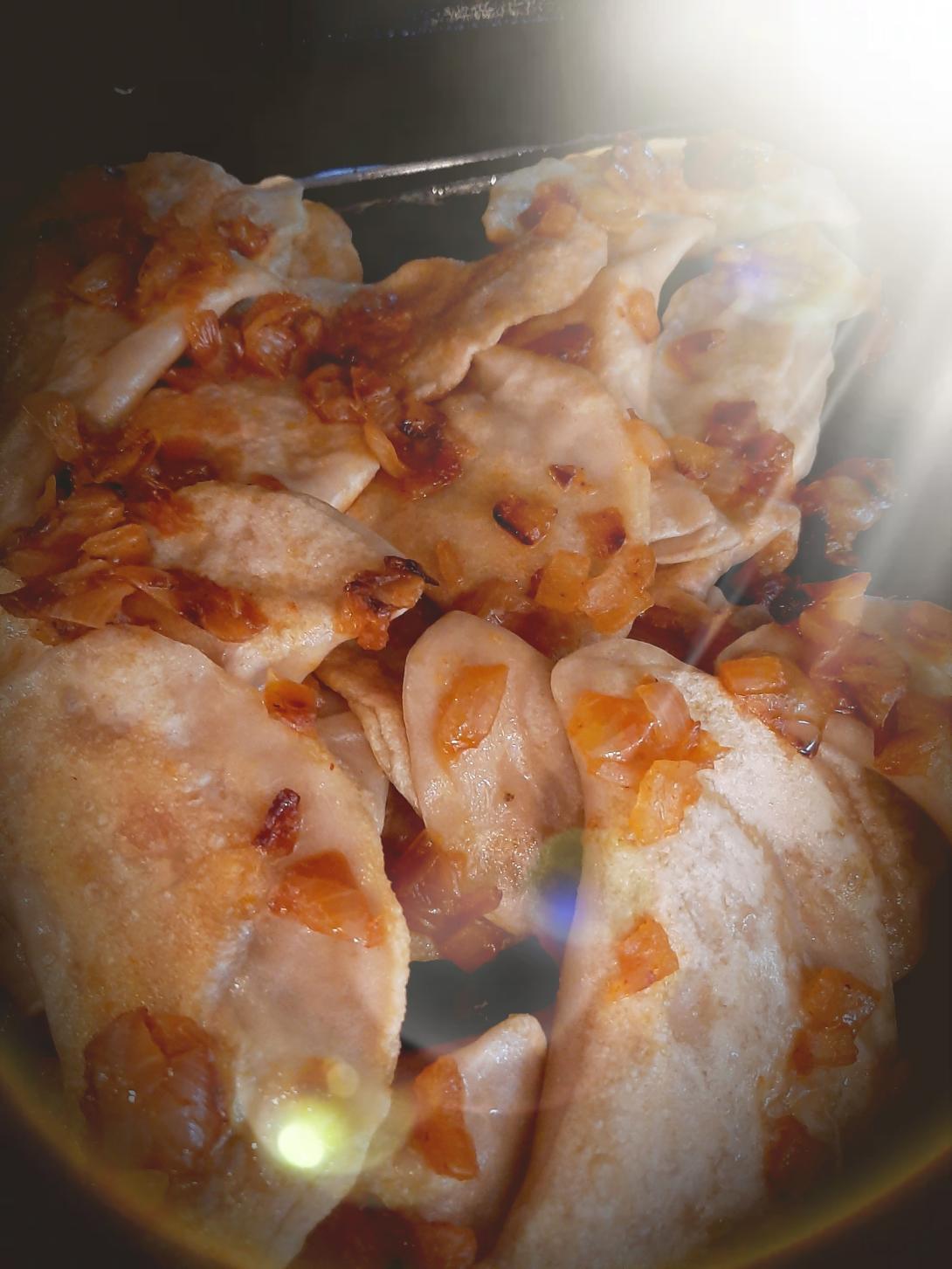
On the internet, you can find everything you’re capable of imagining—and plenty of things you’re absolutely not.
One of them is “culinary Marxism.” The moment I saw the phrase, it stole my heart, and I’ve since enjoyed calling myself a “culinary Marxist.” Whatever that may actually mean. And I found a very intriguing interpretation of the term on a certain blogger’s page.
FISHLESS DUMPLINGS FILLING
INGREDIENTS:
600 g cooked chickpeas
50 ml flaxseed oil
2 onions (150 g)
50 ml flaxseed oil
2–3 sheets of nori
2 lemons
2 tbsp dried parsley
METHOD:
Dice the onions finely.
Squeeze the lemon juice.
Divide the cooked chickpeas into two equal portions.
To one half, add the torn nori and the oil, and blend until fairly smooth.
Mash the second half with a potato masher, leaving small chunks.
Combine both portions with the onion and lemon juice. Adjust seasoning with more lemon juice and salt. The filling should have a distinctly “fishy” aroma and taste.
VARIATIONS:
You can season the filling with smoked salt/smoked paprika/use smoked tofu.
There’s plenty of room to play with combinations of sea and “fishy” flavours.
Instead of chickpeas, you can use tofu or any TVP protein.
Other types of seaweed are also excellent to experiment with—even spirulina can work in this flavour profile.
Dried parsley can be replaced with dried dill, for example.
The fishless filling also works great as a spread on bread; you can enrich it with finely chopped pickles.
NOTES:
This dish is partly the result of my search for a Polish cucina povera, folk cuisine. Of course, our ancestors did not use seaweed. Probably. But really—why would bladderwrack be any worse than wakame? I haven’t been able to find historical evidence that Baltic seaweeds were eaten here, but logically speaking—people living near rivers and the sea would surely have turned to them in times of need.
For texture, some of the chickpeas/TVP must be mashed, not blended—this makes the filling more reminiscent of fish.
This filling also works beautifully as a bread spread; you can enrich it with diced pickles.
SERVING:
Cook the pierogi in vegetable broth lightly acidified with lemon juice or vinegar, with some seaweed added. Cooking with vinegar has the advantage of reducing the gas-producing effects of legumes.
Serve traditionally, drizzled with flaxseed oil or another aromatic oil. Truffle oil works well. Fresh herbs like wild garlic, sage, dill, or a squeeze of lemon/lime are excellent additions.
The blogger whose definition of “culinary Marxism” I stumbled upon seems like someone who overdosed on lat right (and, worse, took him seriously), then chased it with the Illuminatus! trilogy (also taken seriously), and now obsesses about the supposed destruction of culinary tradition.
And that is exactly what culinary tradition really is: something alive, not a prop locked in a museum case, not an unchanging bronze monument (covered in pigeon droppings).
The whole history of cooking is the history of interaction, cultural cross-pollination, and constant evolution of recipes.
A classic example from Poland is bigos, which originally was a dish of the magnates—the top 1%—made exclusively from roasted meats. Very far from what today reigns on Polish tables as bigos.
That is, if it still reigns—since many traditional Polish dishes are, sadly, disappearing.
Today, under the piling crises—the post-COVID crisis, the crisis caused by the war in Ukraine (and Ukraine is the breadbasket of the world)—we will likely be forced to “tone things down” and live more frugally. A more economical kitchen. Cheaper, without food waste.
A classic example of such food (still popular, though everyone loves eating it and no one loves making it) that has conquered the stomachs and hearts of German Buddhists is: DUMPLINGS!
Sometimes called here “Polnische momos.”
For clarity: momo are Tibetan dumplings, usually with meat (because in Tibet, there was hardly anything to eat besides meat).
And in Germany, we also have dumplings—Maultaschen, with their square shape, popular in Swabia.
Dumplings perfectly illustrate the way cuisine evolves, constantly in dialogue with culture and history.
Dumplings called ruskie (“Ruthenian,” now often “Ukrainian”—initially this irritated me, but then I realized it’s simply the next step in their evolution)They
are called Polish Dumplings in Ukraine.
Which is actually quite correct.
"Ruthenian” is also correct.
In Poland, all dumplings are “Ruthenian”—because…
Dumplings were brought to Poland from the lands of today’s Ukraine (then Ruthenia) by Saint Hyacinth Odrowąż.
A fascinating figure, one of the first Polish Dominicans, exercising power over the elements and reversing the effects of natural disasters through the force of his holiness.
It’s striking how many elements in Catholic saint veneration parallel the meditational deities of Tibetan Buddhism.
Thus, every pierogi in Poland is ultimately from Rus’. And before that—further back in space and time—from China.
But the filling of pierogi ruskie is actually Polish.
In Ukraine, the filling was made from potatoes and onions; the addition of cheese is a Polish contribution to the Kingdom of the Pieróg.
There is also a miracle story about Saint Hyacinth and pierogi—one that, from what I can tell, never made it into the official Roman canon:
How Saint Hyacinth fed an entire village with one piece of meat.
That makes sense: he added potatoes, curd cheese, onion—and voilà, he had pierogi filling. Kneaded dough and made enough pierogi to feed the whole village.
And someone might ask: What kind of miracle is that?
The highest kind! There is no greater miracle than feeding the hungry, comforting the distressed, and lifting those who have fallen.
In this, Buddhism and Christianity align quite closely.
And Saint Hyacinth served the suffering, often simple, poor peasants. Though he himself came from a noble family close to royalty.
One of the officially recognized miracles is his help to peasants whose crops were destroyed by hail: after his night-long prayer, in the morning a lush, more beautiful crop than before the storm stood in the field.
Saint Hyacinth, then, is a very practical kind of saint—saving food, ensuring nourishment, rolling up sleeves and standing by the pots.
“Hands that help are holier than lips that pray.”
Which, of course, doesn’t forbid combining the two.
Both Christianity and Buddhism have a spirituality of almsgiving.
The most refined and mischievous version of it was practiced by the incomparable Patrul Rinpoche, the great yogi of the Nyingma school of Tibetan Buddhism. Living in a small retreat hut, he was frequently visited by wealthy donors offering money, gems, gold—dropping them through the opening used to pass food inside.
Rinpoche would then throw those offerings out the back opening (yes, the one meant for waste), where the local poor were already waiting.
It would be fascinating to study whether this form of redistribution had a tangible impact on the economic life of Tibet before the Chinese occupation.
In the social and economic reality of late capitalism, almsgiving has become charity—performed under spotlights and in front of cameras.
Concerts and galas “for Ukraine” or whichever group is media-fashionable at the moment.
And let’s not pretend: in this kind of celebrity philanthropy, that group is the least important element.
It serves to present oneself in a favourable light—it’s like an Instagram filter, like makeup on a rotting corpse, like perfume on the skin of someone dying from cancer.
It is also a new opium for the masses—spread generously to ensure nothing changes, so business can continue as usual.
Whether it’s Kyiv or Gaza, if there is suffering, then soon enough the media and political vultures and hyenas will gather to feed on it.
It is astonishing how utterly detached from reality the inhabitants of the upper and middle floors of the social structure become when war breaks out:
In all their naivety, they chatter about film plans, elections, celebrity gossip, underwear scandals—while above them (and all of us) hangs, like a sword of Damocles, a whole series of catastrophes straight out of Revelation, filling our world with fear, despair, and tears.
How stubbornly they keep supporting the beams of the collapsing social edifice, performing their concerts and charity shows—this time “for Ukraine”—the same people who, just weeks earlier, mistreated the Ukrainian cleaner, shop assistant, or housekeeper.
How eagerly they rub their hands together, thinking that labour will once again become too cheap to live on, because a reserve army of desperate, dispossessed workers has arrived.
Apparently, some dim, sagging dickwads drool at the thought of young Ukrainian women they’ll be able to screw.
But far worse are the ones who drool at how they’ll be able to drive down wages.
They aren’t even bastards—they’re the worst kind of scum, no different from grave-robbers and looters, worms feeding on the flesh of war and its victims.
So how would Saint Hyacinth act?
Would he settle for making pierogi—
Or would he follow the words of one of the greatest saints, the martyr Óscar Romero, and look for the causes of suffering, injustice, and war in the “structures of social injustice”—and not only give the poor pierogi, but also ask why the poor have nothing to eat?
- Zaloguj lub zarejestruj się aby dodawać komentarze