Working in a kitchen is tough, stressful, and usually poorly paid. To cope with it all, to relieve the stress, the most common go-to is, of course, alcohol.
A few words about substances.
I love that term. And about addiction in the kitchen.
I’m practically an expert here. Both rock’n’roll and depression fuel any kind of substance use, drugs, and addiction.
Not long ago, I was trying to remember something and I went, “When was that… when was that?” And I guess normal people think: when I changed jobs, when I met my wife, when I got promoted, when I got laid for the first time. But for me, it was: “Ah yeah, that was the time I was doing cocaine.”
Luckily, I couldn’t afford a proper coke addiction.
Nowadays, I probably could. Europe, and Germany in particular, is currently flooded with cheap, high-quality cocaine. So I don’t even ask the price when the dealers approach me. Just to be safe.
Cocaine, as most of you probably know, like amphetamines and a few other substances, comes in the form of a white powder.
And one morning, back when I was still working catering in Poland — we usually started work around 7 or 8 AM — I’m standing there in the kitchen (fuck that, on the kitchen, not in it — “in the kitchen” is where your husband might fondle you while you’re frying cutlets),
Anyway, I’m chopping something, and one of my coworkers comes up and asks:
— “Did you take the magic white powder this morning?”
And after a second, it hit her what she’d just said and how it sounded.
She meant vitamin C. But if you were thinking speed, mephedrone, or coke — you weren’t wrong.
Because those drugs are present in kitchens.
Not in the kitchen, but behind the bar, I personally had a period of regularly doing speed. Just to make it through another overnight shift.
Another popular one — actually the first and most classic — is, of course, alcohol.
I’ve worked with chefs in alcohol treatment, chefs who needed a shot in the morning or they’d start shaking, chefs who’d go out for a smoke break and chug a bottle in ten minutes.
This kind of thing is definitely more accepted in the food industry.
Professionally speaking, it’s the worst crap. Alcohol messes with both your motor skills and your thinking. And most importantly, it wrecks your taste buds — both while drinking and during the hangover.
The reality is what it is. Showing up hungover is the least of the offenses. Working drunk, drinking at work — not just a beer — isn’t even considered weird.
What is weird is that no one on the kitchen staff has a drinking problem.
There’s this stereotype of the chef who either has a drinking problem, legal troubles, child support debt, or some combination of the three. Oh, wait — four — mental illness too. Which, of course, contributes to higher substance use.
And that stereotype exists for a reason.
The fact that you’re working around alcohol doesn’t help either.
Cigarettes:
Just as much crap as alcohol for your taste buds, maybe even worse. If you smoke, you’re going out every half hour or hour, and you lose all sensation in your mouth. It’s not just the taste buds — it’s the physiological effect nicotine has on the brain.
If you’re curious about nicotine, read Narkotyki (Drugs) by Polish author Witkacy — there’s no better or more accurate description. He describes how colors look like a dirty rag, and taste becomes just as dull.
Weed:
From a professional standpoint, the worst part is the hot smoke hitting your taste buds, similar to cigarettes.
But it does intensify and deepen your perception of taste, which is actually a problem.
You’ll make a sandwich out of stale bread and mayo and think you’ve created gourmet fine dining.
As I said, I have more experience with substances than I wish I did.
As the poet said, “The fact I survived is a miracle.” And I appreciate that.
Many of my friends didn’t. Two of my closest friends died in the ’90s from heroin.
The reason behind my desperate need to alter my consciousness in any way possible?
The same thing that’s just as common in kitchens as drugs: mental illness.
For me, it was depression. Just trying to silence it any way I could.
Shortly before I left Poland, I worked with a great guy — a recovering heroin addict.
Again, the stereotype: chefs have issues with drugs, with the law, or with child support, or some combo of those.
Substance use also means organized crime to some degree.
It’s no coincidence that in the current gang war in Hamburg, all the attacks are linked to restaurants. Which also means easy access to illegal substances.
Normally, there’s always someone on the kitchen crew who “knows a guy.”
Sometimes the dealers are sitting out in the dining room. Sometimes the bartender is the dealer. That’s a problem — and should be stomped out. Unless the owners are buying from them, too.
Yeah, I worked in a place like that years ago.
Same place, one of my weirdest food service stories happened.
I was working as a bartender. I come in for the night shift, and the other bartender says:
— “What the fuck, man, you trying to buy a gun off someone? Are you out of your fucking mind?”
— “What are you talking about?”
— “Some guy came in, asked if the bartender was around. I said no, but I could pass on a message.
He wanted to sell you a gun.”
— “A gun?”
— “Yeah. And he opened his coat and showed me one.”
I was shocked because I had never asked anyone about buying a gun. Never even had a conversation about guns.
But I am sure some of our guests at the time carried firearms. The real mafia guys? Probably not, everyone was scared of them anyway.
Also, back in my bartending days, there was a dealer who’d regularly give me something to smoke after work.
Because I had insisted on not smoking on the job.
That was just a friendly gesture from an old friend.
When I was already a “senior crew guy,” he was a young punk.
I’ve also found both weed and speed while cleaning up.
So yeah, the access to substances is huge.
Long hours, 12 to 14-hour days, week after week. Stress, pressure, and bullying.
Substances are the easiest way out. And in gastronomy, it’s not just alcohol — it’s all kinds of emotional regulators that are readily available.
You can’t eliminate drugs from kitchens. But you can and should try to reduce their presence.
And tackle the root causes — not just the symptoms.
Bullying, overwork, crap pay, unstable jobs, no career path. Fixing those things is the simplest — and the only — way to significantly reduce substance use in kitchens.
I’ll write a separate ode to caffeine one day.
Photo caption:
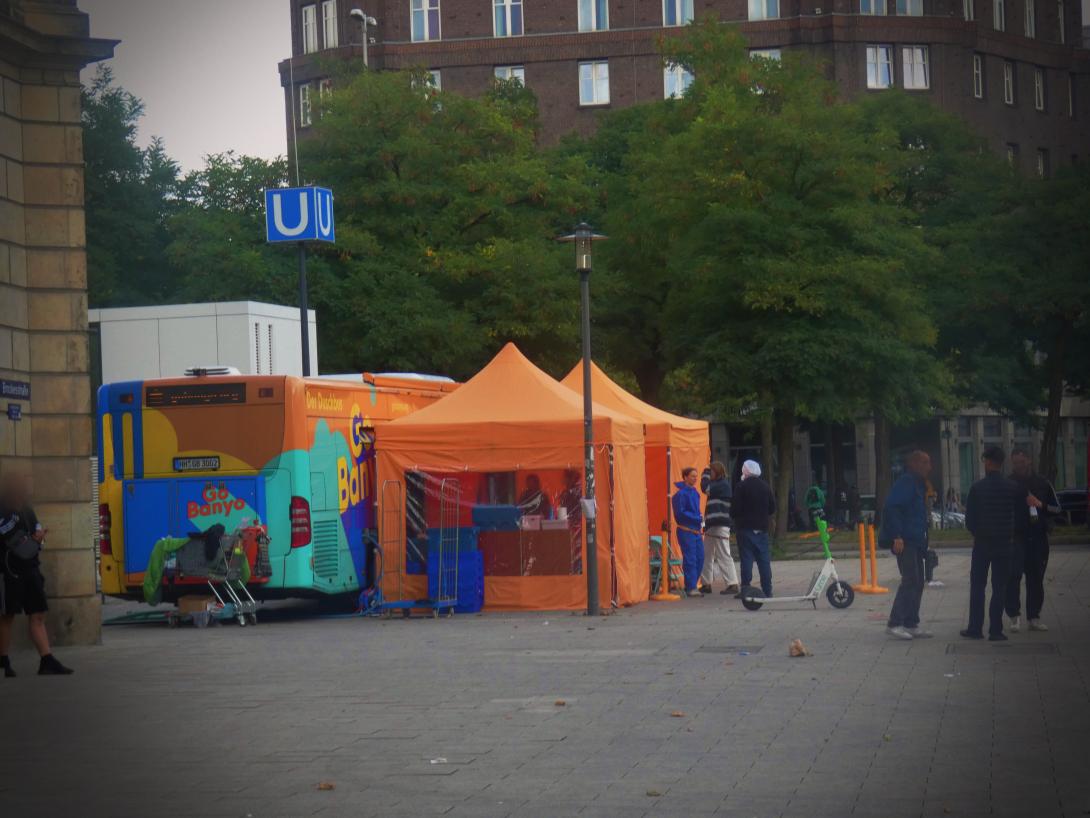
Alcohol and other substances are a fast track to homelessness.
Photo: the GoBanyo shower bus for the homeless, near the drug park, right next to Hamburg’s Central Station.
In the gastronomy world, the best motivation is a good tip. If you like what I write here, you can leave me a tip

Did you like this text? Do you want more similar ones? Support my blog
- Zaloguj lub zarejestruj się aby dodawać komentarze