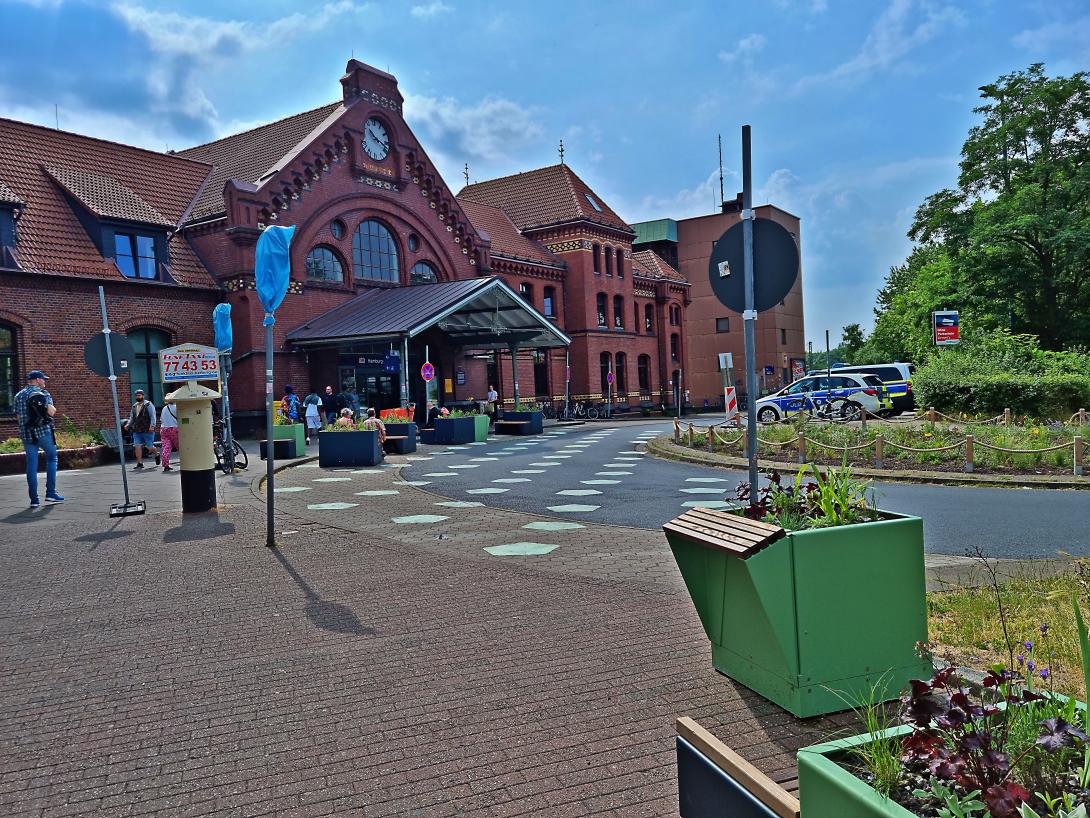
The Deutschland-Ticket is a sufficient reason to stay permanently in Germany.
As long as the Deutschland-Ticket remains permanent, which is by no means certain. Introducing the ticket was more of a Polish-style move than a German order. And still, it doesn't work as it theoretically should.
Theoretically, for example, the D-t. renews itself automatically. In practice, it doesn't work that way for me. The ticket cannot be printed. No! Every time you purchase a ticket, you have to enter the same data, including your shoe size and your great-grandmother's maiden name.
But definitely yes. There's less crowding than last year, and there aren't as many significant delays or train cancellations either.
The Heidebahn, the Hanover-Buchholz line, and further to Hamburg regularly experience delays of around 10 minutes. But it's still running. It was quite different last year. Very different. And I know that a 10-minute delay is nothing for PKP (Polish State Railways) veterans, but for DB (Deutsche Bahn), it's a shame and disgrace for centuries.
In Hamburg itself, it's more about planned renovation work, changes in the S-Bahn routes, so it's worth checking the boards on the platforms and the route not on Google Maps but in the HVV app. I think it's similar in other cities. It's worth installing the app of the local transport association. For Hamburg, it's HVV, and for Berlin and Lower Saxony, it's FahrPlaner."
In Hamburg itself, but it's more about planned renovation work, changes in the S-Bahn routes, so it's worth checking the boards on the platforms and the route not on Google Maps but in the HVV app. I think it's similar in other cities. It's worth installing the app of the local transport association. For Hamburg, it's HVV, and for Berlin and Lower Saxony, it's FahrPlaner.
How does it fare financially? From the perspective of the transport associations, poorly, badly, and it may get even worse, or maybe not at all.
Transport associations want significantly more money as compensation for the costs of servicing the D-T. than the federal government offers. Arguing, in my opinion, rightly, that handling increased traffic requires higher investments in railway or bus infrastructure.
From the passenger's perspective. Excellent. With one or even two reservations. 49 euros is about half the price of a monthly ticket in a major city or two to three trips to such a city from several tens of kilometers away. And as a bonus, at this price, we have rides on local buses, like the ones I take for shopping. Or to the nearest town to catch a ride to Hamburg.
For me, D-T. practically means less than three trips to Hamburg. Or two to Hanover or Bremen, where the ticket is much more expensive (a different transport association than the connection to Hamburg, that's how it is when you live in the triangle of three federal states).
And here's a digression, showing the importance of D-T. or public transportation in general."
For me, a trip to Hamburg is not just relaxation, sitting in the Japanese garden in Planten un Blomen or by the river, watching the port cranes, and reminiscing about my childhood spent near the mouth of the Oder River.
It's also a part of my work. Because it's always an opportunity to discover new flavors. That's why I always look for new places where I can eat something. I seek new tastes, textures, and culinary interpretations different from my own. By the way, the vegan scene in Warsaw definitely surpasses Hamburg's, both in terms of culinary level and diversity. But I'll write a separate text about that later.
In Warsaw or any other big city, this is available on the way from work to home. Whether it's a restaurant or a shop with interesting products. Not necessarily exotic, but I won't find tofu like the one I used to buy from the Vietnamese in Warsaw in my neck of the woods. The closest is in Hamburg.
Because when you live in a remote area, such shopping requires logistics and a lot of free time. A trip to the city, excuse me, to the City, takes up an entire day. To the local metropolis (just under 20,000 residents), it's a minimum of 2-3 hours. And D-T., or similar solutions, reduce the disparities a bit. It evens out the chances and opportunities for someone living in the middle of nowhere and someone living in Hamburg.
Of course, it depends on what values matter to us and what place we occupy in society. For someone who believes in a fairer and more equal society, this is a significant value. For psychopaths and followers of social Darwinism, also known as Korwinism-memecentrism, it's quite the opposite.
For someone living in a remote area and belonging to the lower-income segment of society (which, in Poland, accounts for... 70 percent of the working population), [I often write in a humorous tone, but this is a serious matter. 70% of Poles earn below the average, which at the end of 2022 was 6,665 PLN gross, i.e., 4,700 PLN net. If you earn less, and statistically, you probably do, you're not a failure or an entitled complainer, as the media have been telling us for years, but a representative of the majority of the Polish population.](https://www.rp.pl/wynagrodzenia/art38428871-ile-tak-naprawde-zarabiaja-polacy-raczej-nie-srednia-krajowa), this is definitely an advantage in every respect.
For a resident of Hamburg who has attractions like restaurants and shops with exotic food at their doorstep, it's a smaller advantage, but on the other hand, they not only get a cheaper ticket (50 euros stay in their pocket per person per month) but also a customer at the restaurant, shop, or museum where they work. I wouldn't have left twenty euros at Aple and Eve if I hadn't gone to Hamburg. And I wouldn't have gone if I didn't have the D-T. On Sunday, I want to go to Planten un Blomen for a tea ceremony. Because such a trip doesn't cost me anything. And I'll probably eat something somewhere again. And that will also be a benefit for me. Because even in the tea ritual, I will learn something about cuisine. And I'll write something and show pictures later on. And even in such a seemingly unrelated field like online content competition, it levels my chances with someone who lives in Hamburg and strolls to Planten un Blomen and Aple and Eve.
For me, by the way, there's still the issue of the "last stretch," which is the 6 kilometers from the city to the center. And this is a topic that already emerged last year, which is rural transport exclusion.
But it's like with train delays. In Germany, it's a big deal because the Heidebahn arrived 10 minutes late. And here, in Lower Saxony at least, exclusion looks like this: I have a bus 6 times a day to and from the city. And the stop is there specifically to serve our center, and above all, our nearest neighbor (about 600 meters away), whose little daughter takes this bus to school. And such buses go everywhere and pick up children, and they arrive at the school a few minutes before classes.
And here's a practical tip: on these local buses, the driver often only opens the front door and checks tickets upon boarding. In such remote places like mine, it's also good to tell the driver where you want to get off and use the "request stop" button. And check with Google Translate if you're pronouncing the German name correctly. It's best to have your route prepared in Google Maps and show it to the driver if needed.
The problem is that the last bus from the city, depending on the season, is either at 6 or 7 p.m. And this is where the issue of transportation exclusion mainly arises because it's either a 6 km walk at the end of the day or over 20 euros for a taxi (and there isn't always a taxi in this remote area), which significantly limits participation in afternoon events. Whether it's about having a beer, watching a cooking show, attending an art exhibition, or joining a protest.
Comparing public transportation in large German cities, especially Hamburg but also Bremen and Hanover, and the connectivity from small towns to Hamburg, it's a cultural shock for someone coming from Poland. Even Wi-Fi in some local trains. It might seem like a minor detail, but here, in the Luneburg Heath region, the internet or even phone signal disappears in quite large areas, especially when the train passes through the forest.
Practical advice: yes, there's Wi-Fi on local trains, but not necessarily card payment. You need to have at least 20 euros in cash because in many places, you still can't pay with a card, and in others, it's above 10-20 euros.
It's worth remembering and noticing that there are direct consequences, as in the case of the Deutschland-Ticket (D-t.), for many actions in the social (common) space. Here again, we have a question of values. According to what values should we organize this social space? And surprisingly, this is a question that, even if it isn't, should be present in the kitchen. It directly relates to transportation and the common space in cities, villages, and fields on a very direct, daily level.
To what extent do those living in the vicinity of "restaurant hubs" where cars arrive with supplies at various odd hours and where the trash bins are full of food scraps attracting rats and bugs know this from experience? It's a question familiar to residents of Krakow, St. Pauli, Amsterdam, Świnoujście, and many other cities where tourist traffic and restaurant customers make ordinary, everyday life difficult.
And here's an unexpected and unfavorable consequence of D-t. This ticket increases tourist traffic even more in such places. So, there are reservations. With the reservation that the benefits, both short-term and long-term, of the 49 euro ticket outweigh the inconveniences. I mentioned some of these inconveniences, but there are two more reservations.
First, Germany is a federal country, meaning a union of 16 German states (which is the essence of German political history), and this means that the situation regarding railways, etc., will be different in each state (Land). My experience is with Lower Saxony and Hamburg.
Apologies. Free and Hanseatic City of Hamburg. Three cities have the status of a federal state: Berlin and the Hanseatic cities of Hamburg and Bremen. Interestingly, this illustrates two German political traditions: the republican, democratic Hanseatic Germany of poets and philosophers (that's how Germany was called in the 19th century, the "country of poets and philosophers"), and Prussia from Bismarck to Hitler. And as it's known, the Prussians are the worst.
Regionalisms, a not-so-universal German identity but a local one, including Plattdeutsch as an official auxiliary language, which is as different from German as Silesian and Kashubian are from Polish. This is also one of the differences. A bit like in "Konopielce": "I'm a local."
But precisely because of that, there are such large differences between states (Länder) and even regions within the states, and what I'm writing may not apply at all to another state, even in terms of formal, official, and legal matters.
Practical advice: there are significant differences between the individual German states (Länder), so it's worth checking not only nationwide holidays but also regional ones where you are. Especially since in Germany, the ban on opening stores on Sundays and public holidays is taken much more seriously than in Poland.
The second reservation is raised by many people: the lack of discounted tickets for children and young people. On German Facebook, there is a petition to introduce such a ticket for 29 euros and increased public transport subsidies. Last year, due to the 9 euro Ticket, the issue of underinvestment and poor infrastructure in Germany came up. However, again, in Germany, this underinvested railway infrastructure means a denser network of trains, better passenger service, and newer trains than in Poland.
The aforementioned two-tier division of the country and all its competencies complicates many nationwide actions, especially when it comes to new issues where it's unclear what falls under the competence of the federal government in Berlin (Prussians, ugh!) and what falls under the individual German states. The same goes for transportation matters. A crucial part of the whole issue is the disputes between state governments and the federal government over how much each should contribute to the ticket.
There is also an important difference in public transport between Germany and Poland. In Germany, there is a separate legal form called "transport association" (Verkehrsverbund), created by local authorities and transport companies serving local transport. Usually, DB (Deutsche Bahn) also participates in such associations.
Importantly, the goal of these associations is not profit maximization, as is often the case with private companies in Poland, which has had adverse effects on public transportation. Instead, the aim of these associations is "to jointly and coordinately provide high-quality public transport services." This topic is very interesting for me and directly affects daily life. Based on my experiences, this model works exceptionally well. In fact, even a cruise on the Elbe River in Hamburg is included in the regular public transportation ticket price. Highly recommended!
Practical advice: the DB website (bahn.de) has a Polish language version, as do many ATMs in my area, where many Poles live. In general, my experience is that communicative English is sufficient in about 90% of situations. However, again, my region is a tourist area where knowing English pays off. In other regions, it may be different.
Thanks to Bartosz Oszczepalski, who helped me research and compare transport systems in Poland and Germany. I'll probably delve deeper into this topic as I gain more practical experience through my excursions in the local and wider area. For now, I plan to go to Hamburg again next Sunday for a visit to Planten un Blomen for a Zen tea ceremony and a few days in Lüneburg in the second half of the month. I'll also explore the areas around Hanover and Bremen, thanks to the benefits of the Deutschland-Ticket, as a trip to Bremen or Hanover is equivalent to using the ticket for me.
From the perspective of a passenger comparing German and Polish public transportation (with the caveat that things may have changed in Poland), there are significant differences. In Germany, you can use a single app, DB Navigator, to purchase almost any public transportation ticket. For example, if you're going to the Botanical Garden in Bremen, you can buy one ticket for the entire journey, including the tram ride to the botanical garden, through the DB app. You can also buy a daily pass for all of Bremen or all of Hamburg in one go. My experience in Poland (again, subject to change) involved using three different apps, and if you wanted to know if the train would be on time, you needed a fourth app. In the DB app, this information is readily available, and proposed connections are adjusted accordingly.
Here's a practical tip: buy tickets through the app or website as they tend to be slightly cheaper. This may vary depending on the operator, especially in the case of HVV (Hamburg and surrounding areas), so it's worth checking in advance. If you're planning a longer journey, I recommend printing out your ticket as there are more ticket checks nowadays, both on Deutsche Bahn and local transport.
I recently encountered one of the infamous ticket checks for fare dodgers in the poorer neighborhoods of Hamburg, which I mentioned earlier, reminiscent of the martial law era in Poland. Now, I've come across a ticket check at a station near the trade fair area, which is more business-oriented. Interestingly, in both cases, the inspectors were stationed at the exit of the stations, not within them. However, this time there were only a few inspectors, not dozens.
Practical advice: The ticket that covers Hamburg and the surrounding areas, even to towns located dozens of kilometers from Hamburg, includes the Fünf Ringe, or Five Rings. The fare zones are organized in the form of rings (with extensions) of increasing diameter, starting from A. Hamburg itself is in zone A.
Hamburg's case is interesting because its local transport association operates in three German states: Schleswig-Holstein, Lower Saxony, and the Free and Hanseatic City of Hamburg, which has the status of a separate German state, a remnant of the Hanseatic League era. The sentiment, preservation of memory and traditions, and pride in Hanseatic heritage are strongly felt not only in Hamburg. "The Fairytale Town" of Buxtehude proudly emphasizes its links to the Grimm Brothers' fairy tales and its Hanseatic identity. This sense of local identity is pervasive, even in rural areas, such as the "Hedjers" or "Country Folk" in my region.
The election of the Potato Queen is a traditional event that attracts many tourists at the end of the potato harvest season. Similarly, "Duch Wrzosowiska," a local herbal liqueur with 50% alcohol content, made from local herbs found in meadows, forests, and heathlands, is another tradition. It's somewhat similar to the famous Jägermeister but much better.
This strong sense of locality is also evident in practical aspects, like buying potatoes at the store. Here in the Edeka supermarket, I buy potatoes from a farm located just 6 kilometers away. Most vegetables proudly bear the slogan "Aus Niedersachsen" (From Lower Saxony). I live in the heart of Germany's potato-growing region and one of the most important areas for agricultural production in Germany.
Practical advice: Throughout the region, there are weekly Wochenmarkt or Weekly Markets where many farmers sell their products during the season. I especially recommend trying the local wild garlic, known as Bärlauch, which traditionally grew in the wild here and is now cultivated. During the season, I indulge in it every year, and I wish the same for you.
Practical tip: When searching for connections in the DB app or on the DB website, you need to set the filter to "Nur Nahverkehr" or "Local Transport Only." This will show you the connections you can take with the Deutschland-Ticket.
Summary
From a daily perspective, the Deutschland-Ticket (D-T) provides significant convenience and savings, especially for those living in more rural areas. In cities, its benefits are even more pronounced, often costing less than a monthly pass. The inconveniences are fewer than anticipated, contrary to the concerns of many in Germany.
However, the question now is whether the ticket will remain available and at what price point. For me, a ticket priced above 50 euros would no longer be particularly cost-effective. For individuals residing in remote areas who don't commute daily to work or school, the cost-effectiveness in larger cities largely depends on the price of monthly passes. Additionally, transport associations inadvertently compete with each other, resulting in an unexpected and detrimental effect of the D-T.
In the commercial market, this phenomenon is known as cannibalization, where a company's new product competes with its existing product. Thus, transport associations find themselves competing internally between the D-T and monthly passes, often leading to reduced prices. Currently, a monthly pass for the entire HVV network, including areas dozens of kilometers from Hamburg, costs 69 euros. Additionally, the City of Hamburg offers a 30-euro social subsidy for this pass.
Practical advice: In Germany, various subsidies are more widespread and higher than in Poland. Utilizing these subsidies is considered normal and obvious. This includes the Kindergekld, which is expected to increase significantly. If you plan to stay in Germany permanently or for an extended period and establish your "center of life" there, it's worth familiarizing yourself with these matters.
Lastly, the frustration of elites in Germany, akin to the "pincetplus" phenomenon in Poland, can be observed. These elites frequent Sylt Westerland, a seaside resort on the North Sea, for vacations and parties. It's a bonus joy, especially since there was a strong punk presence during the Sylt invasion. Oi! for life! Oi! until we die!
Did you like this text? Do you want more similar ones? Support my blog
- Zaloguj lub zarejestruj się aby dodawać komentarze