The topic of intellectual property isn't very catchy unless there's a scandal about plagiarism or the use of someone else's recipes. From time to time, there are cases of wholesale utilization of other people's recipes, whether on a blog or in an e-book.
And usually, it turns out that the aggrieved parties have no clue about intellectual property rights. World Intellectual Property Day is a good opportunity to shed some light on this issue.
Firstly, intellectual property rights and copyright are not the same thing! Just like family law is not the same as civil law. Family law is a part of civil law (alongside inheritance law, for example).
Similarly, in this case, intellectual property rights is a broader concept that includes, in simplified terms, not only copyright but also patent rights and industrial property rights. In Poland, when this topic arises, it is often implicitly limited to a very narrow and one-sided interpretation of copyright. This crucial issue (as seen, for example, in vaccine production) concerning practically all aspects of our lives is reduced to the interests of a narrow group that likes to call themselves "artists" or "creators" and, more importantly, the lobbying efforts of large corporations in their financial interest (which is completely different, even opposite, to the societal interest, i.e., all of us) for increasingly restrictive intellectual property laws. This leads to absurdities such as American patents for rounded corners on smartphones or double-clicking with a mouse.
In a nutshell, copyright applies to "any manifestation of creative activity of an individual nature, expressed in any form, regardless of value, purpose, and method of expression." Clear? Not really. Sometimes I think we're dealing with a global conspiracy of lawyers who hide behind incomprehensible language in all legal acts and contracts, just so we need their services.
The scope of this definition and what constitutes a work subject to legal copyright protection has been a dispute as old as copyright itself. It's also worth remembering that copyright (and intellectual property rights in a broader sense) is a relatively new concept. We won't find it (contrary to what lobbyists try to convince us) in the Ten Commandments or the Law of Moses, nor in the Code of Hammurabi or Roman law. Shakespeare's nemesis (which didn't stop him from creating the greatest masterpieces of world literature) were pirates who transcribed his works by ear in the theater and published them without the author's consent in distorted versions. And all the great Stratford playwright and his publisher could do was chase after the fleeing scribe and give him a beating, or maybe burn down the pirate printing house.
Not that I condone violence, but it shows that copyright is not necessarily the only means for creators to make a living from their works. Moreover, not too long ago, protection for printed works, for example, lasted only 10 years from the first edition and was not inheritable. The 20th century saw a continuous expansion of the scope of intellectual property protection, which, in the case of copyright, now lasts for 70 years after the author's death.
Protection may potentially apply to the name "Skinhead's Cake" if I register it as a proprietary name/trademark (which is neither quick nor inexpensive). This is explicitly stated in Article 1 of the Intellectual Property Law, which states that "only the manner of expression may be protected; discoveries, ideas, procedures, methods, and principles of operation, as well as concepts, are not protected." A recipe itself is considered a procedure and method of food preparation. Therefore, any claims made by Weganon, for example, would be completely unfounded (unless they explicitly reserved the recipes presented during the training in a contractual agreement).
By the way, this legal situation is the cause of something I have personally experienced - attempts to bribe and corrupt chefs by companies or establishments seeking to obtain the competition's recipes. Essentially, any person or company can take any recipe from anyone and sell dishes prepared according to it.
We can be outraged (and rightfully so) by such practices, as well as the fact that even the most beautiful cake and the most perfect recipe are not considered works and creations, and cannot be legally protected from use and exploitation by individuals who don't even bother to inform us, let alone ask for permission or pay royalties. However, this is the current legal status.
On the other hand, it's important to remember that a dish cannot be copied exactly from a written recipe, just as a musical score cannot be played exactly the same way twice, and the same screenplay can serve as the basis for five very different films directed by five different directors. A recipe is somewhat similar to a screenplay or musical notation, which the performer imbues with individual character through interpretation, arrangement, or direction. It's also crucial to consider that we have different tastes, and something like "lightly salted" may mean different things to two individuals, while the ingredients used in the kitchen are mostly not standardized. Carrots can have varying amounts of water content and sweetness. Even the same carrot will taste differently a few hours after being picked and after several months. Not to mention the different varieties, soil and weather conditions, which also affect the taste. Using the same amount of ingredient can produce different results in terms of taste and texture.
On the other hand, we are all "dwarves standing on the shoulders of giants" and we benefit daily in the kitchen from the achievements of figures like Escoffier or Alexis Soyer. If strict copyright laws were applied in the kitchen, none of us would cook anything or even learn. This almost anarchic copyright law allows for immense creativity and drawing inspiration from everywhere.
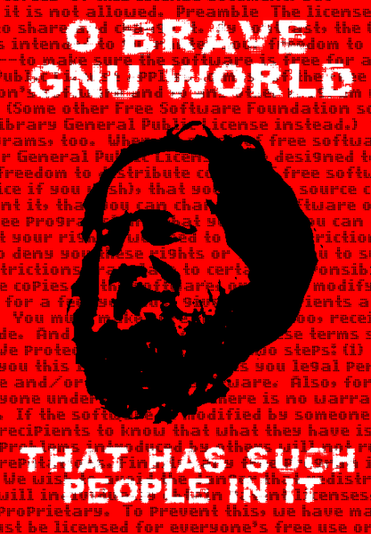
From another perspective, it's worth mentioning (just briefly) the Free Culture/Free License movement, which has a similar approach to one's own and others' creations. The Free Culture/Free License movement views the current intellectual property laws as too restrictive, unfair, and inhibiting progress and creativity. Writing a separate text about this topic would be worthwhile, but for now, just pay attention to the footer of my website (and both recipe e-books) with the (cc) logo. This is the mark of a Creative Commons license, one of the so-called free licenses, which significantly expands (simplifying, of course) what is known as "fair use." There are several versions of CC licenses, as well as Open Source and GNU licenses, and Public Domain. But that's a topic for another time.
Did you like this text? Do you want more similar ones? Support my blog
- Zaloguj lub zarejestruj się aby dodawać komentarze