I’m not a dessert guy. Nor am I a baker or pastry chef.
Though in reality — and not just in my current job — you often have to be a one-man army and do everything.
Lately, for added fun, it’s been my eating disorder that’s been pushing me toward experimenting with sweets of all kinds.
INGREDIENTS:
- 30 g thick (solid) part of coconut milk
- 2 tbsp water
- 50 g vegan yogurt, preferably Skyr- or Quark-style (see Variants)
- 75 g powdered sugar (see Notes)
- 1 tsp baking powder
- 10 g chickpea flour
- 150 g shredded coconut
- Also: cupcake liners
METHOD:
Add all the ingredients to a bowl and mix thoroughly.
Let it sit for half an hour so the coconut can absorb the liquid.
Preheat oven to 180°C (356°F).
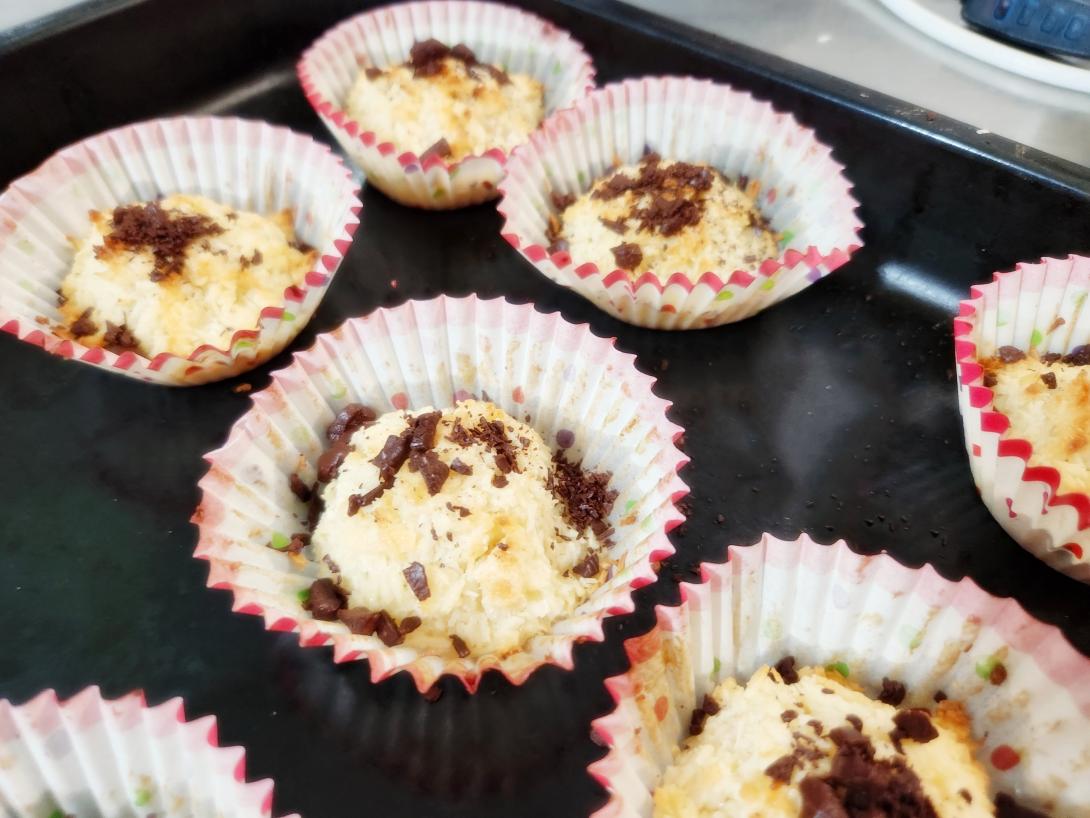
Scoop the mixture into cupcake liners and bake for about 15 minutes.
VARIANTS:
The type of milk or yogurt you use is entirely up to you.
I’m planning to try these with mango yogurt or chocolate soy milk (which, for some reason, I have sitting in my kitchen and no clue why).
You can also sprinkle chocolate on top or mix in chopped chocolate pieces, raisins, or my beloved Corinthian currants.
NOTES:
Unless you’re using massive amounts of powdered sugar (like half a kilo just for cookies), it’s best to make your own from regular sugar. That way, you can use something like brown sugar and make your own brown powdered sugar.
A coffee grinder is best for this. I use one with two containers — one for coffee, and the other for herbs, spices, seeds… or sugar.
Just remember that dark muscovado or other intensely colored sugars will change the color of the cookies.
I need to check that myself, since I still have some muscovado left — curious to see the effect.
SERVING SUGGESTION:
Put a plate on the table and notify everyone via WhatsApp or Messenger that cookies are served.
Coconut macaroons — unintentionally — are also gluten-free.
While I often try to accommodate gluten-free diets when planning menus or developing new dishes so that everyone can enjoy the food I prepare,
I also think the religion of gluten-freeness is just as silly as many other food cults.
It’s natural to want simple answers to complex health problems — we often convince ourselves that some miracle diet will cure us.
Because we want to believe in something.
But reducing the complex web of dietary effects and outcomes to one single factor — gluten, carbs, sugar, whatever — makes about as much sense as claiming that masturbation causes blindness.
Or that tea drinking is dangerous.
(Unless, of course, you forget to take the spoon out of the cup…)
That said, there are a few simple rules that lead to a good, healthy diet.
Of course, diet isn’t everything — it’s always connected to lifestyle.
A tomato from a supermarket that’s flown thousands of kilometers is not the same thing for your health as one you picked from your garden.
But when it comes to the food itself, we do know what kind of diet is healthiest — and it’s not some trendy dogma like keto-crapo, gluten-panic, or yogi-bogus.
It’s first and foremost a balanced and varied diet, rich in all the necessary macro- and micronutrients.
And according to virtually all health and dietetic organizations — and backed by proper evidence-based medicine — the gold standard is the Mediterranean diet, or related versions like the MIND diet.
Pretty much everyone has a general idea of what that means:
Lots of diverse fruits and vegetables.
Healthy unsaturated fats.
If you eat meat, lean toward fish rather than land animals.
Falafel. Moussaka. Greek salad. Olives. Yogurt…
And it has perhaps the most important quality of all:
It’s delicious.
If you eat like that most of the time, and every now and then a few coconut macaroons sneak in —
especially if you’re into long walks like I am (15 km, anyone?) —
then I highly recommend this lifestyle.
In our gastro world, the best motivation is a tip.
If you enjoy my recipes and would like more, you can leave me a tip.
- Zaloguj lub zarejestruj się aby dodawać komentarze