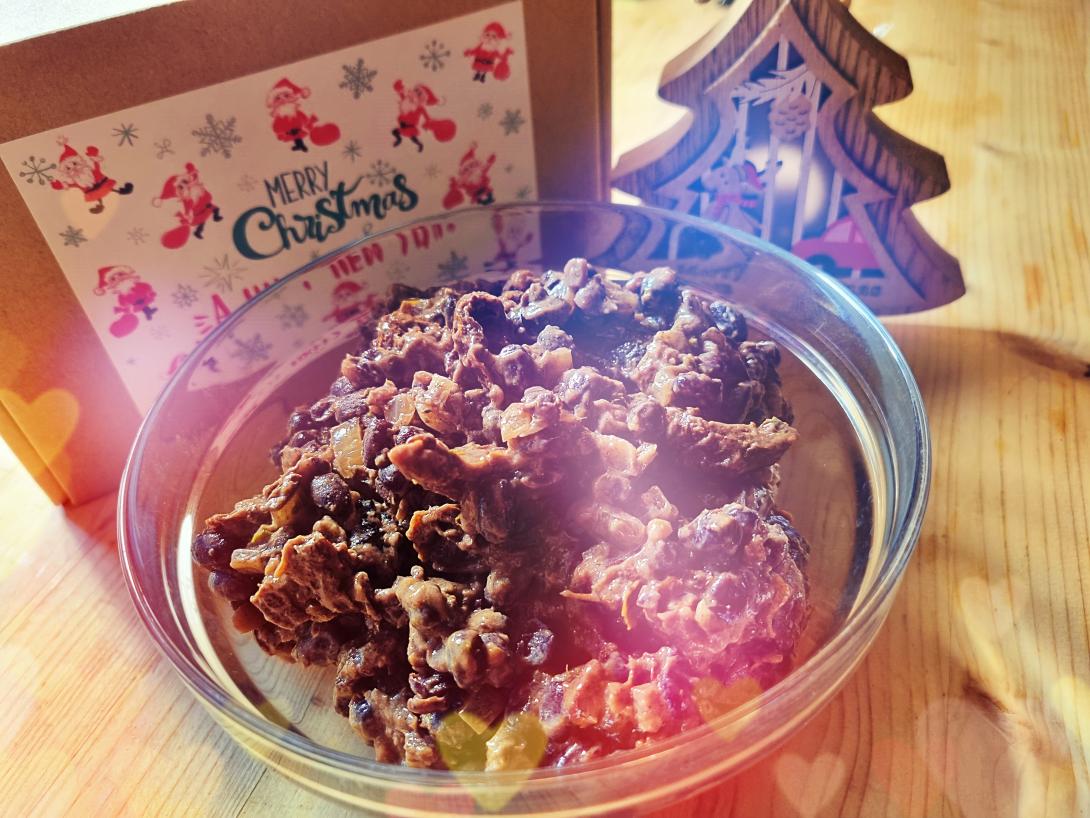
Traditionally, Christmas Eve dinner is a fasting meal, so you really don’t have to try very hard to make 12 fully vegan Christmas dishes.
But we also have no reason to limit our creativity — especially since today’s Christmas Eve customs are guests from abroad anyway: from Germany (the Christmas tree), from Ukraine (kutia), or even from China (pierogi).
So why not take a traditional Podlasie dish made with “Piękny Jaś” beans and make it with Asian adzuki? You can use red kidney beans instead. I just have a soft spot for red beans.
INGREDIENTS:
- 250 g dried adzuki beans
(which gives about 500 g cooked beans, or the equivalent amount from a can) - 200 g onion (2 pcs)
- 250 g smoked plums
- 150 g sun-dried tomatoes
- 30 g sun-dried tomato oil (3 tbsp)
- 400 ml cashew milk
- 1 tbsp marjoram
- 1 tsp ground juniper
- pepper
- cumin/caraway
PREPARATION:
Soak the beans for 8 hours. Drain the water, rinse the beans, cover with cold water, and cook with 1 teaspoon of baking soda until soft — still slightly al dente.
Dice the onions, slice the tomatoes into strips.
Heat the tomato oil in a pot and fry the onions until golden. Add the tomatoes, beans, and plums. Mix well, pour in the milk, and let it simmer on low heat for a few minutes.
VARIATIONS:
Both sun-dried tomatoes and smoked plums (or any smoked fruit) are sources of umami — that “meaty” taste. You can add dried mushrooms as well, which are also rich in umami.
You can also enrich this fasting-but-rich bean dish with almonds or nuts. This was also a Polish tradition — especially almonds, used during fasts as substitutes for dairy.
Instead of plant milk, you can use passata, vegetable juice, or a good broth.
NUTRITIONAL VALUE:
100 g of the dish contains 4.7 g of protein and 154 kcal.
NOTES:
Cooking beans with baking soda significantly shortens the cooking time, but also makes them boil over violently. So you need to watch them.
SERVING:
Serve with bread, on toast, or with potatoes. It can also be served cold.
Beans are a typical Polish peasant winter food, although they have only a four-century tradition in Poland, and — like potatoes and tomatoes — came to Europe from the Americas. Today, they are a major source of protein and calories for much of the global population.
The world’s largest producer of beans is… India. Interestingly, among all major bean-producing countries, India has the lowest yield per hectare, twice lower than Mexico, four times lower than China.
I know I’m being boring, and before Christmas, most people just want to be in a relaxed mood, but in a way, we’re in a situation that is not unusual at all — worrying whether there will be enough food for everyone.
The food security we’ve enjoyed in Europe for decades is an anomaly in human history. The last few hundred years have been a dazzling period of economic growth, rising prosperity for increasingly wide segments of society.
But this extraordinary success had a price. That price is the current ecological catastrophe, which is becoming an increasing threat to Europe’s food security as well.
And now we also have war — something that has been, and still is, an everyday reality for many people. And that also means smaller harvests.
In spring, they reported that Ukraine sowed one-third less arable land this year than last. Fertilizer prices next year will be more than twice as high as before the war… The future is more uncertain than ever in our lifetime.
But isn’t that truly our condition? Impermanence is one of the three fundamental characteristics of conditioned existence in samsara. Every pleasure and every suffering ends.
I am not — and in this lifetime never was — a Christian, so I’ve always had a specific relationship with the Winter Holidays.
Christmas always had the charm of its magical symbolism for me, but it is not far from the magic of the reborn Sun and all the solar deities representing the forces of nature. Today, these holidays are very close to me, because the God who is born at the Winter Solstice dies in spring, and his body becomes fertilizer for Mother Earth. He stands at the beginning of the road from field to table, and at the other end, I toil like other chefs to prepare masterful holidays.
I like to call myself a Buddhist heretic, although in this strange religion-not-a-religion, it’s hard to become a heretic, because on my “spiritual” (I hate that word) path I had experiences from Western traditions, Indigenous religions, shamanism, and magical traditions. And I experienced what in those traditions are called gods, demons, or angels.
And yes — I believe the Spirit of Christmas exists. And he severely punishes anyone who doesn’t like good food and good fun.
So, regardless of what holidays you celebrate, and regardless of how uncertain these times are — celebrate, enjoy, eat. And remember not only symbolically about the lonely, the hungry, and the sick. Because they are the essence of these holidays.**
- Zaloguj lub zarejestruj się aby dodawać komentarze