The Belgian-Swiss chocolate giant Barry Callebaut is working on cell-based cocoa.
This is probably the first case of this technology being applied to a plant-based product.
The effects of climate-change-driven weather anomalies are already being felt by all lovers of the two pillars of our culture and civilization: coffee and chocolate.
Coffee and cocoa prices have been hitting record highs for about two years now.
Just late last year, every time I bought coffee from the local roastery, the price was higher, and I watched in horror as it jumped from around €5 to €10–12 for 250 g. It hurts…
And that price hike hurts the food industry even more.
The pastry and dessert sectors are going through very tough times. Many businesses are going under, many are changing recipes, many are raising prices. Remember: food cost — the cost of ingredients in a dish — shouldn’t exceed roughly 25%. If it does, the business won’t last long. On average, the break-even point in gastronomy is a food cost between 20–25%.
And the last few years have brought massive increases in energy costs. Gastronomy is energy-intensive. This isn’t an office where 10 computers draw 1–2 kW. A single professional blender uses about 1 kW, and an oven can draw several times that.
Since the pandemic, there’s also been a general drop in real wages, meaning people have less disposable income and cut back on “luxuries.” One of the first “luxuries” to go is eating out or grabbing coffee and cake.
And that’s where the idea of lab-grown chocolate comes in.
The technology is still in testing and experimental phases. Production from single cells has so far been applied — also still in trials — to meat. This seems to be the first time it’s being used for a plant-based product.
The company says it decided on this innovation to expand its flavor portfolio, but mainly because of the growing threat of supply chain disruptions and weather disasters drastically reducing cocoa availability on the global market.
Cell-based cocoa also has a smaller environmental footprint. The current problem is cost. When large-scale production begins, costs will drop.
But here’s the catch! When cell-based products become widespread and significantly cheaper, they may deepen social inequality.
The vision is a bit like the show Incorporated, where the elite eat natural meat and drink real coffee while the masses consume cell-based substitutes.
And as we’ve known at least since Piketty’s Capital in the Twenty-First Century, inequality is bad for democracy, development, and for 90% of society (sometimes 99%).
That’s what cell-based cocoa is really about. That’s what the climate catastrophe is really about. Will you be able to drink good, real coffee?
I really don’t want to live in a society where natural coffee is only for the ultra-rich.
To flip the old saying: you are what you eat — in a class society, everything is class-based, including our food. You can clearly see it in the whole “fit lifestyle” trend, which is largely about status, through expensive gear and sportswear, or through what and where you eat. The “fit life” model promoted in the mass media requires lots of time and money.
I recently bought a new smartwatch because my old one was ready to retire. I use it mostly for work — to set reminders for when to check if the potatoes are soft or to turn off the stock in 4 hours.
One function is heart rate tracking. You can tag the reading as: pre-workout, workout, post-workout, during sex, etc.
But there’s no option for… work. That says a lot about the target audience for the watch.
It’s aimed at the leisure class that spends time taking care of themselves and posting pictures on Instagram. Not at the people serving them.
This key issue — the social aspect of the climate crisis — is missing from public discourse, even though we’re already experiencing it through rising coffee and cocoa prices. And, of course, it hits the poorer parts of society hardest.
That also isn’t emphasized enough publicly: the climate catastrophe is already hitting all of us, and it’s hitting us in our wallets.
The situation isn’t helped by the EU’s stupid and counterproductive “climate” policy, which targets the poor instead of, for example, taxing, confiscating, or grounding every private jet.
The result of this idiocy is public resentment toward climate policy, seen as an attack on poorer people’s wallets instead of, as the German left’s slogan puts it, “those who have, give.” Take the wealth from the richest for climate protection, whether through luxury taxes (hello, private jets), progressive taxation (like in the so-called Golden Age of Capitalism after WWII when top tax rates for millionaires hit 90% in Europe and the US), or ideas like a universal personal CO2 budget, the same for both rich and poor.
If someone asked me why I’m a socialist, I could answer: because I like good coffee and do not want to live in a society where only the richest drink it.
But is there one more aspect to lab-grown chocolate.
Lab-grown chocolate (and other cell-based foods) can be fascinating and offer new culinary possibilities. That’s an underappreciated aspect of both cell-based production and 3D-printed food. It opens up massive potential for new flavors, textures, and enriching menus in incredible ways. Lemon-flavored chicken meat, cocoa with added protein, or anything else we can imagine.
A 3D food printer to design new textures and flavors is one of my professional dreams — right after seeing my dishes served in school cafeterias.
This ties into something I’ve been mentioning for a while: whether we’re creating plant-based dishes that mimic specific animal products — chicken drumsticks, beef steaks, Kraków sausages — or creating something entirely new that just matches meat dishes in flavor and comfort food quality.
With a 3D printer, we could design and print the meat of a nonexistent creature, like a basilisk tail or centaur steaks.
And that’s not so different from what we’ve been doing ever since we started processing food before eating it. Humans are the only animals that cook their food. Cooking made us human.
Just as at some point we started selecting plants to create new varieties (trust me, you wouldn’t want to eat the “natural” tomatoes from centuries ago). Natural cereal varieties wouldn’t feed today’s population. Wheat yields today are 10 times higher than just 100 years ago.
It’s the same with sugar beets, whose yield over the last 200 years (since they became the main sugar source) increased from 10 to 100 tons per hectare and sugar content from 4% to over 20%.
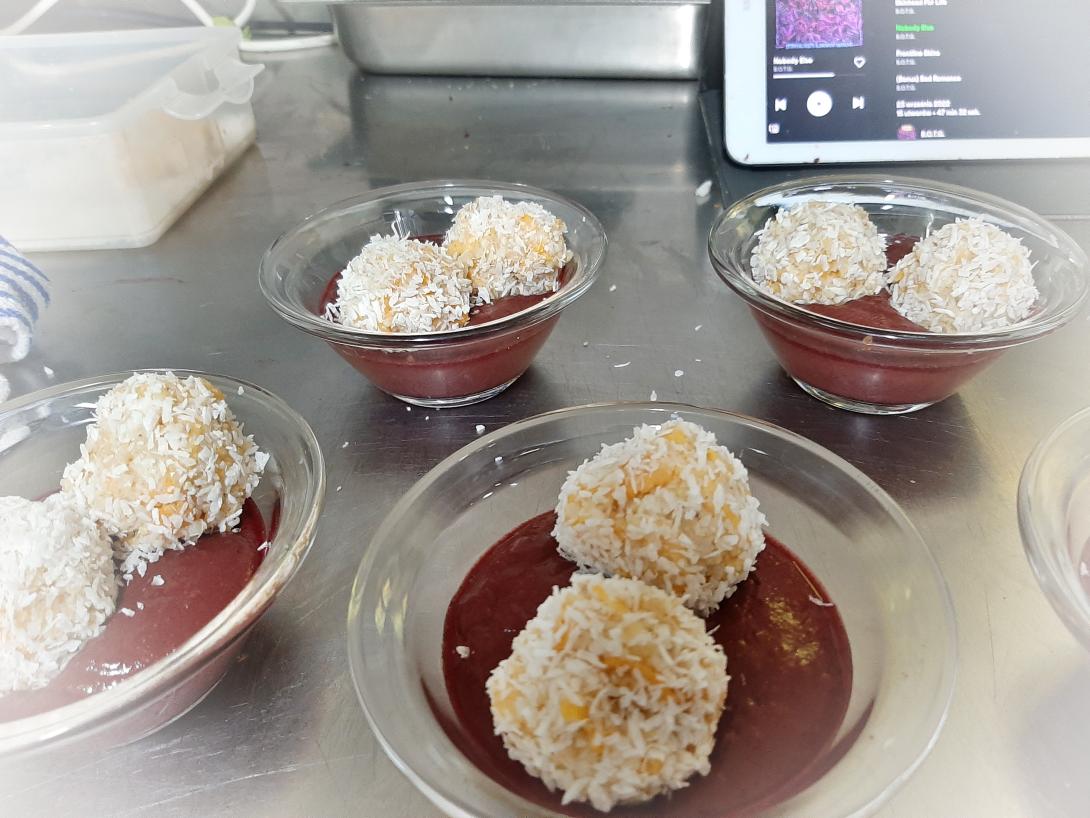
Photo: A dessert from two years ago that would be much more expensive today — plant-based Raffaello in chocolate sauce.
- Zaloguj lub zarejestruj się aby dodawać komentarze