Can you pay by card in Germany?
Of course — but not everywhere, not for everything, and not always for free.
But it’s getting easier and more common.
You won’t be able to pay by card everywhere, so it’s good to always carry some cash with you.
That said, it’s also not like you’ll starve or be stranded without it.
As of 2023, cash still made up 63% of all offline retail sales in Germany.
The COVID-19 pandemic was a game-changer.
When I arrived in Germany in 2019, I was surprised that card payments were much less common than in Poland.
A fun fact: several people even asked me what kind of card I had.
That’s because Sparkasse (where most German banks are) used to have its payment system and card terminals that didn’t accept other cards.
That’s now changing — Sparkasse is transitioning to a more standard, widely accepted card system.
But still, always have some cash on you.
Kiosks, small shops, some restaurants (though fewer now), and weekly markets (Wochenmarkt) — or in winter Weihnachtsmarkt — are all places where cash is better.
Some places still accept cards only starting from €5 or even €20, though that’s less and less common.
In my recent trips around Hamburg, I honestly can’t remember a time when I couldn’t pay by card.
(Except maybe for the disclaimer below.)
Even in the bathrooms at S-Bahn stations — card accepted!
How Much Cash Should You Carry?
It depends.
(For example: Are you buying drugs?)
You can get lunch in Hamburg for under €20.
Add a beer or drink and you’re looking at €25. You’ll find falafel for €10, though not always of great quality.
Bremen is a bit cheaper.
My favorite in Hamburg is in Harburg at the Phoenix Center.
Best ever? Yalla Yalla in Viertel, Bremen.
If you’re shopping at Rossmann, Edeka, Lidl, any big supermarket or chain, or at the post office, you’ll of course be able to pay by card.
Hidden Fees: The Catch with Card Payments
This is where things get tricky —
Card payments and ATM withdrawals can involve multiple fees:
- A currency exchange fee from your bank
- A foreign withdrawal fee from your bank
- A fee from the ATM itself
Always check those things carefully.
Using a Your Country Bank Card in Germany?
Generally, not worth it.
At the Polish bank I used before moving, I had another surprise.
After a couple of failed transactions, I called the bank —
Turns out that at 7 p.m., the cleaning lady shuts down the euro transaction server.
No one knew why I couldn’t pay or withdraw after 7 p.m.
Revolut Is (Still) a Good Option
There are now many fintech options that let you cheaply exchange currency.
Back in 2019, Revolut was the only one around — and I still use it.
Why it’s good:
- Cheap, fast currency exchange
- Basic account is free
Drawback: Free accounts have a €200 monthly ATM withdrawal limit.
Premium accounts have higher limits and let you create child accounts — great for sending your kid pocket money while traveling.
Withdrawing Cash: Which ATMs Are Free with Revolut?
Be warned: not all ATMs let you withdraw with Revolut for free.
You’ll see a notice before confirming the withdrawal.
Banks that usually don’t charge (as of this writing):
- Berliner Volksbank
- Berliner Sparkasse (as of 09.2022)
- Baden-Württembergische
- HypoVereinsbank
- Santander
- Commerzbank
- Postbank
- Landesbank Baden-Württemberg
In my case, the closest free ATM is next to the train station in my small town.
In Hamburg, I don’t use them as often, and definitely not at train stations!
Most ATMs in Hauptbahnhof and on transit systems (DB, S-Bahn, U-Bahn) are from one operator and charge high fees.
How to Open a Revolut Account?
Super easy. And best to do it today using my referral link:
Why?
If you make three purchases of at least €5 each by July 8, I’ll earn a commission to put toward my summer trip to Berlin 😉.
What Else?
More coins.
I carry a lot of change — I go to Hamburg with the tips I earn from work.
Hamburg has the highest number of homeless people per capita in Germany, and you’ll notice that on the streets.
Many are begging, but they are not aggressive.
They usually sit with a cup in front of them.
If you’re reading this, and you’re traveling — whether to Hamburg or anywhere else —
You can probably afford to give someone 50 cents.
If you can give €2 — great.
I’ll even include you in my prayers.
The way a society treats its most vulnerable shows its level of humanity —
whether individually or systemically.
Systemically, we fail — in Poland, the U.S., Germany, everywhere.
So, at least individually, let’s be human.
The Second Reason: Tipping
I’ll write a full post on tipping from a chef’s perspective soon —
But for now, this is the rule:
ALWAYS TIP.
The standard is 10%.
But if your bill is €18.50, and you give €20 with a smile and a “thank you,”
— That’s awesome.
Even tossing 50 cents into the tip jar helps.
Let me be clear:
Tips are not part of the salary.
Employers should not underpay workers, assuming “they’ll make it up in tips.”
(That’s standard in the U.S., as far as I know.)
Tips are extra.
Your base salary should already cover rent and living expenses.
If workers need tips to survive, that’s reason enough for strikes and Molotov cocktails.
So if your meal costs €20, be ready to leave a €2 tip.
TL;DR Summary:
✅ Revolut is better than banks
✅ Pay by card wherever possible
✅ Always ask if the card is accepted
✅ Plan how much cash you’ll need
✅ Carry a few euros in coins
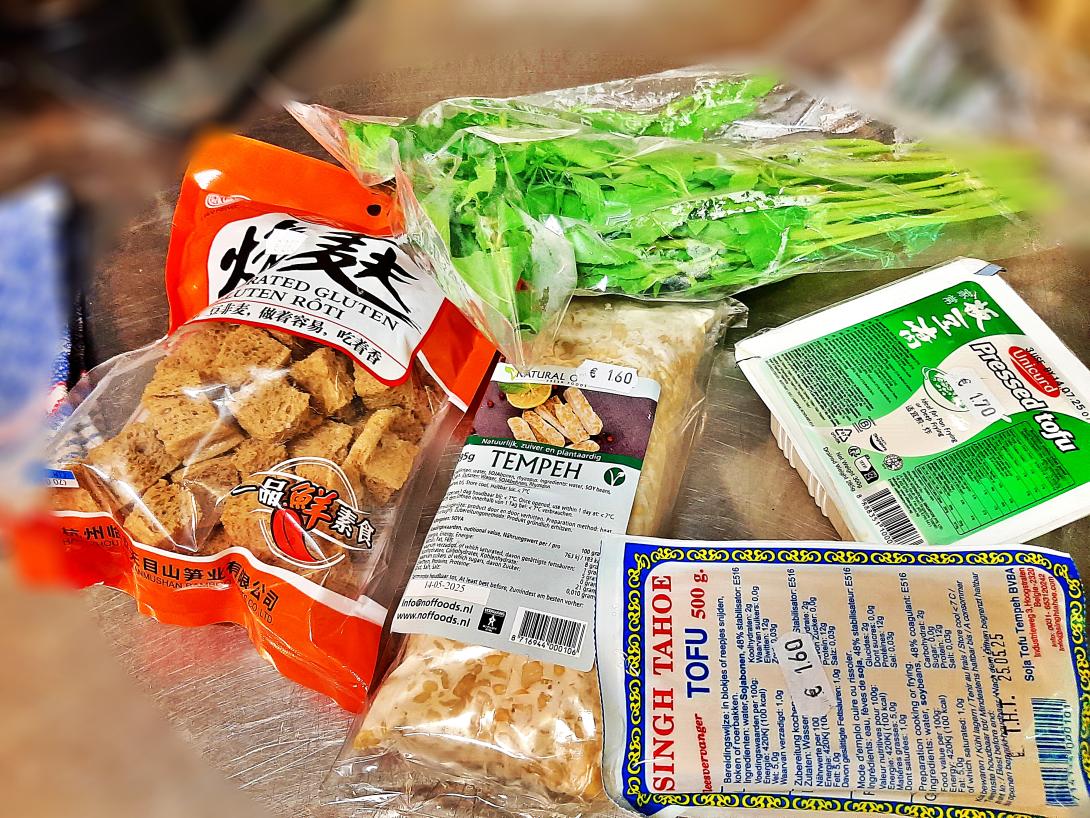
In the top photo:
Groceries from an Asian supermarket in St. Georg, Hamburg.
There are lots of these kinds of stores in Hamburg —
You can usually pay by card in big ones. In smaller shops, ask first.
- Zaloguj lub zarejestruj się aby dodawać komentarze