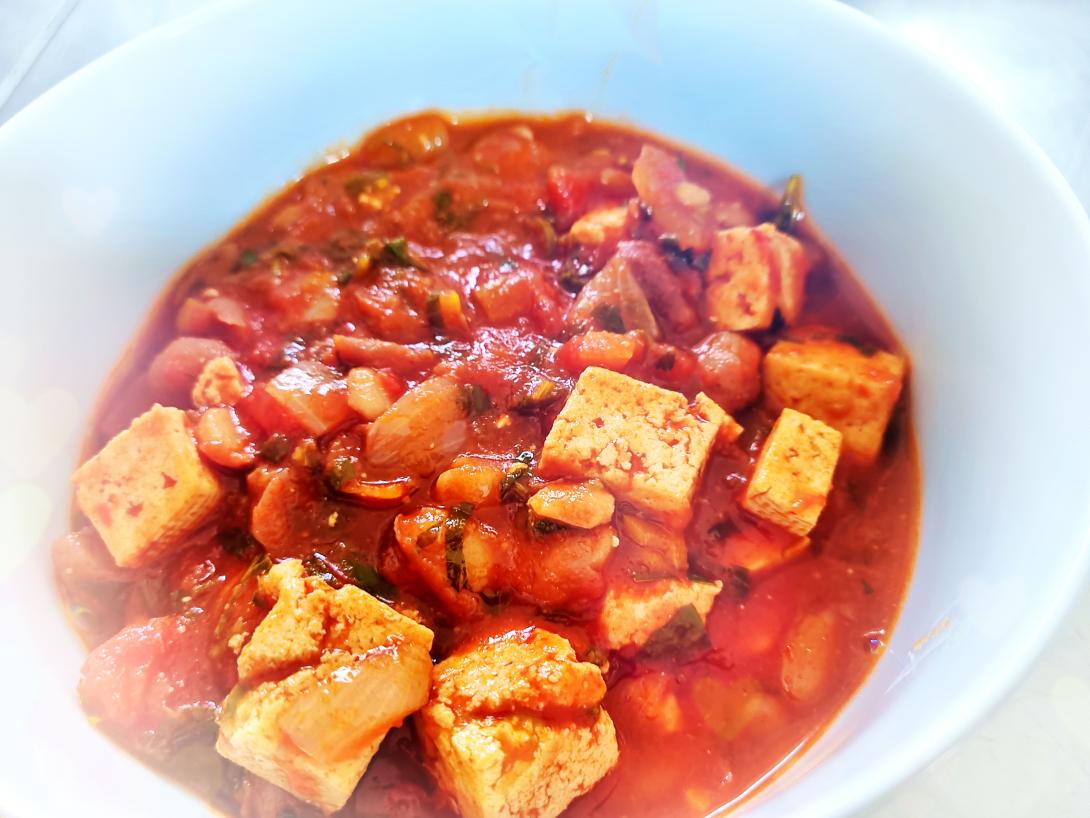
Tomato and bean stew is a very traditional Polish dish, some would say it's a bar or canteen style combination. Of course, we're talking about "Breton-style" bean stew, whose origin is not entirely clear. The dish was known in Polish cuisine in the 19th century, which would actually indicate France as the country of origin from which the dish traveled to Poland during the Napoleonic Wars. Especially since in French cuisine there is a dish called "cocos de Paimpol a la Bretonne", which is similar to the Polish "jasia" beans cooked with tomatoes. But... it is likely that this dish was in turn inspired by British "baked beans", which in turn originated from the cuisine of Native Americans, including the Iroquois, known from young adult literature and Westerns. And here, I feel a strong connection to this dish, in my early youth, I used to wear a wide "Iroquois" haircut.
But... it may not be the case at all. Some trace "baked beans" back to the authentically French, medieval cassoulet, which, like many dishes, "became poor" and turned from a stew with a lot of meat into a dish where meat plays at most the role of a seasoning. But... England also had its native dish that could be the prototype of the Polish "Breton-style" bean stew, which was "beans and bacon". Interestingly, in the historic English dish, mustard was an important ingredient.
And this shows us how we can treat the recipe for Polish bean stew. And use what we have. And it doesn't even have to be "Jaœ" beans.
INGREDIENTS:
Tofu 200g (1 block)
Onion 100g (2 medium)
Olive oil 40g
Cooked beans 350g
Canned tomatoes 1 can
Water/stock 250g
Tomato concentrate 50g
Soy sauce 20g
Vinegar 10g (1 tablespoon)
Sugar 5g (1 teaspoon)
Smoked paprika
Cumin
Fresh chili (optional)
Parsley or other herbs
PREPARATION METHOD:
The downside of beans is the time it takes to prepare them. First, you need to soak them for several, eight hours and then cook them, which also takes time. Remember to drain and rinse the beans after soaking.
When it comes to cooking beans, there are two things worth mentioning. First: it's best not to cover them until they boil, and then reduce the heat. If you cover the beans, be careful and cook them in a large pot with plenty of room for them to expand.
NOTES:
Remember that the fat should be really hot before adding the fried ingredients. This "seals" them. This creates a crispy surface that doesn't allow the fat to penetrate the juicy center.
As I mentioned earlier, the problem with beans is the time needed for the initial processing. It's worth cooking a larger amount and dividing it into portions for single use, and freezing it.
Unless someone like me doesn't mind eating the same thing for a few days, with some additional modifications, in subsequent versions, and cooks half a kilo of dry beans at once.
If you use sugar, I definitely recommend brown sugar, preferably Dark Muscovado, which has much more flavor than just sweet. Various syrups are also excellent, I've recently been using quince syrup.
We can also use a different flavored vinegar than apple cider vinegar.
SERVING:
Like traditional Polish baked beans, we can eat them with bread. Personally, I prefer croutons, which are also a great way to use stale bread. But also, for example, baked potatoes would go perfectly here. You could also go in the direction of Mexico, add coriander and lots of chili and serve with rice, make it thicker and put it in a burrito. In the kitchen, as in sex, our imagination is our main limitation.
Food and sex have a lot in common. Like any experience, they engage all the senses. Evolutionarily, food was also associated with sex. Food is also a sense of security.
Today, we often eat mechanically, without pleasure, without sensual experience. It's worth stopping for a meal and making it a feast for the senses, as intoxicating as a night with a loved one. Of course, it's best if we share this meal with a loved one.
I wish you all the best from my hermitage.
- Zaloguj lub zarejestruj się aby dodawać komentarze